


After nearly a decade of implementation since 2016, Ho Chi Minh City's large-scale tide control project is expected to be operational by the end of November 2026.
However, its actual effectiveness will depend on the internal water drainage capacity and the overall system's synchronization, as merely blocking tidal water from outside only partially addresses the urban flooding issue.
The operation of six major tide control gates (out of nine components of the Phase 1 project addressing tidal flooding in Ho Chi Minh City, considering climate change factors) on November 30, 2026, is anticipated to enhance water level control in the protected rivers, canals, and streams.
The "super" anti-flood and tide control project, affecting an area of 570 km2 and serving approximately 6.5 million residents, plays a crucial role in limiting tidal intrusion and reducing pressure on the existing drainage infrastructure.
Tide control is necessary but not sufficient to solve flooding
The project's investment scale of nearly VND10 trillion (nearly $388.5 million) necessitates a broader evaluation of its effectiveness. This includes assessing the extent of tide control, the actual reduction in flooding, and what the city needs to do to maximize the project's effectiveness once it transitions to the operational phase.
According to the design, the project comprises nine components, including six major tide control gates at Ben Nghe, Tan Thuan, Phu Xuan, Muong Chuoi, Cay Kho, and Phu Dinh, two smaller gates at Cau Kinh and Ba Buom, along with a system of embankments, riverbank revetments, and 43 smaller tide control gates, all connected to a central control center and an automatic monitoring and control system.
The operational principle involves closing the gates when external tides rise to prevent water from entering the internal river, canal, and stream systems. When the external water level drops below the internal level, the gates open to drain water while maintaining waterway traffic. Regulation is based on water level changes and actual hydrological conditions.
Essentially, the project creates the ability to control water levels from the river, limiting the situation where rising tides cause water levels in main canals to rise, hindering urban drainage. When water levels in the canals are maintained at appropriate levels, the area's drainage system can discharge water more effectively.
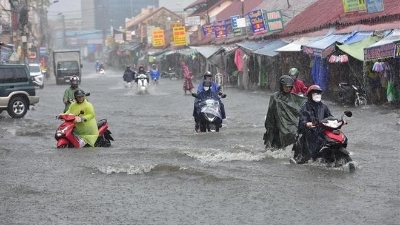
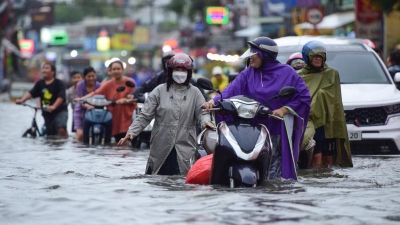
However, it is crucial to distinguish between tide control and flood resolution. A road flooded after heavy rain does not necessarily result from tidal surges. Water may not drain quickly due to small, degraded, or silted drains; narrowed or encroached canals; low ground elevation; or rainfall exceeding the system's capacity. Ground subsidence and urbanization also increase pressure on drainage infrastructure.
This means that even if the gates operate correctly, the city may still experience flooding if rainwater is not collected and drained promptly. Particularly, during heavy rain coinciding with high tides, the gates must close to prevent external water intrusion.
In such cases, rainwater generated within the protected area needs to be managed through a system of drains, conduits, retention ponds, and appropriate pumping solutions. If the internal drainage capacity is insufficient, the risk of flooding remains.
According to the Ho Chi Minh City Department of Construction, the existing drainage system is designed with a three-year recurrence cycle, corresponding to 85.36 mm of rainfall in three hours and a tide level of 1.32 m. These parameters must be considered when evaluating the infrastructure's capacity. When rainfall exceeds the design threshold, the risk of overload can still occur, even if the tide control project is operational.
Another requirement is to close the protection perimeter. Before the project's expected launch, the investor (Trung Nam Construction Investment Corporation - Trungnam Group) proposed that the city government address 19 low, unclosed embankment points. If these points are not reinforced, tidal water can still enter the protected area when the main gates are closed.
Thus, the project's effectiveness depends not only on the capacity of individual gates but also on the continuity of the embankment system and connection points.
Operational challenges and investment effectiveness after project completion
As the project transitions from construction to operation, the critical issue is no longer whether the gates are completed but how well the components coordinate under different weather and hydrological conditions.
The automatic control system can provide water level data, supporting gate operation according to procedures. However, effective operation requires coordination between the gate management unit, drainage system, pumping stations, discharge outlets, and canal management units. Monitoring data must be continuously updated, and the response process must clearly define responsibilities during heavy rain, high tides, or equipment failures.
Particularly, closing gates to block tides and opening them to drain water must be calculated for each moment. If the focus is solely on blocking external water without addressing internal rainwater, the project may not fully realize its potential. Conversely, reasonable water level regulation in main canals can create additional capacity for the urban drainage system.
This is why operation, maintenance, and personnel training should be considered part of the investment effectiveness, rather than just post-project tasks. The investor has committed to supporting operations, training personnel, and transferring technology in the initial phase. However, in the long term, the city must ensure a capable team to manage, supervise, and handle arising situations while maintaining equipment and infrastructure in stable working conditions.
In addition to the tide control project, Ho Chi Minh City plans to implement 87 anti-flood projects from 2026 to 2030, with a total estimated investment of over VND142 trillion, aiming to address flooding points and gradually build a smart drainage system.
Specifically, from 2026 to 2027, the city plans to implement 54 projects with a total investment of approximately VND69,4 trillion, addressing 33 flooding locations. In 2026 alone, there are nine projects with a total investment of over VND7.15 trillion, expected to address three flooding locations on Phan Van Hon Street, Binh Quoi area, and National Highway 51 at Huynh Thuc Khang intersection.
This investment scale indicates that the city's flooding issue cannot be resolved by a single project but requires multiple layers of solutions, from water source control, increased drainage capacity to water regulation and storage.
Therefore, when the nearly VND10 trillion tide control "super" project becomes operational, its effectiveness needs to be verified through specific changes, including: how water levels in main canals are controlled; whether areas frequently affected by tidal surges experience reduced flooding; how flooding duration and severity change; and whether the system can handle heavy rain combined with high tides.
Evaluation should also distinguish the causes of flooding in each area, avoiding attributing all results solely to the tide control project. If tidal flooding is mitigated but rain-induced flooding persists, the city needs to identify remaining bottlenecks in the drainage network for further investment. Conversely, if protected areas still experience tidal intrusion, the system's closure and operational procedures need to be reviewed.
The ultimate measure of a "mega project" is not the number of gates built or the official operation date, but its ability to reduce flooding risks for residents and improve the city's resilience.






 Google translate