


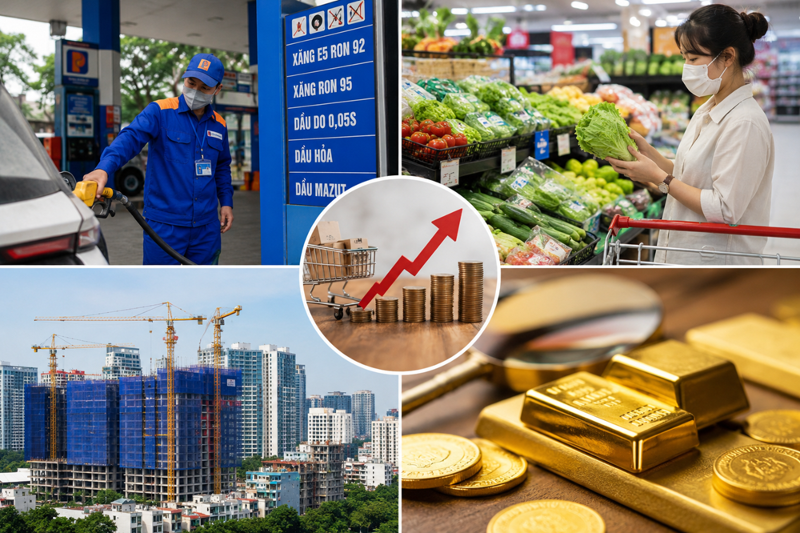
In the first nine months of 2026, Vietnam’s Consumer Price Index (CPI) rose 4.52% year-on-year—higher than the 3.27% increase logged in the same period of 2025 and exceeding the full-year target of 4.5%. Looking ahead to the end of the year, the Ministry of Finance (MoF) plans to restrict price hikes on select public services, freeze electricity tariffs, and deploy fiscal tax measures to alleviate upward pressure on overall price levels.
Addressing questions regarding room for inflation management in the final stretch of 2026 at the ministry's regular third-quarter press briefing on October 6, Ms. Le Thi Tuyet Nhung, Deputy Director General of the Price Management Department, noted that upward price pressure is intensifying as fuel prices rebounded sharply in Q3, triggering ripple effects across economy-wide costs.
Against the backdrop of keeping 2026 inflation anchored near the 4.5% target, the Ministry of Finance has instructed line ministries, government agencies, and local authorities to closely track market supply and demand trends as well as commodity prices, particularly for essential goods. Accordingly, securing adequate supplies remains the top priority to prevent shortages from driving up consumer prices in the final months of the year.
In parallel, ministries, agencies, and localities must actively forecast market demand, formulate suitable pricing plans, and tighten inspections on price regulations to curb hoarding, speculation, and artificial price hikes.
According to Ms. Nhung, for localities experiencing higher-than-average price surges, the MoF has requested an in-depth breakdown of pricing structures and root drivers. This will help identify which specific goods are exerting the strongest upward pressure on the CPI, enabling tailored administrative solutions.
Among the key cost-push factors, petroleum products are considered to have the widest spillover impact, directly affecting not only commuting expenses but also freight transport, manufacturing, product distribution, and ultimately end-consumer retail prices.
To mitigate pressure from these foundational commodities, the MoF submitted and secured the Government’s issuance of Resolution No. 43/2026/NQ-CP on September 30. The resolution extends preferential import tariffs, environmental protection taxes, and value-added tax reductions on gasoline, oil products, production raw materials, and aviation fuel from October 1 through December 31, 2026.
This serves as a crucial fiscal tool to cool input costs across the economy, thereby aiding price stabilization efforts late in the year. Given that volatile energy prices can spill over into numerous goods and service categories, maintaining tax relief on these commodities remains an essential price-management measure, Ms. Nhung said.
Another vital consideration is the timing and magnitude of tariff adjustments on state-priced goods and public services.
Deputy Minister of Finance Nguyen Duc Chi stressed that capping 2026 inflation within the threshold mandated by the National Assembly is a priority task firmly directed by the Government and the Prime Minister.
On that basis, the ministry will continue price management by securing strategic supplies, balancing petroleum availability, avoiding electricity shortages across the economy, and guaranteeing abundant supplies of essential goods.
For state-administered goods and services, the Government will continue steering tariff adjustments in electricity, healthcare, and education to minimize compound inflationary impacts on the CPI.
“With these combined solutions, I am confident we will achieve our target of keeping 2026 CPI growth strictly within the ceiling authorized by the National Assembly,” said Mr. Chi.









 Google translate