


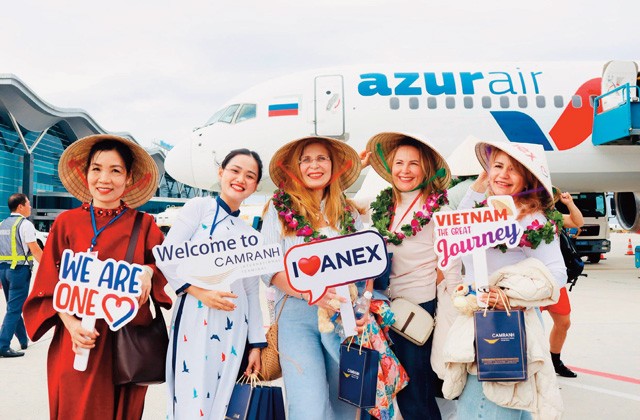
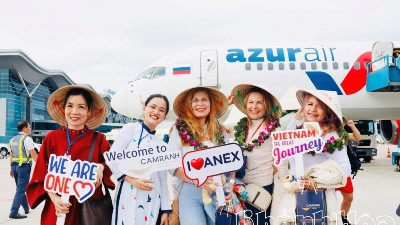
On September 23, the arrivals terminal at Cam Ranh International Terminal (CRTC) in Khanh Hoa province was filled with excitement, as in collaboration with the Khanh Hoa Tourism Promotion Center, Anex Vietnam, and Vietjet Air, it welcomed flight VJ 5074. Departing from Sheremetyevo International Airport in Moscow, the wide-body aircraft carrying nearly 370 passengers touched down safely at 2.50pm, marking a special milestone in aviation connectivity between Vietnam and Russia.
While Russian carriers already operate flights to Cam Ranh, the event was nonetheless highly significant as Vietjet became the first Vietnamese airline to fly directly from Moscow to Khanh Hoa. Demand is robust: in the first eight months of 2026 alone, Khanh Hoa welcomed 851,390 Russian tourists; a remarkable 3.05-fold increase compared to the same period last year and contributing strongly to the province’s total of 6.3 million international arrivals.
The tourism sector has become of the fastest-growing areas of Vietnam - Russia relations over the years. According to the latest data from the National Statistics Office at the Ministry of Finance, Vietnam welcomed more than 1.25 million Russian visitors in the first ten months of the year; a 150 per cent increase over the same period last year. That figure placed Russia as Vietnam’s third-largest source market overall and its largest in Europe. October alone brought 120,116 Russian visitors, up 80.5 per cent compared to October 2025.
Long-standing affinity
Those numbers from part of broader recovery and expansion in Vietnam’s international tourism segment. The country welcomed a total of 19.5 million foreign visitors in the first ten months, up 13.8 per cent year-on-year and tracking toward 25-27 million for the year as a whole. Coastal destinations have absorbed most Russian visitors, including Nha Trang, Phu Quoc, Da Nang, and Mui Ne. Phu Quoc remains the primary draw for Russian travelers seeking warm beaches during their winter months, while cultural and urban itineraries in Hanoi and Ho Chi Minh City have also grown.
Vietnam has maintained a unilateral visa exemption allowing Russian citizens to stay up to 45 days, a policy extended through March 2028 under Resolution 44/NQ-CP. In 2025, the two countries added dozens of flights on new routes linking Russian cities with Hanoi, Ho Chi Minh City, Nha Trang, and Phu Quoc.
Russian officials noted that Vietnamese tourist flows to Russia rose by more than 35 per cent in the first half of 2026. Vietnamese travelers have historically focused on Moscow and St. Petersburg for culture, history, and winter scenery. The addition of more flight capacity and simplified entry is expected to broaden that interest.
A significant new step arrived on October 15, as Russian President Vladimir Putin signed a decree granting Vietnamese citizens holding ordinary passports visa-free entry for stays of up to 30 days until October 15, 2027. Russian tour operators project a further 25-30 per cent lift in Vietnamese demand once the policy takes full effect. “The reciprocal visa exemption arrangements are expected to boost travel between the two countries and potentially set new records in 2026-2027,” a representative from the Vietnam National Authority of Tourism (VNAT) said.
The Authority is currently focusing on developing and upgrading the international tourism promotion website at vietnam.travel, which is now available in eleven languages, including Russian. “Vietnam offers a wide range of tourism products suited to Russian travelers, particularly coastal resort tourism, cultural tourism, sports tourism, MICE [Meetings, Incentives, Conferences, and Exhibition] tourism, and experiential discovery,” Mr. Nguyen Trung Khanh, Chairman of the VNAT, was quoted as saying.
He also called for both sides to increase the sharing of information and statistical data on visitor markets, support tourism businesses in accessing information and seeking partners, and study the feasibility of organizing Russian-language training programs for Vietnam’s tourism workforce, especially tour guides.
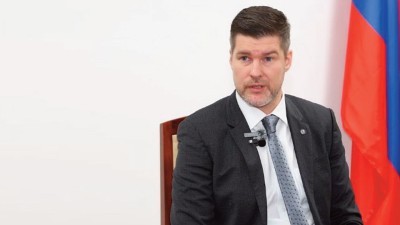
During a meeting with VNAT in late September, Mr. Alexander Kardo-Sysoev, Representative of the Ministry of Economic Development of the Russian Federation in Vietnam, expressed his desire for the two sides to continue promoting tourism cooperation. He added that the Russian side would coordinate with relevant agencies and authorities to study and improve immigration procedures, thereby making travel more convenient for tourists.
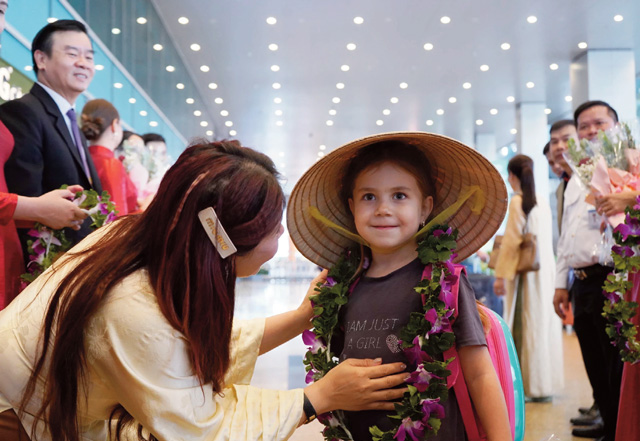
Last year, Vietnam and Russia signed a memorandum on cooperation in tourism until 2030. The two parties commit to jointly training personnel for the tourism and hospitality industry, exchange relevant statistical data, facilitate mutual promotion of the two countries’ tourism potential, and help representatives from Vietnamese and Russian tourism business establish mutual contacts in the form of joint projects and events.
Future potential
According to Russia’s Ministry of Economic Development, the number of Russian tourists visiting Vietnam is projected to reach a record 1.5 million this year. Mr. Nikita Kondratiev, Director of the Department of Multilateral Economic Cooperation and Special Projects at the Ministry, said the number of Russian tourists visiting Vietnam was only about 750,000 a year at the market’s pre-pandemic peak in 2018-2019. The projected 1.5 million arrivals would therefore represent roughly double the pre-pandemic level.
Building on the traditional friendship between the two countries, similarities in the demand for cultural exchange and exploration, and the potential for market development, Vietnam-Russia tourism cooperation is expected to continue expanding, contributing to two-way tourist exchanges and strengthening people-to-people ties between the two countries.
According to a representative from one tour operator, Vietnam has become increasingly attractive to Russian travelers compared with other destinations in Asia, helped by the restoration and expansion of direct and charter flights as well as more favorable visa conditions. Russian travelers are also becoming more independent in planning their trips, increasingly researching and comparing hotels, destinations, and experiences themselves rather than relying entirely on package tours.
The strong growth in Russian arrivals has been supported by improved air connectivity, including the resumption and expansion of charter flights offering more direct routes to Vietnam’s tourism destinations.
Mr. Martin Koerner, Commercial Director at The Anam Group, said Vietnam’s warm climate, beaches, diverse landscapes, and increasingly-developed resort infrastructure match the preferences of Russian travelers. “Compared with many other destinations in the region, Vietnam also offers a cost advantage for longer beach holidays while maintaining service quality, creating a strong sense of value for money for Russian travelers,” he said.
Ms. Elena Shelekhova, Head of OneTwoTrip, remarked that thanks to a wider variety of flights, consumer demand for Vietnam has expanded by 25 per cent this year, securing a 3.5 per cent market share.
Given the country’s potential development, some localities in Vietnam are now promoting their tourism development to lure even more Russia guests. Da Nang is one example. Russia was the seventh-largest source market among its Top 10 international tourist markets. From January to August this year, Russian visitors alone numbered nearly 300,000, soaring 151.4 per cent.
Da Nang has carried out promotional activities this year both in person and online in Russia and Commonwealth of Independent States (CIS) countries (including Russia, Belarus, Armenia, Azerbaijan, Kazakhstan, Kyrgyzstan, Tajikistan, and Uzbekistan). In March, the city’s tourism sector attended MITT Moscow 2026, an international travel trade show, to attract more visitors from the market. Along with promotional efforts, Da Nang has worked with airlines, travel companies, and partners in Russia and CIS to expand air connectivity and organize flight welcome ceremonies, familiarization trips, press trips, and business networking events.
Additionally, as one of Vietnam’s leading tourism destinations, Quang Ninh is seeking to expand cooperation with Russia. In July, a delegation from the city participated in the 16th INNOPROM International Industrial Exhibition in city, Russia. On the sidelines of the event, the Quang Ninh delegation also met with the Ural Tourism Association. Discussions focused on the possibility of launching direct air services between the two localities to facilitate tourism exchanges and strengthen cooperation between Russia’s Ural region and one of Vietnam’s fastest-growing tourism destinations.
With direct flights continuing to increase and visa policies aligned more closely, two-way tourism is shifting from recovery toward a more structural feature of the bilateral relationship, for both economies and for the broader people-to-people ties that underpin the Comprehensive Strategic Partnership.



 Google translate