


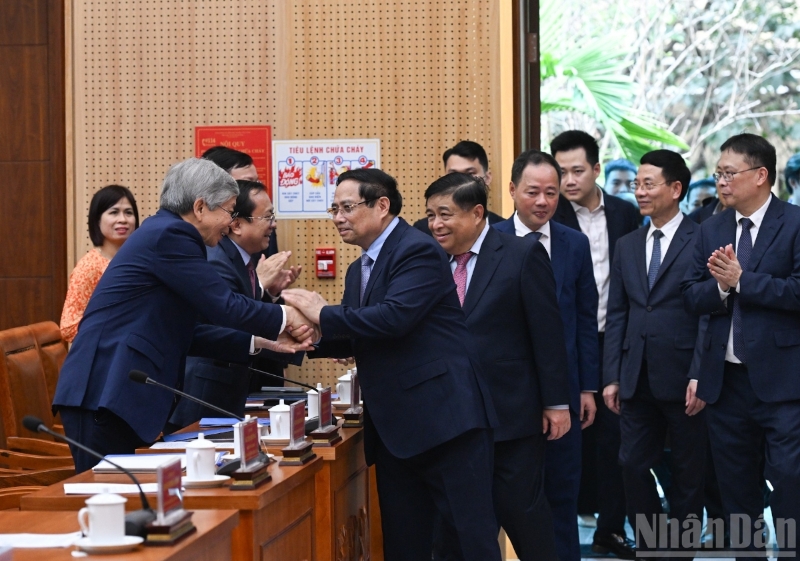
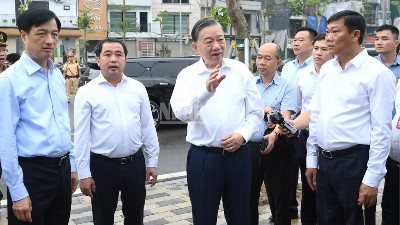
Prime Minister Pham Minh Chinh worked with the Vietnam Academy of Science and Technology on February 23 on the implementation of the Resolution of the 14th Party Congress and Resolution No. 57 of the Politburo on science, technology, innovation, and digital transformation.
The PM was accompanied by Deputy Prime Minister Nguyen Chi Dung and leaders of ministries, sectors, and central agencies.
After 50 years of construction and development, the Vietnam Academy of Science and Technology affirms its position as the core force of the national science system. In 2025, it had 2,300 publications in prestigious journals, and granted 105 patents and utility solutions, an increase of 2.7 times compared to 2024. In the period of 2021–2025, the Academy published over 12,000 scientific works and granted nearly 300 patents, 1.5 times more than the previous period.
Implementing Resolution 57 of the Politburo, out of a total of 45 assigned tasks, the Academy completed 12 tasks on time, with 33 tasks currently being implemented within the deadline, with no tasks delayed.
Closely following the list of strategic technologies issued together with Prime Ministerial Decision No. 1131/QD-TTg, dated June 12, 2025, the Academy achieved many outstanding results, such as mastering the process of manufacturing modular hardware applications of AI for autonomous electric vehicles; developing AI/IoT solutions for real-time detection and warning of abnormal health conditions in livestock; and developing a model to predict rice plant health based on remote sensing and deep learning.
The Academy also successfully applied gene editing technology to restore the function of the Rc gene in rice plant; identified new gene variants related to colorectal cancer, serving personalized medicine; and isolated and cultured many cell lines for artificial meat research. Other core technologies developed include water electrolysis to produce hydrogen from renewable energy; nano materials applied in thermal therapy, MRI imaging, and drug delivery; and new generation Lithium-ion battery electrode materials with high storage efficiency.
In addition, the Academy promotes digital transformation in management and administration; develops shared digital infrastructure and platforms; and trains human resources to serve digital transformation.
At the working session, the Academy proposed to continue perfecting the institutions and policies for science and technology, especially the management, finance, human resources mechanisms, autonomy in science and technology, and investment in upgrading facilities. The Academy suggested being assigned to lead the implementation of 5 strategic science and technology projects on advanced materials; technology for deep processing of rare earths and strategic minerals; new generation UAVs; nuclear energy technology; and training and developing high-quality science and technology human resources.
Additionally, the Academy proposed piloting the establishment of an international science and technology organization for advanced functional materials; approving the project to develop human resources and infrastructure for quantum science and technology research; and approving the project to attract outstanding international research groups and Vietnamese people abroad in key technology fields.
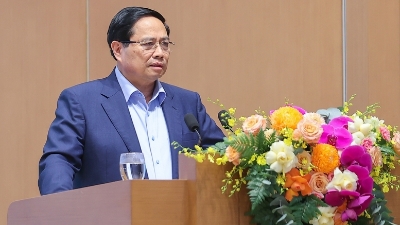
Speaking at the working session, Prime Minister Pham Minh Chinh emphasized that science, technology, innovation, and digital transformation are inevitable trends, strategic choices, and top priorities in investment and development, as they are important drivers to promote rapid and sustainable growth. In this process, the Academy plays a central role as the leading science and technology institution in Vietnam, a place that gathers and crystallizes the intelligence and creativity of intellectuals and scientists.
The Prime Minister hopes the Academy will achieve breakthroughs, gradually reaching the level of advanced countries in the region and the world, aiming to become a leading scientific and technological research organization in Southeast Asia by 2030, with international competitiveness in several key areas, following the motto: “Elite intelligence – Mastering technology – Strong innovation – Keeping up with the situation – Creating the future.”
The Prime Minister requested the Academy to implement synchronously four transformations, including: digital transformation, green transformation, energy transformation, and transformation of the structure and quality of human resources; to take the lead in applying artificial intelligence and big data; to build a national database on science and technology; and to focus on mastering core technologies and source technologies, addressing practical issues of the country.
The Academy is required to “open” laboratories, enhance cooperation with the business sector, making businesses the center of the innovation ecosystem; promote the commercialization of research results, turning inventions into products, specific values in the value chain.
The Prime Minister directed the Academy to build an action program to implement the Resolution of the 14th Party Congress and the strategic resolutions of the Politburo; to complete the dossier to submit to the Politburo for the project to research and master some strategic technologies before March 15, 2026; to submit to the Prime Minister the project to enhance the Academy's capacity in April 2026; to build a development strategy to 2030, a vision to 2045, and a mechanism for autonomy and comprehensive accountability.
In governance, the Prime Minister requested a strong shift from “task thinking” to “result thinking”; from “doing many” to “doing right and doing well”; from “having activities” to “having specific products,” “having clear contributions to increasing national productivity, quality, and efficiency.” At the same time, to strengthen the linkage of the “three entities: State – scientists – businesses, and to develop intellectual property, science and technology enterprises, and the innovation startup ecosystem.
 Google translate