



Vietnam’s green finance landscape is exhibiting a major structural imbalance: the policy framework is becoming increasingly comprehensive but the green bond market has yet to develop at a comparable pace. Decision No. 21/2025/QD-TTg established environmental criteria and a mechanism for certifying projects under the green taxonomy, providing a common basis for identifying green projects and economic activities.
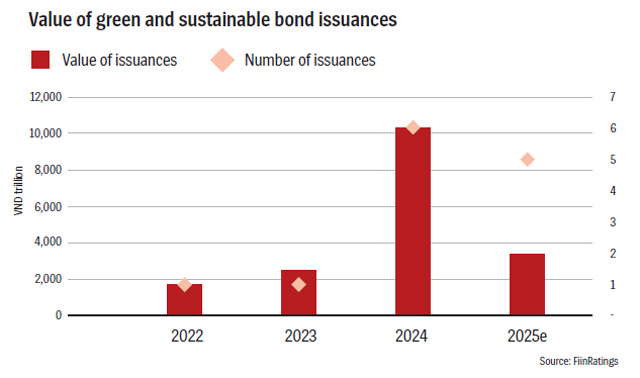
Meanwhile, Resolution No. 198/2025/QH15 introduced a 2 per cent per year interest rate support policy for certain loans serving green and circular projects and those meeting environmental, social, and governance (ESG) standards. However, green bond issuances in 2025 only totaled some VND3.407 trillion ($129.8 million); a significant decline from more than VND10 trillion ($380.9 million) in the previous year.
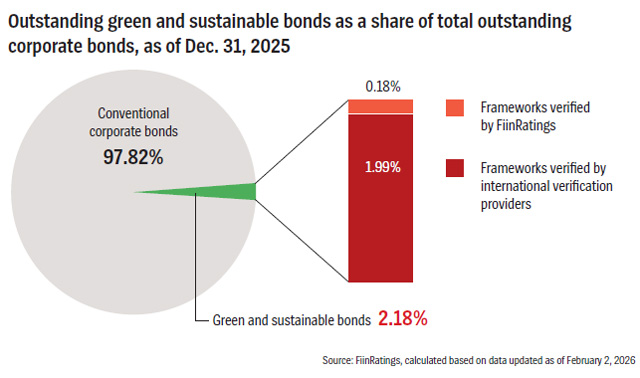
The disparity becomes even clearer when the green bond market is compared with overall green credit. Outstanding green credit had risen to nearly VND828 trillion ($31.5 billion) as of the end of the first quarter of this year. By contrast, outstanding green corporate and sustainable bonds stood at only around $1.1 billion at the same point.
The significant gap between the two channels shows that funding for Vietnam’s green transition remains heavily dependent on the banking credit system, while the capital market still plays a relatively limited role. If most of this green financing demand continues to be met through bank credit, pressure on the maturity structure and funding balance of the credit system could increase, while the capital market’s role in allocating long-term capital remains underdeveloped.
Lessons from Asia
When implementing K-Taxonomy, South Korea not only developed and applied green classification criteria but also introduced a cost-of-capital support program to encourage companies to apply the taxonomy when issuing green bonds. The program provides partial interest-cost support for green bonds applying K-Taxonomy for one year from the date of issuance, with a maximum of KRW300 million ($219,540) per company.
In 2025, the support rate was 0.2 per cent for large companies and public institutions and 1 per cent for small and medium-sized enterprises (SMEs). The primary purpose of the interest rate support is not to replace companies’ cost of capital, but to create an additional incentive for them to issue bonds in accordance with K-Taxonomy standards. The measure has produced a relatively clear effect.
According to South Korea’s Ministry of Environment, K-Taxonomy-compliant green bonds accounted for around 65 per cent of the green bond market in 2025, up from 10 per cent in 2024. At the same time, the budget for the green bond support program increased from KRW7.7 billion ($5.64 million) to KRW8.1 billion ($5.93 million).
South Korea has also provided stronger support for SMEs, which face multiple barriers to entering the green capital market, including in interest rates, issuance size, creditworthiness, and verification costs. Through the Green Asset-Backed Securities program, bonds issued by multiple companies are pooled into an asset portfolio, credit-enhanced, and issued as securitized instruments.
South Korea’s approach offers a useful lesson: support levels are designed around the specific barriers faced by different groups of companies.
While South Korea has focused on reducing the cost of capital, Singapore and Japan have not directly subsidized interest rates. Rather, they have sought to reduce the costs companies face when entering the green finance market.
In Singapore, the Monetary Authority of Singapore (MAS) launched the Green Bond Grant Scheme in 2017, allowing green bond issuers to receive support covering 100 per cent of the cost of an independent external review, up to SGD100,000 ($78,270) per issuance. In 2019, the program was expanded to social and sustainability bonds and renamed the Sustainable Bond Grant Scheme (SBGS). In 2023, MAS allocated an additional SGD15 million ($11.74 million) to expand and extend its sustainable bond and loan support programs, including transition finance instruments, with support intended to continue through 2028.
Japan has likewise opted to subsidize costs rather than interest rates. In fiscal 2026, Japan’s Ministry of the Environment allocated ¥670 million ($4.24 million) to its green finance promotion program. For green bonds, sustainability bonds and green loans, the program covers 30 per cent of external review costs, while a 60 per cent rate applies to sustainability-linked bonds and loans. Advisory costs are supported at 50 per cent, capped at ¥20 million ($126,685) per capital-raising plan.
Notably, the support is not structured as a direct subsidy to issuing companies, and is instead provided through registered capital-raising support organizations. These organizations provide external review services or advice on developing green finance frameworks and receive support for eligible costs.
Proposals for Vietnam
International experience shows that South Korea uses interest rate support to encourage companies to adopt green standards; Singapore reduces verification and market-entry costs; and Japan directs support into the ecosystem of organizations providing issuance-related services. To develop the green bond market and rebalance the capital structure supporting the green transition, Vietnam could consider the following measures.
First, a time-bound cost-of-capital support mechanism for green bonds. It could consider a program similar to South Korea’s, but on a more cautious scale. The support rate would not necessarily need to match the 2 per cent applied to green credit. It could be set at a lower level, such as a small portion of bond interest costs, for a period of one to two years, with a per-company cap and regular reviews. The policy objective would be to reduce market-entry costs while the market remains small. More importantly, criteria should be established to gradually reduce or end the support once the market reaches a certain level of maturity.
Second, turn Decision No. 21 into an interconnected foundation for green credit and green bonds. The Decision establishes a common set of criteria for green credit and green bonds, but having a common taxonomy does not necessarily mean that green certification processes are fully interoperable between the two markets.
This gap could be addressed through a “green passport” mechanism. In the longer term, a shared “green passport” for credit, bonds, investment funds, and other green financial products could create a much greater effect than a standalone interest rate subsidy.
Third, shift from “cheap international capital” to a “credit-enhancement mechanism.” Low-cost international capital remains important for Vietnam. However, if these funds continue to flow primarily into loans on banks’ balance sheets, the capital market will not fully benefit. One approach would be to use capital from international institutions, climate funds, and development finance institutions to enhance the creditworthiness of green bond issuances. This approach would be particularly relevant for SMEs and infrastructure projects with long-term cash flows but insufficiently high credit ratings.
South Korea uses two State-backed guarantee funds to bring 139 small companies into the bond market. Vietnam has a system of local credit guarantee funds and the SME Development Fund, but these institutions have yet to play a significant role in this regard.
Vietnam’s challenge, therefore, is not only to mobilize more green capital but also to rebalance the channels through which capital for the green transition is supplied. The experiences of South Korea, Singapore, and Japan show that governments do not necessarily need to provide large, long-term subsidies. Rather, they can focus support on the costs that currently prevent companies from accessing capital markets.
For Vietnam, policy should aim for neutrality among capital-raising instruments: projects that meet green criteria should be able to access credit, bonds, and other sources of green finance through a common classification framework. At the same time, the country needs to reduce certification costs, strengthen creditworthiness, and gradually integrate data across financial channels. The ultimate goal is for banks and capital markets to share the role of providing long-term financing for the green transition.
(*) Mr. Nam Son is an independent expert.







 Google translate