


The world’s first airline, DELAG (Deutsche Luftschiffahrts-Aktiengesellschaft), was founded in 1909. Later that same year, the second airline to take to the skies, CGT (Compagnie Générale Transaérienne), the predecessor of today’s Air France, was established. Since then, the global aviation industry has expanded at a remarkable pace.
Vietnam’s national flag carrier, Vietnam Airlines, was established in 1956 with just two Lisunov Li-2 aircraft, and conducted its first international flight to Beijing in 1976. Today, it operates a fleet of more than 100 aircraft, serving domestic routes as well as international destinations across Southeast Asia, East Asia, Europe, Oceania, and the Americas.
The aviation experience is shaped not only by different aircraft and airlines but also by airports. Over the past several years, Vietnam has intensified efforts to expand and upgrade its airport network in both scale and quality.
Airports development
The country currently has eleven international airports: Noi Bai, Tan Son Nhat, Cat Bi, Van Don, Vinh, Phu Bai, Da Nang, Lien Khuong, Nha Trang, Can Tho, and Phu Quoc, and eleven domestic airports: Dien Bien, Tho Xuan, Dong Hoi, Chu Lai, Tuy Hoa, Pleiku, Buon Ma Thuot, Phu Cat, Rach Gia, Ca Mau, and Con Dao, excluding military airfields.

Van Don International Airport is the only airport in Vietnam that has been built and operated entirely by a private investor, the Sun Group. Opened in 2018, it was completed in a record-breaking 24 months and became the country’s first entirely new airport developed after 1975.
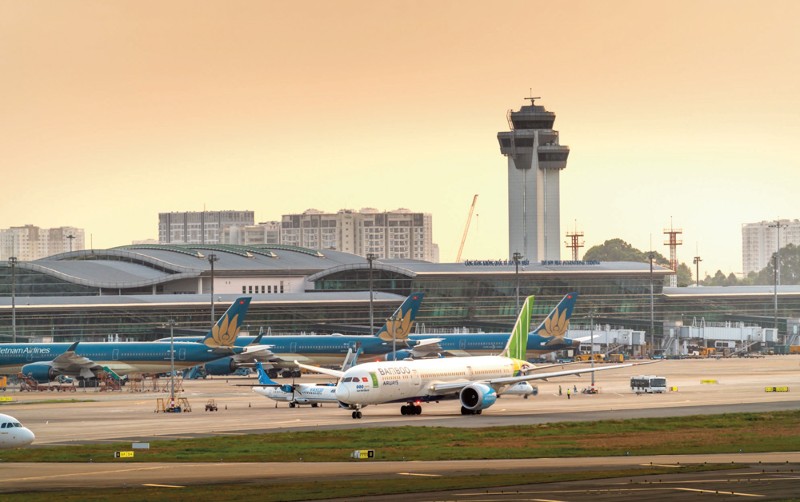
Vietnam’s two largest operating airports today are Noi Bai International Airport in Hanoi, which was originally the Da Phuc Military Air Base, built in 1963, and Tan Son Nhat International Airport in Ho Chi Minh City, originally constructed by the French in 1930 and expanded by the US in 1956. Each currently handles approximately 25-30 million passengers annually. Under plans to 2050, Noi Bai’s capacity is expected to reach 85 million passengers a year, while Tan Son Nhat is projected to cater to 50 million.
Long Thanh International Airport in southern Dong Nai province is being fast-tracked for completion, with operations scheduled to begin by the end of this year. Designed to become Vietnam’s largest airport, it is expected to handle 100 million passengers annually once all three development phases are completed, supported by four runways and four passenger terminals.
Gia Binh International Airport in northern Bac Ninh province is to become Vietnam’s second-largest airport, after Long Thanh, with a projected annual capacity of 50 million passengers by 2050. The airport is planned on a larger scale than both Noi Bai and Tan Son Nhat. Together, Long Thanh and Gia Binh represent Vietnam’s newest greenfield airport developments.
Another major project is the expansion of Phu Quoc International Airport. Construction began in July 2025 under Sun Group investment, with an initial capacity of 20 million passengers a year to support APEC 2027 before ultimately expanding to 50 million passengers annually by 2050. According to leaders at the Ministry of Construction, this also marks the first time the government has transferred the operating rights of a busy international airport while maintaining national security and ensuring uninterrupted trade flows.
Several other airport projects are also moving forward. Phan Thiet Airport, approved in 2014 and awarded to the Sun Group, is currently completing its civilian infrastructure and is designed to serve 2 million passengers annually. Sa Pa Airport in northern Lao Cai province, planned with an annual capacity of 3 million passengers, has completed land clearance and is seeking investors. Quang Tri Airport in the central region, developed by the T&T Group under a public-private partnership, is expected to begin operations by the end of this year with a capacity of 5 million passengers a year.
In July, the Civil Aviation Authority of Vietnam proposed adding Cao Bang, Bach Long Vi, Ninh Binh, and Tho Chu airports to the national airport development plan for 2021-2030 with a vision to 2050.
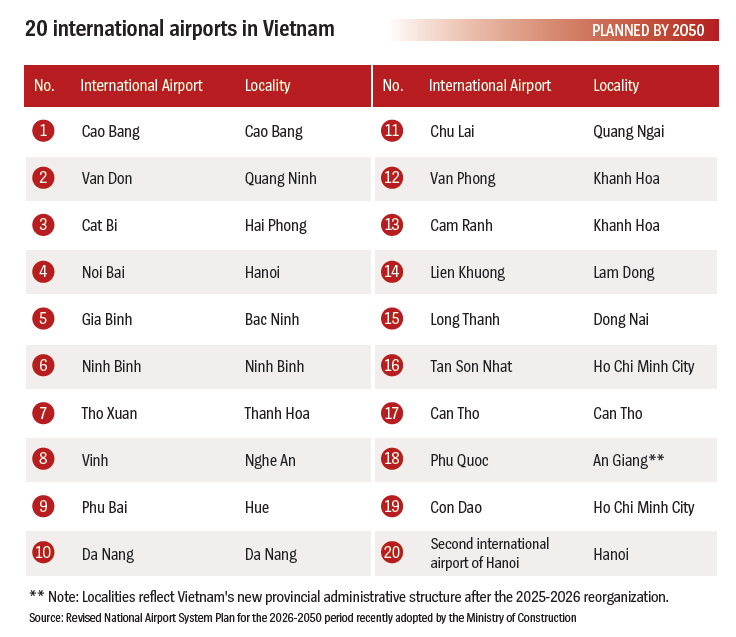
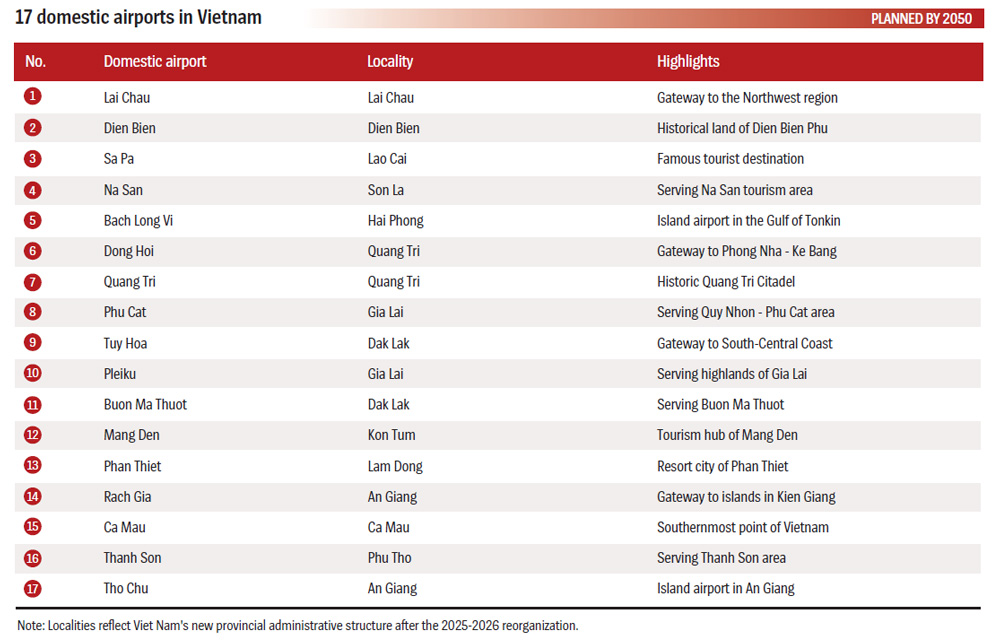
By 2030, Vietnam is expected to operate 36 airports with a combined annual capacity of 300 million passengers. By 2050, that figure is projected to increase to 37 airports capable of handling nearly 540 million passengers each year. The plan includes 19 international airports, or five more than envisioned in the 2021 master plan, with Cao Bang, Gia Binh, Ninh Binh, Van Phong, and Con Dao joining the international network, while Con Dao will be upgraded from domestic to international status. Vietnam will also have 17 domestic airports, adding Bach Long Vi, Mang Den, and Tho Chu while removing Bien Hoa and Con Dao from the domestic list.
Private participation
Private sector participation in developing new airports and upgrading existing facilities is expected to help address the enormous capital requirements for aviation infrastructure, estimated at around VND587 trillion ($22.6 billion), sourced from both public and private investment. Beyond easing funding pressures, private investment is also expected to stimulate regional economic growth. Several major private conglomerates have already proposed additional airport developments across the country.
Ultimately, the number of airports tells only part of the story. While aviation has advanced dramatically in Vietnam and around the world, the true measure of progress lies in travelers’ experiences and their assessment of every element within the aviation ecosystem.
An airport alone cannot determine the success of a region’s aviation infrastructure if it is not integrated into a broader transportation and connectivity network, while also continuously improving service quality and its public image. Da Nang, for example, benefits from having an airport located just minutes from the city center, allowing travelers to reach downtown shortly after landing.
In contrast, some airports require journeys of more than an hour to reach their surrounding cities; longer than certain domestic flights themselves. Long Thanh International Airport, though poised to become Vietnam’s largest, had yet to finalize several critical issues at the time of writing, including rapid transport links to Ho Chi Minh City, dedicated connections with Tan Son Nhat International Airport for passenger transfers, and decisions on how domestic and international operations, or airline allocations, will be divided.
Many other components of the aviation ecosystem also shape the way people travel by air, including aircraft fleets, cabin crews, airlines’ digital platforms and customer communications, duty-free shopping, food and beverage services, business lounges, passenger amenities, route networks, and booking systems.
Overall, private sector participation, both globally and in Vietnam, has played an increasingly important role in improving every component of the aviation ecosystem. It has expanded access to investment capital for airport infrastructure, strengthened management capabilities to accelerate project delivery, introduced international expertise in airport operations, and brought advanced technologies that improve service quality. More importantly, it has helped transform airports into economic hubs by expanding business models and developing new services, ultimately strengthening the broader aviation ecosystem and supporting the industry’s long-term growth.
Taking off
It is worth emphasizing that surviving in the aviation industry is no easy task, whether for private enterprises or State-owned carriers, even in developed countries with long-established aviation sectors. Around the world, many national and private airlines have endured financial crises, bankruptcy, or relied on government support to remain in operation.
Swissair declared bankruptcy in 2002, while Japan Airlines filed for bankruptcy protection in January 2010. Thai Airways sought bankruptcy protection in May 2020, followed by Philippine Airlines, the oldest airline in Asia, in September 2021. Lufthansa, Air France, and KLM all restructured their ownership in exchange for government support packages and direct loans totaling €9-10 billion ($10.5-11.7 billion).
In the US, major private carriers such as United Airlines, Delta Air Lines, Alaska Airlines, JetBlue Airways, and Southwest Airlines received a combined $50 billion federal rescue package, comprising $25 billion in non-repayable payroll support and another $25 billion in loans convertible into equity.
Vietnam has experienced similar challenges. Vietnam Airlines received government financial support after the National Assembly approved a rescue package in late 2020 to strengthen liquidity and recapitalize the airline during the Covid-19 pandemic. Several private Vietnamese airlines have also ceased operations due to financial difficulties. Indochina Airlines, launched in 2008, suspended operations after just one year following the global financial crisis in 2009. Air Mekong, established in 2010, stopped flying in 2013 after years of mounting losses. Trai Thien Air Cargo, also founded in 2010, had its operating license revoked after failing to launch a single commercial flight.
Despite these setbacks, Vietnam has also seen the emergence of successful private carriers, while several others continue to pursue growth despite a challenging operating environment. According to 2026 market data, Vietjet Air has become the country’s largest domestic carrier, with a 45 per cent market share, narrowly surpassing Vietnam Airlines, while commanding a dominant 56 per cent share of Vietnam’s international aviation market. The achievement is particularly notable for a relatively young private airline that continues to expand its international network while delivering stronger business performance.
The newest entrants to Vietnam’s private aviation market are Vietravel Airlines and Sun PhuQuoc Airways. Established by travel company Vietravel in 2019 and commencing operations in 2021, Vietravel Airlines follows a hybrid airline model. The carrier is expected to adopt a new brand name this year while expanding its fleet from four narrow-body Airbus aircraft to ten.
Sun PhuQuoc Airways is Vietnam’s second leisure-focused airline, after Vietravel Airlines. Established and launched in 2025, the carrier is backed by the Sun Group and will base its operations at Phu Quoc International Airport with an initial fleet of ten Airbus A320/A321 aircraft. The airline plans to expand its international route network, connecting Phu Quoc with key markets across Asia.
Vietnam’s aviation industry has clearly come a long way. Looking ahead, the key question is no longer simply how many airports the country will build, but what kind of experience each airport, every flight, and every service will deliver to passengers, and how significant the contribution of Vietnam’s private sector will be in shaping that experience.
Today, several additional private airlines are expected to expand rapidly. Vietnam’s first privately-developed airport has already demonstrated that private investment can successfully deliver and operate major aviation infrastructure. More airports are now being planned by private conglomerates in partnership with leading international organizations. Taken together, these developments underscore the strong growth potential of Vietnam’s aviation industry in the years ahead, with the private sector expected to play an increasingly important role in line with the direction set out in Politburo Resolution No. 68.





 Google translate