


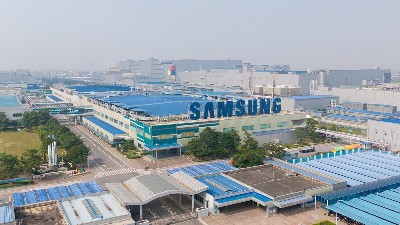
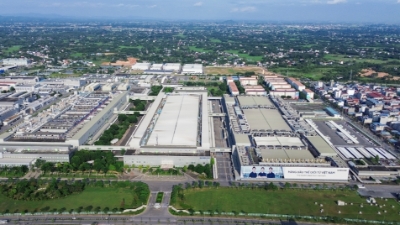
Samsung Electro-Mechanics, a subsidiary of the Samsung Group, has announced a massive investment of 2.510 trillion won (approximately $1.84 billion) to expand its semiconductor substrate manufacturing plant in Vietnam's northern Thai Nguyen province.
This move is part of the Group's overall investment strategy of 6.700 trillion won to enhance the production capacity of high-end semiconductor products, particularly the FC-BGA (Flip-chip Ball Grid Array) line, which serves artificial intelligence (AI) applications.
According to Chosun.com, this new investment will enable Samsung Electro-Mechanics Vietnam in Thai Nguyen to expand its production scale, with completion and operational commencement expected before the end of April 2028. This is part of Samsung's long-term plan to meet the growing demand for semiconductor products used in AI servers, AI accelerators, and smart autonomous devices.
FC-BGA is a crucial semiconductor substrate that connects high-performance semiconductor chips to the motherboard, providing electrical signals and power. This technology reduces signal transmission distance, increases data transmission speed, and improves energy efficiency, which is particularly important as AI demand surges.
Mr. Chang Duck-hyun, President of Samsung Electro-Mechanics, shared with Chosun.com that the demand for FC-BGA for servers and data centers has already exceeded 50% of current production capacity.
Samsung is not only focusing on the domestic market but also expanding its investments abroad. Alongside the expansion in Thai Nguyen, Samsung Electro-Mechanics has also decided to invest 2.51 trillion won in semiconductor substrate production facilities in Vietnam. This demonstrates Samsung's efforts to strengthen its position in the semiconductor field, especially in high-growth markets such as AI, servers, and automotive electronics.
Additionally, Samsung plans to invest $1 billion in Helix Digital Infrastructure in the United States, along with other group companies such as Samsung Electronics, Samsung C&T, Samsung SDS, Samsung SDI, Samsung Life Insurance, and Samsung Fire & Marine Insurance.
Helix, established in June 2026, specializes in developing and operating hyperscale data centers and providing AI infrastructure. This investment not only helps Samsung expand from components to AI systems and infrastructure but also allows Samsung to engage more deeply in building infrastructure for this sector.
In Vietnam, Samsung currently has four core member units, including Samsung Electronics Vietnam Thai Nguyen (SEVT) and Samsung Electronics Vietnam (SEV) under Samsung Electro-Mechanics. In the first half of 2026, these four key factories achieved total revenue of 52.249.5 trillion won, equivalent to approximately $35.26 billion, an increase of 20.5% compared to the same period in 2025. SEVT in Thai Nguyen contributed the most to Samsung's revenue and profit structure in Vietnam, with revenue exceeding 24.006 trillion won, equivalent to $16.2 billion, up 22%.
According to experts, the $1.84 billion investment in Thai Nguyen not only demonstrates Samsung's strong commitment to the Vietnamese market but also represents a strategic move to embrace the development trend of AI technology.
By expanding production and investing in AI infrastructure, Samsung is asserting its position not only as a component supplier but also as an important partner in building the global AI ecosystem. This not only helps Samsung strengthen its competitive position but also opens up many new development opportunities in the future.



 Google translate