


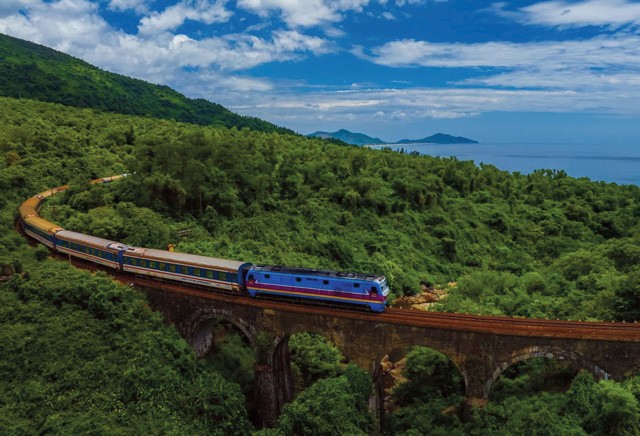
Vietnam is entering an unprecedented period of railway development, with ambitious plans to expand its national network, introduce high-speed services, and modernize existing infrastructure. As the country prepares to develop a railway network spanning more than 6,700 km, the challenge extends beyond mobilizing investment and acquiring advanced technologies, with building a skilled workforce capable of managing, operating, and maintaining increasingly-sophisticated systems becoming an equally-important priority.
Against this backdrop, international cooperation in human resources development is gaining momentum, helping Vietnam draw on the experience of countries with established railway industries while strengthening its own technical capabilities. A training program involving France, Morocco, and Vietnam, which concluded in Hanoi on November 3, illustrates how such partnerships can support the country’s long-term ambitions. Funded by the French Development Agency (AFD) and implemented by France’s national railway group SNCF through SNCF International, the program provided specialized training to more than 130 Vietnamese officials and railway professionals across three countries.
Preparing for the expanded network
Under Vietnam’s railway network plan for the 2021-2030 period, with a vision to 2050, the country aims to develop 18 new railway lines spanning more than 4,200 km by 2030. The longer-term plan envisages 25 new and upgraded lines covering more than 6,700 km. Delivering on these ambitions will require substantial investment in infrastructure and technology, alongside improvements in the country’s capacity to manage increasingly-complex railway projects.
The Ministry of Construction (MoC) has identified railway industry development, technology transfer, high-quality human resources training, and international cooperation as key priorities. France has been among Vietnam’s long-standing partners in the field, supporting projects such as the Yen Vien - Lao Cai railway upgrade, modernization of the Hanoi - Vinh signaling system, and Hanoi’s Metro Line 3 (Nhon - Hanoi Station).
At the training program’s closing ceremony, Deputy Minister of Construction Bui Xuan Dung highlighted the practical value of cooperation with France in strengthening Vietnam’s railway capabilities. He said participants had gained experience in the construction, management, and operation of high-speed and electrified railway systems, providing valuable knowledge to improve their professional expertise.
The need for qualified personnel is considerable. Modern railway systems require specialized expertise in infrastructure engineering, electrification, signaling, safety management, digital technologies, rolling stock operations, and maintenance. Developing these capabilities domestically will be essential not only to implement major projects but also to ensure their efficient operation over the long term.
Learning from France and Morocco
Implemented during 2025-2026, the training program comprised ten modules covering railway governance, regulatory frameworks, project management, infrastructure engineering, signaling, power systems, rolling stock, and safety. It included six short-term courses in Hanoi, attended by 97 participants, three advanced courses at the Railway Training Institute (IFF) in Rabat, Morocco, involving 30 participants, and a one-week study program in France for ten senior officials from the MoC.
The curriculum combined theoretical instruction with practical experience, technical visits, and exchanges with French and Moroccan specialists. For Morocco, the partnership provided an opportunity to share lessons from the development of Africa’s first high-speed railway, which entered commercial service in 2018 through cooperation between French and Moroccan railway experts.
Mr. Abdelkader Boujdad, Chairman of Morocco’s Railway Training Institute (IFF), said the program had been tailored to Vietnam’s requirements, describing it as “Made for Vietnam and Made in Vietnam.” He emphasized that participants had been active partners throughout the training process, raising hundreds of detailed questions based on their professional responsibilities.
Overall participant satisfaction exceeded 92 per cent and even reached 100 per cent in some sessions, while many trainees achieved full marks in competency assessments. For Mr. Boujdad, the program’s value extended beyond its immediate educational results. “High-speed rail is built as much on competent men and women as it is on the tracks we lay and the trains we purchase,” he believes.
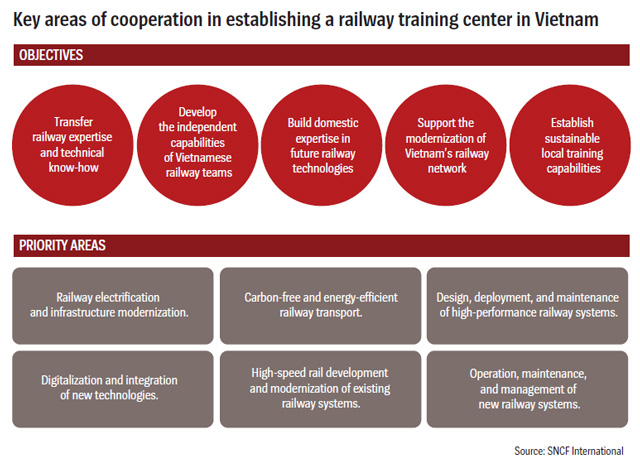
A central message from the French and Moroccan partners was that international cooperation should ultimately enable Vietnam to become self-sufficient rather than dependent on external expertise. This means developing local institutions and training systems alongside the technical skills needed to manage modern railway infrastructure.
Mr. Diego Diaz, President of SNCF International, said the partnership was founded on sharing experience and enabling Vietnam to make its own technological and operational choices. Drawing on SNCF’s experience operating high-speed rail services since 1981, he stressed that an efficient railway network cannot be measured by speed alone. “We must consider safety, capacity, operations, maintenance, energy, service quality, listening to customers, the evolution of services, and ticket prices as an integrated whole,” he said.
He also highlighted the importance of adopting open European railway standards, arguing that they could help Vietnam retain flexibility in selecting suppliers and controlling costs while avoiding technological dependence. Rather than importing a turnkey system, the objective should be to equip Vietnamese professionals with the knowledge to develop and manage their own network. “Our role is not to import a turnkey model, but to share our experience, transfer skills, and enable you to make your own choices, with Vietnamese trainers and, in the future, your own training capabilities,” Mr. Diaz said.
SNCF International hopes to continue the partnership from 2027 through a Team Europe framework, bringing together expertise from across the SNCF Group and French railway institutions. The IFF has also expressed its readiness to support Vietnam in establishing its own railway training center through curriculum development, instructor training, and longer-term technical mentoring.
Expanding European support
The EU is also positioning human resources development as part of its broader support for Vietnam’s transport infrastructure. H.E. Julien Guerrier, Ambassador of the EU to Vietnam, said the EU and its member states had extensive experience in high-speed and urban railways, signaling, safety regulations, and network interoperability. “The European model is based on partnership, and you all know how different this is from simply providing services,” he said. “Our approach is to strengthen local skills and capacities so that countries like Vietnam can eventually develop, operate, and expand their own autonomous and sustainable railway networks.”
This commitment will be reinforced through the Sustainable Transport Facility, funded by the EU under its Global Gateway strategy. Implemented through a Team Europe approach, the facility is expected to support major public infrastructure projects in sustainable transport, representing indicative total investment of approximately €1 billion ($1.12 billion) between 2026 and 2035, backed by €40 million ($44.8 million) in grants.
Capacity building is a central component. On October 14, the facility’s first Steering Committee meeting approved funding for a national railway training center to support applied research and technology transfer while addressing the shortage of qualified railway specialists.
As Vietnam moves toward a more extensive and technologically-advanced railway network, international partnerships can provide valuable expertise but their long-term success will depend on how effectively that knowledge is embedded within the domestic workforce. The training program with France and Morocco is an important step in this direction, laying the groundwork for future cooperation and stronger local training capabilities. “This program is coming to an end, but Franco - Moroccan - Vietnamese cooperation is only just beginning,” Mr. Boujdad said. “Together, we will continue to promote excellence through sharing.”






 Google translate