


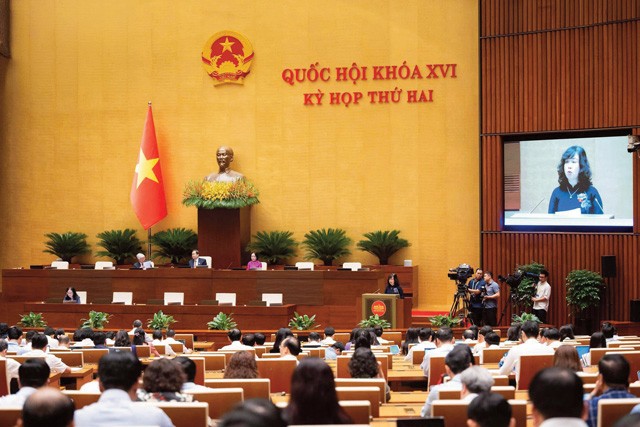
A comprehensive revision of the Law on Food Safety is considered urgent, with priorities including streamlining the State management apparatus, shifting decisively from pre-market inspections to post-market supervision, reducing administrative procedures, eliminating overlapping layers of sub-licenses, and strengthening data-driven monitoring capabilities.
Strengthening risk-based oversight
The draft Law on Food Safety (revised) submitted to the National Assembly focuses on three major areas: risk-based food safety management throughout the supply chain; administrative procedure cuts and a shift toward post-market supervision; and the establishment of a unified lead agency for State management over food safety.
The first major focus of the draft amendments is managing food safety through risk-based controls across the entire supply chain.
Minister of Health Dao Hong Lan said the proposed approach draws on international practices and guidance from the Codex Alimentarius Commission, the international food standards body. Codex guidelines define risk analysis as comprising three components: risk assessment, risk management, and risk communication. Risk assessment enables an independent and objective evaluation of the likelihood of food safety hazards occurring.
While the Law on Product and Goods Quality 2025 classifies products into three risk categories - high, medium, and low - the draft Law on Food Safety proposes a different approach, classifying food products into two categories: high-risk and low-risk. According to the drafting agency, this classification is designed to reflect Vietnam’s socio-economic conditions and ensure that regulatory measures are proportionate to the risks involved.
The Ministry of Health (MoH) said risk analysis results would provide the basis for adjusting management measures for products circulating on the market, including issuing or revising food safety technical regulations, conducting State inspections of imported food products, and implementing post-market supervision.
To support supply chain risk controls and optimize enforcement resources, the draft Law provides for a national food safety information and data system. This would cover product life cycles, food production and business establishments, testing organizations, inspection and monitoring records, food poisoning incidents, and standardized data sharing between central and local authorities.
The draft also specifies product categories subject to product declaration registration, product standard declarations, or exemptions from such requirements. It introduces procedures for issuing, renewing, amending and supplementing product declaration registration certificates. Notably, the MoH proposes limiting the validity of these certificates to five years from the date of issuance or renewal, to strengthen regulatory oversight.
Under Article 46, the draft retains four categories subject to mandatory registration: health supplements, medical nutrition products, foods for special dietary uses, and nutritional products for children up to 36 months old, and adds a fifth: supplementary foods carrying health claims.
The second major focus is cutting administrative procedures and reforming food management measures by shifting decisively from pre-market inspections to post-market supervision.
The draft Law specifies the scope, subjects, principles, and measures of post-market supervision, along with the responsibilities of inspection teams and the frequency of market inspections. Authorities may conduct inspections and examinations, collect samples and test food products circulating on the market, and carry out product traceability.
Food safety inspections may not be conducted more than once a year, except where there are indications of legal violations, or where food ingredients, processing aids, additives, or flavorings are found to have been misused or abused in ways that could turn them into harmful substances. Other exceptions specified in the draft would also apply, with inspection frequency determined by competent authorities.
Another significant change appears in Article 48, which establishes three inspection methods: strict inspection, normal inspection, and reduced inspection.
Imported food products must undergo State inspections under one of these methods and receive confirmation of compliance from the inspection authority for each individual shipment, except where exemptions are granted under government regulations.
The third major focus is establishing a unified State management system for food safety from the central to local levels, while maximizing the delegation and decentralization of authority.
Under the draft, the MoH will serve as the lead agency assisting the government in exercising unified State management of food safety. People’s Committees at all levels will organize and implement food safety management within their respective jurisdictions, following a single-lead-agency model.

Other ministries will continue coordinating the implementation of specialized regulations and government-assigned responsibilities. These include primary production, combating counterfeit food products and commercial fraud, food sales through e-commerce platforms, preventing and handling food-related legal violations, and inspecting imported and exported food products.
Further comprehensive review needed
While agreeing on the necessity of amending the Law on Food Safety 2010, the National Assembly’s Committee on Science, Technology and Environment emphasized in its appraisal report that several provisions identified as breakthrough reforms would still be left to the government to specify in implementing regulations. These include roadmaps for adopting Good Hygiene Practices and advanced food safety management systems, implementing risk analysis, and transitioning between State inspection methods for imported food products.
The Committee called for comprehensive impact assessments and recommended introducing administrative procedures only when genuinely necessary for State management. It also stressed that receiving product standard declarations must not become a pre-market approval requirement for products to circulate on the market. The purpose of requiring product declaration registration certificates to be renewed every five years should also be clearly explained and justified.
Regarding feasibility, the Committee raised concerns about the draft Law’s reliance on detailed implementing regulations, the lack of an assessment of testing capacity for post-market supervision, and the absence of clarity on funding sources and investment schedules for the national data system. Local authorities’ management and enforcement resources have also not been adequately assessed, while the Law’s effective date remains unspecified.
The draft Law also fails to establish when risk-based management will officially take effect. The Committee therefore recommended setting a maximum deadline for completing the risk analysis roadmap, clarifying its relationship with traceability requirements for high-risk food categories, and identifying specific regulatory measures that may only be implemented based on risk analysis results. The list of high-risk food products should be issued as a legal normative document, with consideration given to introducing a provisional list that takes effect immediately when the Law comes into force.
Regarding post-market supervision, the Committee recommended clearly defining the grounds, conditions, scope, and maximum duration for sealing products, suspending food sales, and halting advertising during inspections. It also called for clarification of compensation responsibilities when such measures are applied incorrectly and of exceptions to the proposed limit of no more than one inspection per year.
The draft Law on Food Safety (revised) specifies the scope, subjects, principles, and measures of post-market supervision, along with the responsibilities of inspection teams and the frequency of market inspections. Authorities may conduct inspections and examinations, collect samples and test food products circulating on the market, and carry out product traceability.








 Google translate