


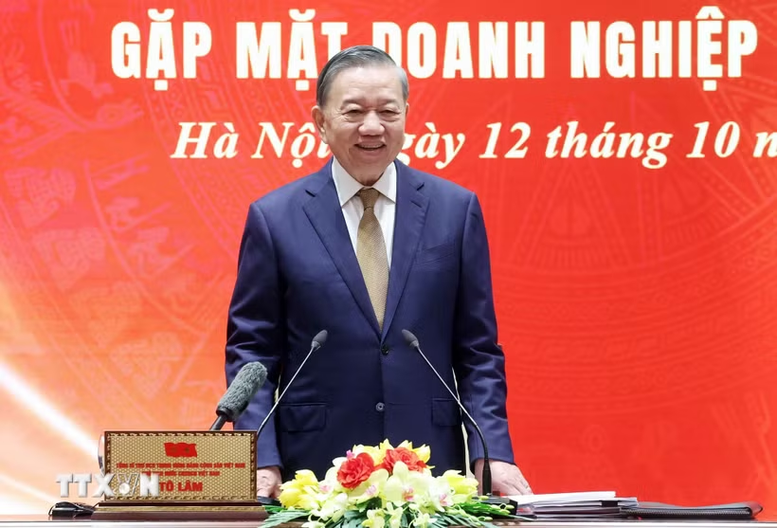
A powerful nation serves as a springboard for businesses to thrive, while strong enterprises reinforce the nation's core strength, General Secretary and President To Lam affirmed during a meeting with 170 representatives of outstanding enterprises on October 12, marking Vietnam Entrepreneurs' Day on October 13, according to the Government's online newspaper (chinhphu.vn)
The top leader emphasized that the Party and State deeply value the contributions of entrepreneurs, guarantee their legitimate rights and interests, and stand ready to foster an enabling environment for them to showcase their talent and build legitimate wealth.
He noted that Vietnam aims to become a modern industrial nation with upper-middle income by 2030, and a developed, high-income country by 2045. These overarching national goals must be materialized through concrete programs, high-impact projects, tangible products, and enhanced capabilities.
The country urgently needs more enterprises that master technology, operate reputable brands, and run internationally competitive production networks. Progress over the next five to ten years must be measured in productivity, quality employment, and consolidated market share, he said.
Calling for a candid appraisal of ongoing challenges, the top leader affirmed that the Party and State must resolve lingering bottlenecks and rectify institutional shortcomings under their remit, while businesses must proactively innovate and elevate their competitiveness.
Mutual trust must be cultivated from both directions: the State protects lawful rights, honors commitments, and ensures policy stability; in return, enterprises invest for the long term, abide by the law, and uphold corporate responsibility toward workers and the broader community.
Outlining key strategic orientations, the top leader called for reinforcing investor confidence and guaranteeing an operating environment that is stable, favorable, transparent, fair, and cost-effective, while delivering substantive resolutions to corporate grievances.
Policies must remain consistent, thoroughly consulted, subjected to rigorous impact assessments, and guided by realistic implementation roadmaps. Legal frameworks must provide timely guidance and unified enforcement, safeguarding property rights, freedom of enterprise, contractual integrity, and the rewards of legitimate wealth generation. The State steadfastly protects lawful asset rights and business freedom.
The Government must maintain macroeconomic stability, tame inflation, secure major economic balances, and resolve bottlenecks in land allocation, urban planning, investment approvals, and construction. Authorities must step up timely regulatory guidance and early warnings to minimize legal compliance risks.
Additionally, Vietnam must formulate a long-term "National Brand Strategy" anchored directly in the substantive competitiveness of domestic enterprises.
Emphasizing the need to boost production capacity, master advanced technology, and cultivate human capital, General Secretary and President To Lam urged business leaders to place technology, talent, and governance at the center of their operations, build on core competencies, commit to sustained investments, and deliver high-value products.
Digital technologies and artificial intelligence must be harnessed to drive productivity, quality, and operational efficiency. National ambitions must be demonstrated through technological mastery and measurable market outcomes.
He called for tighter collaboration among businesses, universities, and research institutes—spanning applied research commissions, commercialization, financial obstacle removal, intellectual property management, and equitable benefit-sharing.
Furthermore, strengthening linkages, opening market access, and guaranteeing fair competition will enable enterprises to grow in tandem. State-owned enterprises (SOEs) must deploy public resources efficiently, focus on critical sectors, essential infrastructure, and foundational technologies, align executive autonomy with strict accountability, and unlock supply chain opportunities for the domestic private sector.
Production linkages with foreign-invested enterprises must be expanded to generate purchase orders, transfer skills, and elevate local manufacturing capabilities. The State guarantees transparent and competitive public procurement, provides access for small and medium-sized enterprises (SMEs), and assists household businesses with accounting, corporate governance, digital tools, and market access so they can scale into formal corporations. Fair access to resources must be assured to facilitate both new market entrants and high-performing enterprises looking to expand.
Underlining the role of entrepreneurs in building an independent, self-reliant economy integrated into international trade, Mr. Lam urged businesses to master critical manufacturing stages, diversify markets and supply sources, navigate global volatility proactively, and consolidate the domestic market through robust distribution networks, high-grade products, services, and trusted branding.
Global integration must ultimately enhance domestic technological capabilities, knowledge reserves, and positioning within global value chains. Entrepreneurs must closely monitor market trends, regulatory shifts, and technological breakthroughs, capitalize on free trade agreements, protect intellectual property, maintain credibility regarding origin and quality standards, and strictly fulfill international commitments.


 Google translate