


Industrialization, urbanization, and the impact of climate change are putting increasing pressure on water resources in Vietnam. Demand for water from the production sector, meanwhile, continues to rise, making the efficient exploitation and use of water resources an urgent requirement.
In this context, on July 28, the United Nations Development Programme (UNDP) in Vietnam, with support from the Dutch Government, together with the Institute of Environmental Science and Engineering (IESE) at the Hanoi University of Civil Engineering, and DEEP C Industrial Zones, launched the “Technical Guideline on Industrial Wastewater and Sludge Reuse under the Accelerating Circular Economy for Businesses (ACE-Biz)” project.
The technical guideline aims to help industrial park (IP) investors and businesses select appropriate technologies for water reuse, risk management, safe operations, and post-treatment water quality control to meet environmental protection requirements.
Reuse in industry
According to the technical guideline, the recycling and reuse of wastewater are regulated by the Law on Environmental Protection 2020, the Law on Water Resources 2023, and related decrees. The amended Law on Water Resources 2023 encourages water reuse projects and provides incentives to stimulate investment in water-saving technologies and practices.
In addition, the National Action Plan on Circular Economy (CE) until 2035, contained within Decision No. 222/QD-TTg dated January 23, 2025, from the Prime Minister, sets a target of treating more than 70 per cent of wastewater in river basins by 2030, encourages wastewater reuse, and includes the treatment of domestic wastewater from urban areas, residential areas, IPs, industrial clusters, concentrated production and business areas, and production and business establishments among its priority sectors. It also prioritizes investment projects, production and business facilities, products, materials, waste, and services implementing the circular economy through 2035.
Though Vietnam has a fairly solid legal framework, the reuse of treated wastewater in practice is mostly limited to the internal operations of businesses. The lack of detailed standards, technical guidelines, and specific regulations governing treated wastewater reuse in IPs and industrial clusters or between businesses, as well as mechanisms for monitoring, quality control, and risk management, has posed challenges to the exchange and trading of treated wastewater between businesses.
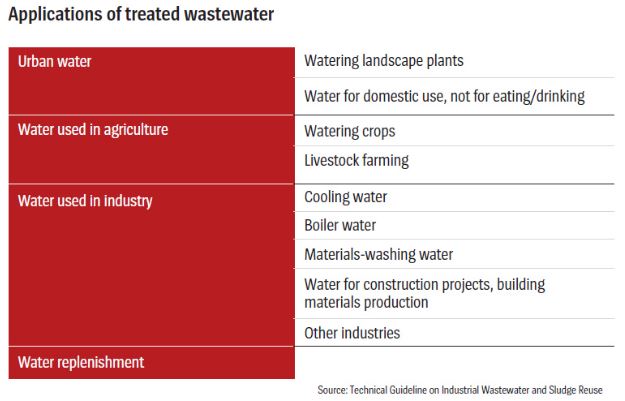
Accordingly, the technical guideline evaluates three scenarios for reusing treated water: supplying water for cooling systems, irrigating plants and washing roads, or treating it to a higher quality for production and partial domestic use. Each option is analyzed in terms of technical requirements, financial efficiency, environmental benefits, and health and safety, helping businesses choose the solution that best suits their needs and investment capabilities.
The study also applies a health risk assessment methodology throughout the entire chain. Experts reviewed the entire process, from technology selection and system operation to quality monitoring and distribution network management, to ensure that the treated water meets the requirements of each intended use. This minimizes risks to both people and the environment.
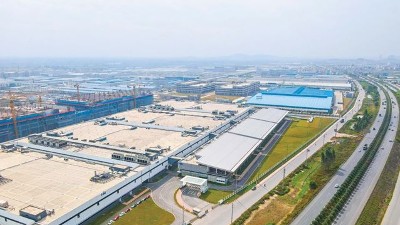
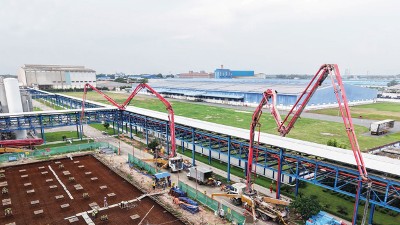
Recently, a pilot model for reusing treated water was implemented at the Dinh Vu Industrial Park, part of DEEP C1 in the northern port city of Hai Phong. With a capacity of 1,000 cubic meters per day, the system utilizes a portion of the water from the centralized wastewater treatment plant, which has a capacity of approximately 6,000 cubic meters per day, for advanced treatment and resupply to meet the IP’s needs. This solution contributes to reducing the need to exploit new water sources while improving the operational efficiency of the existing infrastructure system.
Removing the bottlenecks
Representing the research team, Professor Nguyen Viet Anh, Director of the Institute of Environmental Science and Engineering at the Hanoi University of Civil Engineering, said wastewater reuse in Vietnam is shifting from an internal, fragmented activity to a strategic choice for water security, pollution control, the circular economy, and enhancing supply chain competitiveness.
“Despite its feasibility, the level of application is still early and uneven,” he explained. “Industrial production and tourism services have a relatively higher adoption rate. Meanwhile, IP infrastructure, urban systems, and livestock farming face many institutional, economic, and operational barriers. The biggest barrier is not the lack of technology, but the absence of a complete operational framework.”
Similarly, Mr. Bruno Jaspaert, General Director of DEEP C Industrial Zones, believes complex legal regulations may deter businesses from investing. The lack of specific technical standards for recycled wastewater, tax policies, water allocation mechanisms, and solutions to prevent cross-contamination between recycled water and regular clean water are also issues that need attention.
Ms. Diep Thi Kim Hoan, Chief Sustainability Officer at DEEP C, said that businesses can proactively implement internal water reuse activities when environmental requirements are met. However, when treated water is transferred to another business, many new issues arise, such as determining the type of water source, the responsibilities of each party, and how environmental permits are adjusted. “Businesses are very much hoping to receive the support of regulatory agencies and international organizations to further refine the pilot model so it can be replicated in other IPs,” she said.
Given these challenges, the technical guideline provides some lessons learned from countries and territories around the world regarding wastewater reuse. The US state of California applies Title 22 for the reuse of non-potable water (irrigation, street cleaning, toilet flushing, etc.) and, by October 2024, had issued State-level regulations on recycled water for direct potable reuse (DPR) under California Title 22 and DPR 2024. Accordingly, reuse projects require approval, a multi-barrier system, and online monitoring of critical control points.
Europe, meanwhile, has implemented EU Regulation 2020/741, effective since June 2023, which sets minimum quality and monitoring requirements for agricultural irrigation and includes the 2024 application guidelines. China has adopted the GB/T “urban water reuse” standards based on intended use, in line with the “fit-for-purpose” philosophy. In Southeast Asia, Singapore has adopted NEWater technology with a multistage treatment process for industrial and indirect potable reuse (IPR), following an integrated water engineering and management model.
For Vietnam, Professor Viet Anh said integrating wastewater into a circular economy requires the simultaneous development of multiple solutions, ranging from water quality standards and technical specifications to risk management guidelines, commercial mechanisms, and clearly defined responsibilities for participating parties. “To effectively reuse water, all stakeholders must be considered, from regulatory agencies and suppliers to receiving entities and the community, to ensure safety and shared benefits,” he said.
For his part, Mr. Jaspaert believes a feasible way to expand the model is to allow IPs to self-supply standardized recycled water for uses ranging from cooling and irrigation to production. Thousands of cubic meters of water, rather than being wasted, could be used for higher-value purposes.
Mr. Ho Kien Trung, Deputy Director of the Department of Environment at the Ministry of Agriculture and Environment, said the agency will continue to coordinate with ministries, sectors, localities, and partners to research and refine guidelines and address difficulties in implementing circular economy models. “The results from the pilot program at DEEP C serve as an important reference for businesses when choosing water reuse solutions suited to their actual conditions,” he said.



 Google translate