


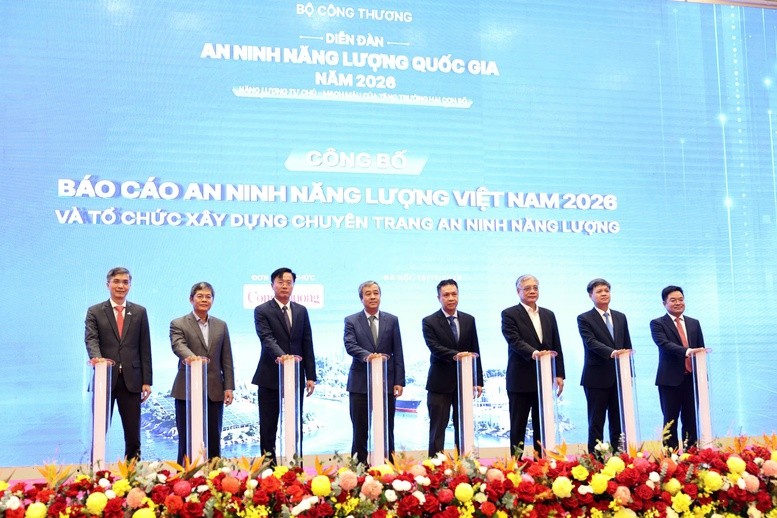
The Ministry of Industry and Trade held the first session of the National Energy Security Forum 2026 in Hanoi on November 10, reported the Government's online newspaper (chinhphu.vn).
At the event, the Vietnam Energy Security Report 2026 was released, noting that 2026 was the year in which the energy system faced the greatest shocks in decades. The Strait of Hormuz was blocked for approximately six months, causing Brent crude oil prices to peak at $118.35 per barrel. Meanwhile, unprecedented heat waves and the El Niño phenomenon pushed electricity demand to record highs, while hydropower generation for the year was expected to be 18.5 billion kWh lower than in 2025.
One of Vietnam’s most notable achievements was ensuring a sufficient electricity supply during a year marked by unprecedented challenges.
According to the report, total electricity generation and imports in 2026 are estimated at 356.2 billion kWh, up 10.3% from the previous year and about 6.2 billion kWh higher than the baseline scenario. The national power system recorded a peak load of 57,537 MW on June 24, 2026, including 30,248 MW in northern Vietnam. Despite these record demand levels, the country avoided rotating power outages.
Commercial electricity consumption increased by 9.84% during the first ten months of 2026, nearly matching the pace of GDP growth for the first time. During the first nine months of the year, the power sector began construction of 136 grid projects and completed 131 projects. These results were attributed to careful planning, including a three-scenario power supply plan approved at the end of 2025, timely commissioning of generation and transmission facilities, reservoir water storage preparations, and completion of major generating-unit maintenance before the summer peak season.
In the petroleum sector, Vietnam continued to secure fuel supplies despite disruptions to major transportation routes. A special Energy Security Task Force was established on March 4, 2026, immediately after the disruptions began. During the first nine months of the year, the country’s two refineries produced approximately 12.1 million tons of petroleum products. The Dung Quat Refinery operated at roughly 123%, while the Nghi Son Refinery operated at approximately 112% of their equivalent design capacities.
Oil and condensate production by the Vietnam National Industry-Energy Group reached 115% of the nine-month target, while gas deliveries to shore achieved 120% of plan. The country diversified its crude oil supply sources from a single type to more than ten different types. As a result, Vietnam experienced no fuel shortages and did not have to draw on its national petroleum reserves.
The report also noted that the government allocated more than VND64 trillion ($2.5 billion) to policies aimed at reducing fuel taxes and fees, as well as advancing funds from the Fuel Price Stabilization Fund. As of October 26, 2026, domestic retail gasoline prices were approximately 63% of the global average, the lowest among the 16 economies included in the comparison. From November 1, 2026, the average retail electricity price was reduced by 2% to VND2,159.9037 per kWh, excluding value-added tax (VAT).
According to the report, ensuring energy security in 2027 will remain challenging, while 2028 is expected to be even more difficult. Electricity demand is forecast to continue growing by around 10% from an already high base, while new baseload power sources will not yet be operational. In addition, El Niño conditions may persist until approximately June 2027.



 Google translate