


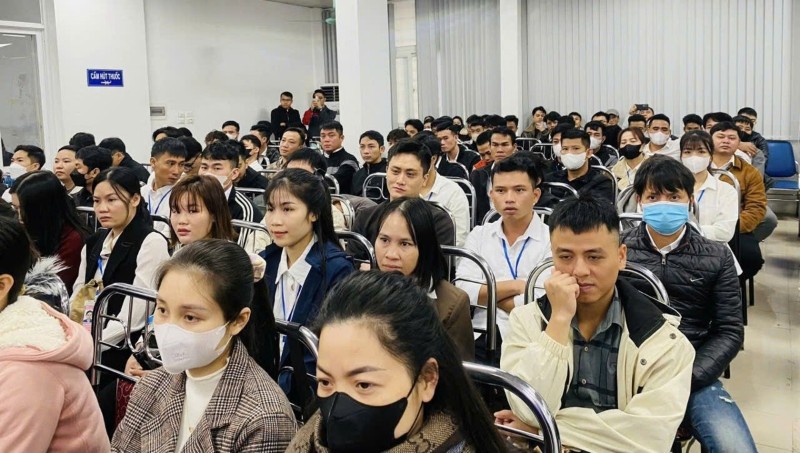
Vietnam dispatched more than 114,000 workers abroad under contract during the first 10 months of 2026, surpassing its full-year target of 112,000 workers ahead of schedule.
According to a report of the Department of Overseas Labor (DOLAB) under the Ministry of Home Affairs, Taiwan (China) remained the largest recipient market with 50,473 Vietnamese workers, followed by Japan with 45,658, South Korea with 7,609, China with 3,276, and Singapore with 1,758. Smaller markets taking in fewer than 1,000 workers included Greece and the Russian Federation, with 967 workers each.
In October, the country sent more than 12,000 workers overseas, primarily to Taiwan (China), Japan, and South Korea.
DOLAB leaders noted that sending Vietnamese workers abroad under contract serves not only to generate employment, raise incomes, and build workforce skills, but also to support sustainable poverty reduction and socioeconomic development in ethnic minority and mountainous regions.
Marking a new phase under the 2026-2035 National Target Program pursuant to Decision No. 1190/QD-BNV, overseas employment is increasingly aligned with a “labor circulation” model. This approach helps workers accumulate vocational skills, workplace discipline, capital, and experience abroad before returning home to launch sustainable businesses.
To address existing regulatory bottlenecks, the National Assembly has passed the Law amending and supplementing a number of articles of the Law on Vietnamese Guest Workers, set to take effect on March 1, 2027.
According to the Ministry of Home Affairs, the revised legislation prioritizes high-quality human resource development by favoring trained workers with technical expertise, while strengthening job placement mechanisms that connect returnees with the domestic labor market.
Notably, the law authorizes the Minister of Home Affairs to specify permissible service fees and standardized labor dispatch contracts. Service charges must be clearly stated in signed contracts, while vocational and language training fees during recruitment preparation may only be collected after a worker is officially selected by a foreign employer.
The legislation also shifts oversight from pre-inspection to post-inspection and replaces registration requirements with notifications, eliminating three administrative procedures, simplifying six others, and cutting compliance costs by 34 percent for citizens and businesses.
Moving forward, DOLAB will intensify inspections of service enterprises, crack down on illegal brokerage, and expand digital outreach to safeguard workers' safety and lawful rights.








 Google translate