


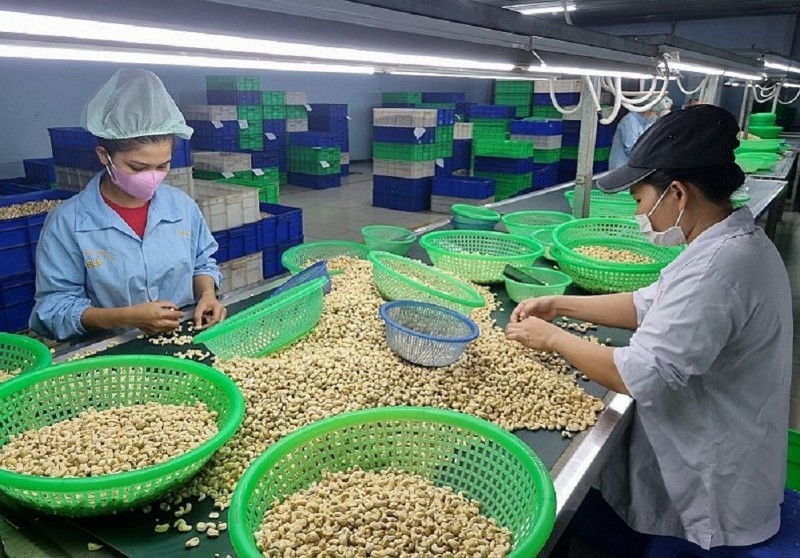
According to the Vietnam Cashew Association (VINACAS), Vietnam exported about 798,000 tons of cashew kernels in 2025, earning over $5.4 billion and maintaining its position as the world's largest processor and exporter for the 19th consecutive year.
However, massive processing capacity comes with heavy reliance on imported raw materials. In the first nine months of 2026, Vietnam imported nearly 2.775 million tons of raw cashew nuts valued at over $4.43 billion to supply domestic factories. Meanwhile, raw material-producing nations are expanding local processing, reshaping the division of labor in the international supply chain.
Mr. Tran Ngoc Hai from the Vietnam Trade Promotion Agency under the Ministry of Industry and Trade, noted that the industry faces long-term structural challenges that require innovations in production, exports, and international cooperation.
He urged VINACAS and local enterprises to explore joint ventures, mergers, and acquisitions overseas, while investing in logistics centers, processing plants, and distribution hubs in key markets.
Mr. Ashok Krishen, Chairman of the International Nut and Dried Fruit Council (INC), proposed strengthening cooperation among nations to establish shared quality and technical standards. Harmonizing standards can facilitate trade and enhance the industry's competitiveness, he noted.
Echoing this view, VINACAS Chairman Pham Van Cong emphasized that a sustainable supply chain must balance benefits across all stakeholders.
“Cashew growers need suitable income, factories require stable raw material supplies, traders need market access, and consumers deserve quality products at reasonable prices,” Mr. Cong said.
He added that the industry must shift from competing on price and volume to focusing on quality, branding, technology, and added value.
During the 15th Vietnam International Cashew Conference in Ho Chi Minh City on October 26-28, VINACAS signed a memorandum of understanding with the Interprofessional Cashew Organization of Senegal (ICAS) to build a stable supply chain.
Under the agreement, both sides will share market policies, production methods, post-harvest technology, and quality standards, while facilitating business matching and trade resolution.
Senegal produces around 150,000 tons of raw cashew nuts annually, exporting 98 percent of its output, with Vietnam absorbing roughly 70 percent of that volume.
Beyond Senegal, other African countries are seeking deeper partnership. Ms. Madina Dansoko, First Vice President of the National Chamber of Agriculture of Guinea, stated that Guinea exported 215,000 tons of raw cashews in 2025, but local processing accounted for only 2 percent. With two million hectares suitable for cashew cultivation, Guinea is implementing policies to expand growing areas and invited Vietnamese firms to invest in local processing plants.
In Southeast Asia, Cambodia aims to boost domestic processing capacity. Ms. Kuoch Chanry, Vice President of the Cambodia Cashew Federation (CCF), said the country targets increasing its domestic processing rate to 25 percent by 2027 and 50 percent by 2032 through tax incentives and infrastructure development.
These strategic shifts demonstrate that raw material-producing countries aim to retain more value locally, presenting both competitive pressures and new investment opportunities for Vietnamese processors.





 Google translate