


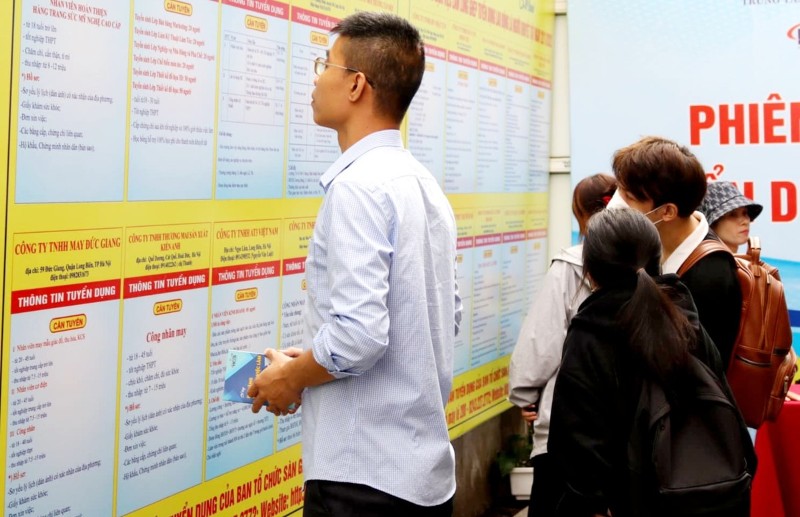
The Hanoi People's Committee has promulgated an implementation plan for Prime Minister's Decision No. 1685/QD-TTg, which executes Politburo Conclusion No. 62-KL/TW on enhancing national labor productivity in tandem with fostering a synchronized, modern, and efficient labor market across the capital in the new era.
A solution highlighted by municipal authorities is the promotion of science, technology, innovation, and digital transformation to serve as key drivers for labor productivity growth.
Under the plan, Hanoi will establish a "living data warehouse" and operate an "AI Brain" to process and leverage data from the Municipal Job Portal. The city will construct and standardize digital profiles for both workers and employers by drawing from this portal and interoperating with the National Employment Exchange.
Artificial intelligence will be deployed to automate candidate screening and job matching, targeting a 30% to 50% reduction in average corporate hiring timelines as well as waiting periods for job seekers.
Remote and flexible working arrangements will also be standardized and promoted, enabling local enterprises to efficiently tap high-quality talent domestically and internationally.
The municipal government encourages local businesses to adopt online recruitment models, digital interviewing, and data-driven human resource management. Enterprises are also urged to standardize their IT infrastructure to digitize all personnel records and roll out electronic labor contracts (e-Contracts). In deploying digital labor management solutions, businesses must ensure information security, protect personal data, and fully comply with statutory regulations.
Furthermore, companies are encouraged to standardize workflows, proactively adopt and manage flexible and remote work arrangements to attract high-caliber talent without geographical constraints, and transition to objective- and performance-based HR management models to replace conventional time-tracking practices.
Alongside technological advancements, Hanoi is setting targets to enhance the quality of human resources to meet evolving market requirements.
Vocational training models will undergo substantive reforms, shifting fundamentally from "supply-driven training based on available capacity" to "demand-driven training tailored to enterprise orders and real-world needs," with digital skills, foreign languages, and AI integration positioned at the core.
The capital will implement support policies for training, upskilling, and career transitions to empower workers to adapt proactively to emerging demands in the twin digital and green transitions.
Crucially, Hanoi will cultivate a talent pipeline tailored to high-productivity sectors. Priority will be placed on attracting high-tech foreign direct investment (FDI) projects in fields such as semiconductors, artificial intelligence, and biotechnology, while simultaneously stimulating the production of Hanoi-branded "Make in Vietnam" industrial products.
Under targets set through 2030, Hanoi strives to create jobs for an average of 180,000 workers annually.




 Google translate