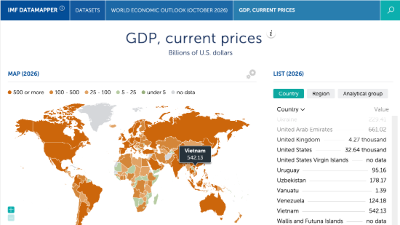
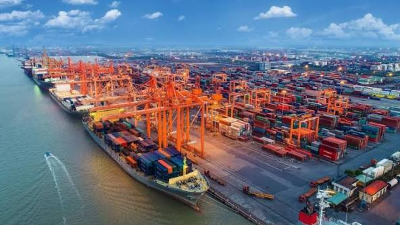
Vietnam’s nominal per capita gross domestic product (GDP) is forecasted to reach $5,259 this year, allowing the country to overtake Indonesia and climb to fifth place in ASEAN, according to the International Monetary Fund’s (IMF) October 2026 World Economic Outlook report.
The Ministry of Finance estimated that the policy would reduce budget revenue by approximately VND6,700 billion (more than $260 million) over two years.
At a government conference with localities on January 5, Prime Minister Pham Minh Chinh identified eleven risks and challenges in socio-economic activities this year, including economic restructuring, the budget deficit, bad debt risks, and inflationary pressure. He also spoke of measures to overcome difficulties and challenges, with it being necessary to continue to innovate, be creative, and take drastic and effective action.
Though inflationary pressure will be great from the beginning of 2022, with the Lunar New Year (Tet) holiday on the horizon and large-scale economic stimulus packages in place, there remains plenty of space to keep Vietnam’s CPI at below 4 per cent, economists believe. International organizations have forecast CPI of 3.5-4 per cent for the year.
According to an analyst from Mirae Asset, the economic stimulus package of nearly VND350 trillion ($15.35 billion) submitted to the National Assembly by the Ministry of Planning and Investment (MPI) will meet investors’ expectations. With the boost in public investment, even the banking sector, which has been dormant for six months, will be active again.
Four important issues the National Assembly (NA) will discuss at its extra-ordinary session on January 4 are a draft law amending and supplementing a number of laws; a draft resolution on specific mechanisms and policies for the development of the Mekong Delta’s Can Tho city; a project to develop mechanisms and policies on fiscal and monetary support; and the investment policy for the East North-South Expressway Construction Project in the 2021-2025 Period.
Minister of Education and Training Nguyen Kim Son recently chaired a session on “Vietnam’s education development strategy for the 2021-2030 period, with a vision to 2045”, setting a goal of Vietnam’s education sector reaching the region’s advanced level by 2030 and the international advanced level by 2045. The draft also outlines ten solutions for education development, including accelerating the application of information technology and digital transformation, and strengthening international integration.
At an online conference on December 29 summarizing work in the agriculture and rural development sector during 2021 and the plan for 2022, Prime Minister Pham Minh Chinh said that the agriculture, forestry, and fisheries sector needs to improve strategic forecasting to bring higher added value. Added value in the sector increased 2.85 per cent in 2021, of which agriculture rose 3.18 per cent, forestry 3.85 per cent, and fisheries 1.85 per cent. The Ministry of Agriculture and Rural Development has set a target of the sector’s total export turnover reaching $49 billion next year.