



Outbound investment has been concentrated among a small number of large Vietnamese corporations in recent times, with the regulatory and administrative framework making overseas expansion less practical for many smaller businesses. “For most of the past two decades, Vietnam’s investment story has focused on the flow of foreign capital into the country,” said Mr. Matthew Lourey, Chairman of Alitium. “That remains central to Vietnam’s growth strategy. But another part of the story is beginning to gain momentum: Vietnamese businesses investing and expanding overseas.”
Significant changes introduced this year are intended to facilitate a more practical and transparent pathway for Vietnamese investors to establish and fund operations in other countries. Vietnam recorded approximately $2.36 billion in newly-registered and additional outbound investment capital in the first seven months of 2026, or 4.5-times the amount recorded in the same period of 2025.
Investment boost
The latest report from the National Statistics Office at the Ministry of Finance shows that, in July, Vietnamese investors had 106 new overseas investment projects and added capital to 23 existing projects, investing in 17 sectors.
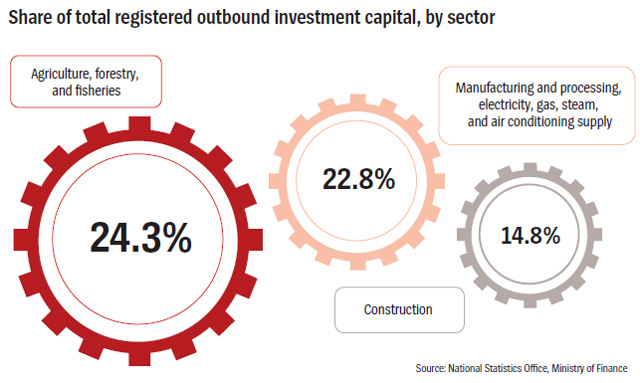
The transportation and warehousing sector led the way, with eleven new projects and registered capital of $601.69 million, accounting for 25.5 per cent of the total. The sector comprising the production and distribution of electricity, gas, hot water, steam, and air conditioning ranked second, with two new projects and total registered capital of $585.8 million, representing 24.8 per cent.
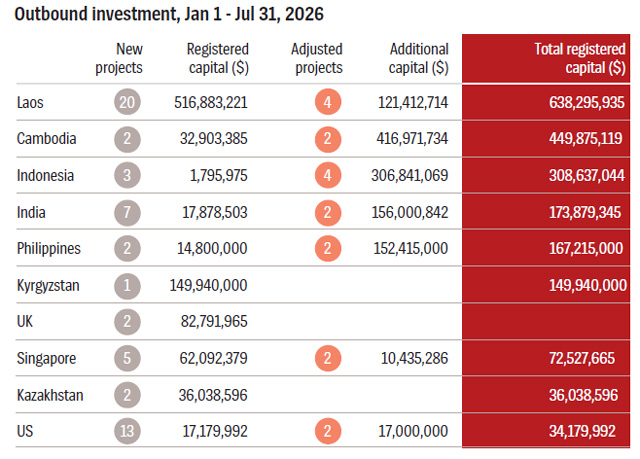
Agriculture, forestry, and fisheries ranked third, with eleven new projects and registered capital of $487.39 million, accounting for 20.6 per cent of total investment. It was followed by construction; manufacturing and processing; and wholesale and retail trade, including the repair of automobiles, motorcycles, and other motor vehicles.
Vietnamese investments in July were directed toward 35 countries and territories. Laos topped the list with 20 new investment projects and total registered capital of nearly $638.3 million. Cambodia ranked second, with two newly-licensed projects and total investment of $449.9 million.
As of July 31, 2026, Vietnam had 2,075 active outbound investment projects, concentrated primarily in the mining sector (27 per cent) and the agriculture, forestry, and fisheries sector (14.9 per cent). The leading destinations were Laos (26.9 per cent), Cambodia (12.9 per cent), and Venezuela (7 per cent), among others.
While neighboring markets like Laos and Cambodia remain important, Vietnamese businesses are increasingly establishing operations in Singapore, the UK, Kazakhstan, the Middle East, and other strategic jurisdictions that offer access to regional markets and have favorable regulatory environments and international financing.
According to Mr. Lourey, government policy is evolving alongside this trend. Politburo Resolution No. 68-NQ/TW identifies the private sector as the principal driver of economic growth, while the Go Global Program 2026-2030 aims to develop 1,000 globally-competitive Vietnamese enterprises and directly support 100 businesses undertaking large-scale overseas investment.
At the same time, Decree No.103/2026/ND-CP introduces a modernized regulatory framework designed to streamline outbound investment procedures while maintaining appropriate regulatory oversight. “This development reflects a broader shift in Vietnam’s economic story,” he said. “For much of the past four decades, success was measured by the country’s ability to attract foreign investors. Increasingly, it will also be measured by the ability of Vietnamese enterprises to compete and invest on the regional and global stage.”
Looking ahead
According to Alitium’s Vietnam Outbound Investment Guide 2026, ASEAN remains the preferred destination, selected by 65 per cent of Vietnamese businesses for expansion, with Thailand, Singapore, and Indonesia emerging as leading markets. Vietnam is the fastest-growing outbound investor by percentage terms in the region, but starts from a much smaller base.
Investment structures are expected to become increasingly sophisticated as Politburo Resolution No. 68 and the government’s Go Global Program encourage Vietnamese enterprises to internationalize. Rather than viewing overseas expansion as a series of isolated investments, businesses are likely to adopt regional platforms that allow them to scale into multiple jurisdiction, attract international capital, and manage cross-border operations more efficiently. “In this context, the choice of investment structure becomes a strategic decision, not merely a legal or tax consideration,” according to the Alitium report.
Much of outbound investment capital still comes from a relatively small group of large investors, it noted. The more interesting longer-term development, however, is the opportunity now available to a broader range of Vietnamese businesses. “Vietnam’s next stage of international growth will not only be defined by its largest corporations,” it stated. “It will also be shaped by the smaller and mid-sized businesses that take Vietnamese products, services, expertise, and brands into new markets.”
As Vietnam’s outbound investment footprint continues to expand, businesses are becoming increasingly strategic in selecting investment destinations and structuring overseas operations. Traditional markets such as Laos and Cambodia will likely remain important due to longstanding commercial relationships, while established financial centers, including Singapore and Hong Kong (China), alongside emerging gateways such as the UAE, are expected to play increasingly strategic roles.
According to Mr. Lok Kah Seng, Associate Director, Group Commercial, at Ascentium, Vietnam’s outbound investment is expected to remain on an upward trajectory as domestic enterprises continue expanding internationally. “As investment destinations become more diversified, Vietnamese companies will need to balance market opportunity with regulatory certainty, tax efficiency, and long-term operational flexibility,” he believes.
He added that Singapore and Hong Kong (China) each offer distinct institutional strengths, from financial ecosystem depth and treaty network coverage to capital market access and proximity to global investors. Both continue to serve as established platforms for Vietnamese enterprises pursuing regional and international growth. “The appropriate choice of jurisdiction will ultimately depend on each company’s strategic objectives, sectoral focus, and target markets,” he was quoted as saying. “What is clear is that Vietnamese outbound investors are becoming more deliberate and sophisticated in how they structure and locate their international operations.”







 Google translate