


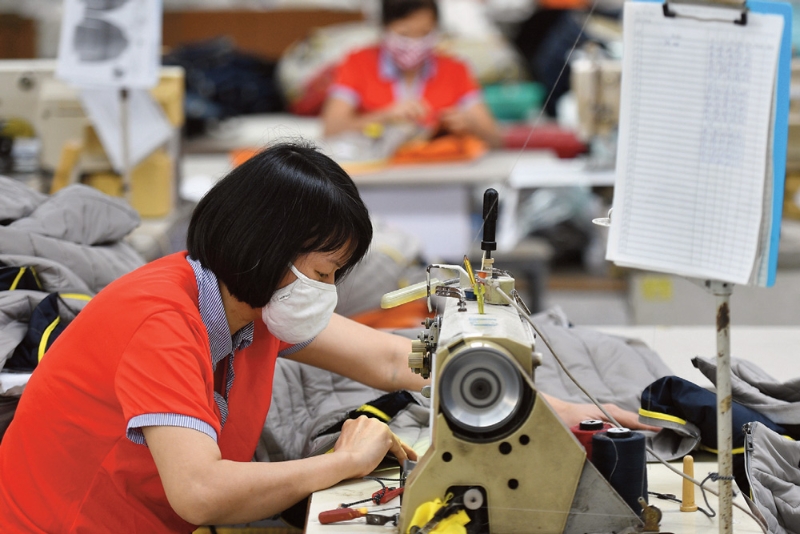
Vietnam’s three largest labor-intensive export industries are projected to have generated more than $86 billion in export turnover in 2025, accounting for 18 per cent of the country’s total exports, with textiles, garments, and footwear ranking second globally by export scale. These industries employ approximately 5.4 million workers, representing 30 per cent of Vietnam’s industrial and construction workforce, with average income per capita roughly equivalent to national GDP per capita.
Notably, the domestic value-added ratio in textiles, garments, and footwear is estimated at 45-50 per cent, or approximately $35 billion; significantly higher than in the electronics sector. The textile and garment industry alone is expected to have reached $46 billion in exports in 2025, holding the top market share in the US and maintaining an important position in other major markets.
However, from 2026 onward, these industries are expected to face significant challenges. Global trade growth is projected to remain below 2 per cent, while uncertainties such as conflict in the Middle East and US tariff policies could further dampen global economic growth. Maintaining annual export growth of over 10 per cent is increasingly unrealistic due to weak market demand and intensifying competition.
Textiles & garments
The textile and garment industry currently operates within global supply chains, encompassing seven core functions across the value chain: market planning, design, development, sourcing, manufacturing, delivery, and sales. Over the past 30 years, Vietnam’s textile and garment industry has focused mainly on garment manufacturing, while upstream materials production has remained limited.
Vietnam’s domestic value-added ratio in textile and garment products is currently estimated at 45-50 per cent, yet domestic fabric production accounts for only around 30 per cent of total demand. As a traditional industry with limited technology transfer or intellectual property barriers, textile manufacturing competes primarily on price. Vietnam has struggled to develop a competitive domestic materials industry due to weaker cost competitiveness and product diversity compared with China, which accounts for 53 per cent of global fabric production.
In practical terms, manufacturing industries have three ways to contribute to the country’s double-digit growth ambitions: achieving double-digit export growth, generating double-digit trade surplus growth, or delivering double-digit income growth for workers. However, with global demand for textiles expected to rise by only around 2 per cent annually and Vietnam now classified as an upper-middle-income economy, maintaining annual export growth above 10 per cent is no longer realistic. As a result, the textile industry effectively has only two viable paths forward: increasing the trade surplus and raising workers’ incomes at a double-digit pace.
Solution 1 is to increase domestic fabric production. To achieve double-digit growth in the trade surplus while export growth remains below 5 per cent, imports would need to continuously decline by more than 5 per cent each year. Of Vietnam’s roughly $23 billion in annual imports serving the textile and garment industry, around $17 billion consists of fabric. Therefore, reducing imports requires a substantial increase in domestic fabric production, supported by large-scale enterprises capable of competing effectively.
Solution 2 is to increase the value of logistics and sourcing services. Currently, 90 per cent of Vietnam’s textile and garment industry revenue is concentrated in manufacturing, leaving significant space for expansion across the remaining six functions of the global value chain. Increasing revenue from these additional stages would enhance the industry’s value-added without necessarily expanding production.
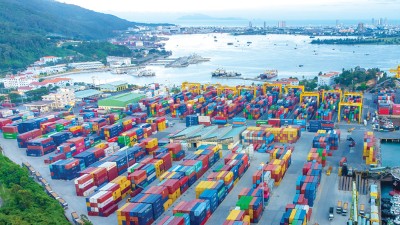
Logistics services, in particular, represent a new growth opportunity, leveraging Vietnam’s container port infrastructure alongside the rapid development of domestic digital platforms and solutions. Vietnam could provide digital logistics not only for its own textile exports but also for textile industries in Cambodia, Laos, and western China. This opportunity could be strengthened by the standard-gauge Lao Cai - Hai Phong - Quang Ninh railway currently under construction, which would shorten the transport distance from western China to seaports by nearly 1,000 km.
Solution 3 is to increase automation and reduce labor-intensity per product. Raising workers’ incomes is not only a way to contribute to substantive national growth but also a means of ensuring labor retention for enterprises. A sustainable target would be to maintain textile workers’ income at 1.3-1.5 times the gross regional domestic product (GRDP) per capita of the locality where factories are located. According to research by the World Bank, this level would support the cost of maintaining one dependent at local living standards.
Solution 4 is to establish targets and solutions for achieving Total Factor Productivity (TFP) growth above 5 per cent. In reality, export turnover per textile worker in Vietnam is currently only around 50 per cent of that in China. Domestic labor supply is expected to become increasingly constrained in the years ahead and may even decline by an average of 5 per cent annually.
Empirical studies suggest that in the textile and garment industry, labor contributes around 0.65 to productivity growth, while capital contributes approximately 0.35. Therefore, even if capital investment increases by 10 per cent annually while labor declines by 5 per cent, achieving TFP growth above 5 per cent would still require value-added or revenue growth of more than 5 per cent.
Given the difficulty of achieving such growth through conventional textile manufacturing, the industry faces mounting pressure to identify new growth pathways. These could include R&D of multifunctional advanced materials, circular materials, and strategic entry into niche sectors where large-scale global production has yet to emerge.
Policy recommendations
In line with these four solutions, the government should introduce strategic policies to incentivize businesses to act.
First, Vietnam should establish planning frameworks and incentives for large-scale raw materials production, supported by shared infrastructure and State-invested environmental treatment systems operated on a competitive fee basis. Policies should prioritize Vietnamese enterprises through long-term, low-interest financing, with investment in raw materials treated similarly to national infrastructure such as electricity, roads, airports, and ports. Preferential financing should be tied to commitments to supply the domestic market and reduce import dependence.
Second, authorities should allow existing production facilities in major cities to be converted into smart logistics hubs serving the fashion and textile industry. As part of urban restructuring, centrally-located factories could be repurposed into logistics centers, while businesses should receive incentives to invest in this transition. Support could include allowing firms to reinvest pre-corporate income tax profits and leveraging digital transformation programs from major State-owned enterprises (SOEs) such as Viettel and VNPT to provide logistics management platforms.
Third, the State should commission enterprises to research and develop new materials aligned with green transition trends and proprietary technologies. This would create new intangible value for the textile industry and reduce its reliance on pure price competition. Intellectual property rights for such technologies could remain with the State, while businesses would pay licensing fees for commercial application.
Fourth, the government should continue divesting State capital from SOEs and make the most of the next five years of growth potential driven by the flexibility of private enterprises. To 2031, opportunities will still exist to expand conventional manufacturing, making it important to unlock private sector dynamism through faster State divestment. Beyond 2035, as Vietnam develops foundational industries such as semiconductors, metallurgy, and mechanical engineering, policymakers could consider establishing new SOEs or assigning strategic mandates to technology leaders to drive innovation, equipment production, and R&D for labor-intensive sectors.
Across East Asia, industrialization and the transition to high-income status in the 20th century generally began with labor-intensive, export-oriented industries that generated foreign exchange and provided higher-paying industrial jobs than agriculture. However, after around 30 years of development, most countries saw these sectors gradually decline in scale. China remains an exception, having leveraged economies of scale and timely technology adoption to transform industries such as textiles into more advanced production sectors rather than conventionally labor-intensive industries.
By improving productivity, reducing labor requirements per unit of output, and expanding participation across the textile value chain, China’s textile industry has remained competitive and continues contributing to growth despite the country’s high-income status. This offers an important lesson for Vietnam’s long-term strategy: rather than abandoning traditional labor-intensive sectors, the country should upgrade them into competitive industries suited to a higher-income economy through digital technologies, automation, and early adaptation to green transition trends.


 Google translate