


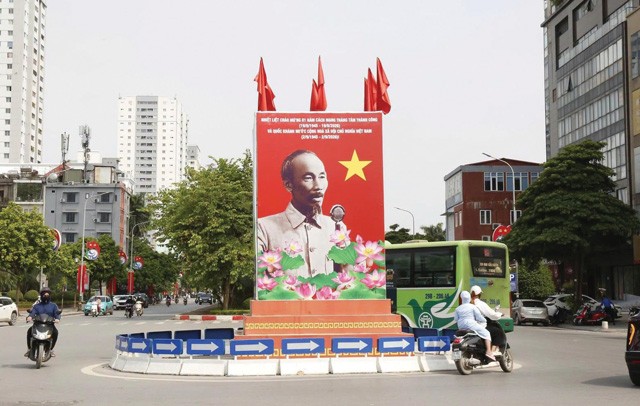
The 1945 August Revolution, which involved millions of people in a general uprising for national independence under the leadership of the Communist Party of Vietnam, then headed by President Ho Chi Minh, successfully ended in late August of that year, and all power belonged to the working class and farmers as a result.
Looking back at the history of the Vietnamese nation in its national establishment, construction, and defense, we can see that the success of the revolution has since stood as a profound testament to the wise leadership of the Party and its leader, Nguyen Ai Quoc, later known as Ho Chi Minh.
The Party at that time was only 15 years old and had only some 5,000 members, while the Vietnamese people, the majority of whom were poor farmers, had suffered oppression and exploitation for over 80 years under the colonial rule of the French and then the Japanese fascists. In such a difficult situation, when the opportunity arose, they seized it and successfully carried out the general uprising to claim power across the country in a very short time. (By August 19, 1945, when the uprising succeeded in Hanoi, it had only taken six days since midnight on August 13, when the Insurrection Committee issued Military Order No. 1).
Party vision and leadership
In August 1945, as World War II was coming to an end, the Japanese fascists, who were occupying Vietnam and many other Asian countries at the time, were forced to surrender to the Allies, creating a once-in-a-thousand-year opportunity for the Vietnamese people to rise up and reclaim independence.
The success of the August Revolution was primarily due to the vision of the Party Central Committee and President Ho Chi Minh, who knew how to seize the opportunity brought about by the Allies’ victory in World War II.
However, the most decisive factor for the success of the Revolution was the leadership role of the Communist Party of Vietnam, a Party that always placed the interests of the nation and the people above all else, relied on the people, and understood their aspirations for independence and freedom.
Thus, despite having very few members compared to the entire population at that time, the Party still garnered trust from the people, and therefore could successfully mobilize and unite the entire nation in the struggle for national independence.
During the August Revolution, in Phu Luu commune, for instance, which at that time belonged to Ung Hoa district, Ha Dong province (now Hanoi), a teacher who was the sole Party member in his commune, mobilized hundreds of people to march to the district town to participate in the uprising to seize power, under the direct guidance of Mr. Do Muoi who was then assigned by the Ha Dong Provincial Party Committee to oversee the revolutionary movement in the southern regions of Ung Hoa and My Duc districts, and later, during the 1991-1997 period, became General Secretary of the Communist Party of Vietnam.
The ability of just one Party member to mobilize hundreds of enthusiastic and voluntary participants in the uprising, as seen in Phu Luu commune and many other localities, reflected the fact that the people had absolutely trust in the Party and had shown their unwavering support for it. Without such trust and support, one Party member could not persuade anyone to take part in an uprising full of hardship and deadly danger.
The successful August Revolution was the first significant victory of the Vietnamese nation under the leadership of the Communist Party of Vietnam, marking a pivotal moment in Vietnamese history. It illustrated the Party’s determination and strategic acumen as it charted a revolutionary course with foresight, adaptability, and precise timing to ensure success. This victory remains one of the most remarkable achievements of the Party and the Vietnamese people in their decades-long struggle for national independence and liberation.
Moreover, the success of the August Revolution was a prerequisite, a condition, and an important legal basis for the Party to successfully organize the Independence Declaration Ceremony in Hanoi, with tens of thousands in attendance, on September 2, 1945, where President Ho Chi Minh solemnly read the Declaration of Independence, affirming to the nation and the world the newly-gained independence of Vietnam and officially announcing the establishment of the Democratic Republic of Vietnam.
September 2 then officially became the National Day of the Democratic Republic of Vietnam, now the Socialist Republic of Vietnam.
Monumental significance of the Revolution
The victory of the August Revolution and the profound significance of September 2 that year have always been associated with the name of President Ho Chi Minh and have entered the national history as one of its most brilliant milestones.
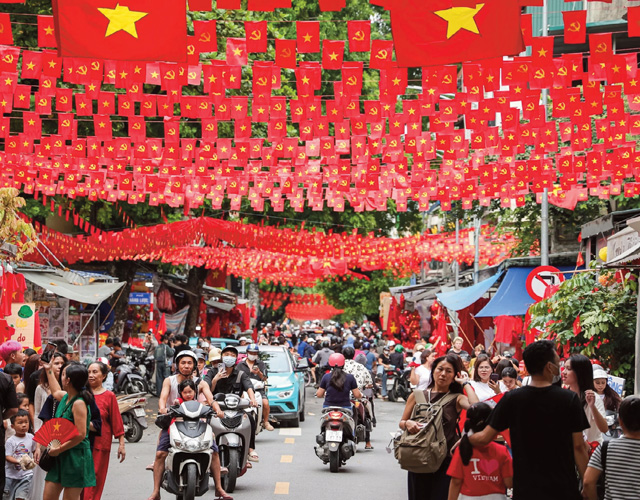
Victory marked the culmination of national unity, patriotism, and the indomitable will of the entire Vietnamese people, who voluntarily joined the revolution under the Party’s leadership. It demonstrated the Party’s resolve and intellect in choosing the correct revolutionary path.
The August Revolution opened a new era - an era of independence and freedom - for the nation, thus creating a solid foundation for the Vietnamese people to successfully conduct their continuous struggles for national liberation and defense until the final victory in Spring 1975.
Victory in the August Revolution as well as the successful later struggles of the Vietnamese people against all foreign aggressors paved the way for Vietnam to rebuild the country, thus making significant achievements in efforts for sustainable socio-economic development.
After more than 40 years of implementing the “Doi Moi” (Economic Renewal) policy initiated and led by the Party, Vietnam has continued to develop. From being one of the 20 poorest countries in the world in the mid-1980s, the country has strived to overcome difficulties and became one of the 32 largest economies in the world by 2025, with an economic scale nearly 100-times larger than in 1986. It also ranked among the 20 countries with the largest trade volume in the world, and was among the Top 20 economies attracting the most foreign investment capital since 2019. Later, on July 1, 2026, the World Bank officially classified Vietnam as an upper-middle income country, as its gross national income (GNI) per capita increased from $4,490 in 2024 to $4,970 in 2025.
These achievements in socio-economic development not only bring prosperity to the country and a happy, prosperous life for the people but also contribute to enhancing Vietnam’s international standing and prestige.
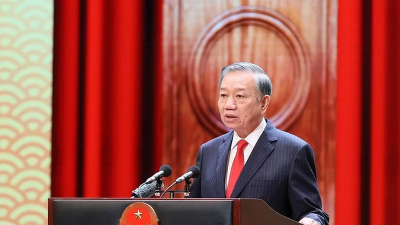
In his speech at the 14th National Congress of the Party in January 2026, Party General Secretary and State President To Lam affirmed: “After 40 years of implementing Doi Moi, our country has achieved significant, comprehensive, and historically-meaningful accomplishments, continually improving the lives and happiness of the people and enhancing the country’s prestige and position on the international stage.”
Thus, all of the abovementioned victories and achievements stemmed from the August Revolution, and will serve as a solid foundation for Vietnam to enter a new era of development, as outlined by the 14th National Congress of the Party, aiming to become a developing nation with modern industry and upper-middle incomes by 2030, and a developed, high-income country by 2045, when the 100th anniversary of the Party and the 100th anniversary of the August Revolution and the Democratic Republic of Vietnam will be celebrated.



 Google translate