


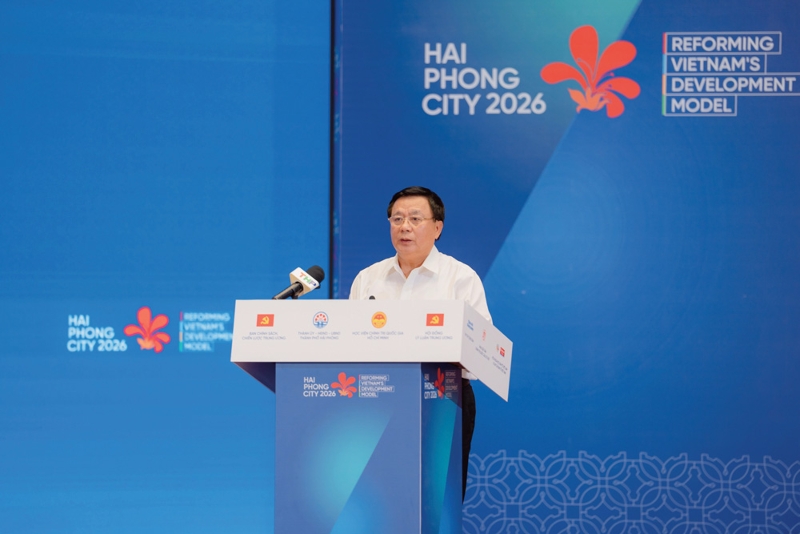
After 40 years of “Doi Moi” (Economic Renewal), shaped by both domestic experience and adaptation to global trends, Vietnam has gradually developed a distinctive development model grounded in its steadfast commitment to national independence and socialism. This model places people at the center, promotes inclusive and sustainable development, and seeks to ensure that no one is left behind. In this framework, citizens are not only beneficiaries of development but also active participants in creating its outcomes.
At the same time, this model has defined Vietnam’s unique development path in the 21st century, reflected in the balance between continuity and innovation; stability and growth; rapid development and sustainability; economic progress and social equity; independence and self-reliance alongside international integration; a modern market economy with a socialist orientation; and modernization combined with the preservation of national identity and cultural values.
Beyond the limits
At the heart of any development model lies its growth model. For many years, Vietnam’s growth relied primarily on capital, natural resources, and low-skilled labor. However, at the 14th National Party Congress, the Party called for a decisive shift away from a model driven mainly by capital, resources, and cheap labor toward one powered by science and technology, innovation, digital transformation, high-quality human resources, and modern governance capacity.
Yet a new growth model answers only part of the equation: how the economy grows, what its main drivers are, and the role of economic actors. It does not fully address broader questions such as growth for what purpose, for whom, and according to which social values. Nor does it determine the place of human development, happiness, citizen satisfaction, culture, society, and the environment in the development process.
For this reason, countries are increasingly focusing on defining broader development models. The ultimate aim of development is not limited to GDP size, GDP per capita, growth rates, or labor productivity, but also includes improving quality of life, expanding opportunities, and enhancing people’s well-being.
A development model cannot be separated from the political and social model, as the latter shapes the values and long-term goals of development. In Vietnam, this is reflected in a socialist model built on three pillars: a socialist-oriented market economy; a socialist rule-of-law State of the people, by the people, and for the people; and socialist democracy under the leadership of the Party.
Vietnam’s growth model, development model, and socialist model are often viewed as three concentric circles, closely linked and mutually reinforcing. Reforming the development model therefore goes far beyond changing the economic growth model. It also provides a foundation for further refining Vietnam’s socialist model and shaping its long-term development path.
In an increasingly complex and unpredictable world, reforming the development model is also seen as essential for Vietnam to move beyond the limitations of outdated growth thinking, create new drivers of development, and strengthen the country’s strategic autonomy and resilience.
Shaping a new model
In the new development model, people are simultaneously the objective, resource, and most important internal driver of development. This requires the comprehensive development of a new generation of Vietnamese citizens in the 21st century - individuals with patriotism, civic awareness, respect for the rule of law, digital skills, innovative thinking, lifelong learning capacity, and a strong sense of cultural identity and contribution.
Inclusive, people-centered development is identified as a guiding principle of rapid and sustainable growth. Development goals will therefore go beyond reducing income poverty to addressing multidimensional poverty and ensuring equitable access to education, healthcare, employment, and digital skills.
Within this framework, investment in education, science, healthcare, culture, and social welfare is viewed as a strategic investment in the future. Culture, meanwhile, must become a genuine regulator of development, an internal resource, and a source of national soft power. It plays an important role in fostering social trust, ethics, identity, creativity, and national adaptability.
In the digital era, culture not only helps shield society from fragmentation and distortions, but also creates new opportunities for cultural industries, the creative economy, tourism, media, and the promotion of Vietnam’s global image.
At the same time, green growth is no longer optional but a necessity. However, the green transition must be implemented in a socially-equitable way, ensuring that adjustment costs do not disproportionately burden low-income groups, small businesses, or vulnerable communities.
The new development model, built on science and technology, innovation, and digital transformation, is envisioned as one that fully integrates cultural, social, and human development with economic growth, social progress, equity, environmental protection, and adaptation to major global shifts such as digital and green transitions, energy transformation, workforce upgrading, and new governance models.
At the same time, Vietnam must deepen international integration in both scope and quality, gradually building a new development ecosystem to support the country’s next phase of growth.
Turning institutions into competitiveness
The documents of the 14th National Party Congress set out an important principle: to “strengthen strategic autonomy, establish a new development model, use development to maintain stability, and use stability to promote rapid and sustainable growth while improving people’s well-being and happiness.”
This idea of “development for stability, stability for development” is seen as a defining feature of Vietnam’s development approach. Development builds national strength and creates conditions for safeguarding the country, while stability provides the secure environment needed for innovation and long-term progress.
In an increasingly fragmented and competitive world, strategic autonomy is viewed as essential to sustainable development. This extends beyond institutional and macro-economic independence to include autonomy in technology, data, energy, food, defense, security, and foreign affairs.
At the same time, strategic autonomy does not mean isolation. Rather, it calls for deeper international integration that is smarter, more diversified, and supported by stronger domestic capabilities.
Throughout this process, the Party’s leadership is regarded as the decisive factor in safeguarding socialist orientation and guiding reform. This leadership must go beyond sound policymaking to include stronger strategic foresight, better institutional capacity, more effective implementation, and stronger oversight.
Development leadership must be accompanied by improved governance capacity, more modern and transparent institutions, stronger democracy, intensified anti-corruption efforts, and greater accountability across the governance system.
In the new development model, the State is expected to act as a socialist rule-of-law State that enables development, serves citizens and businesses, and governs with integrity. Rather than replacing the market, the State should proactively build institutions, infrastructure, data systems, and a fair competitive environment while ensuring social equity and addressing market failures.
This also requires a shift from traditional State administration toward development governance, creating more room for innovation and experimentation. In this approach, institutions are no longer merely tools of management but a source of national competitive advantage.
Against this backdrop, discussions at the recent national scientific conference in Hai Phong are expected to deepen around reforming Vietnam’s development model through science, technology, innovation, and digital transformation.
A key priority is identifying both the opportunities and challenges these forces present, particularly in linking economic growth with social progress, equity, human development, and environmental protection, while also improving productivity, governance, and living standards.
Additionally,serious attention must be given to challenges related to institutional quality, technology absorption, workforce capabilities, digital infrastructure, data systems, cybersecurity, and the risk of falling behind or widening inequalities during digital transformation.
Another priority is learning from international experience in development models, drawing lessons from both successes and failures that may offer useful guidance for Vietnam.
Equally important is clarifying the relationship between Vietnam’s growth model, development model, and socialist model; establishing criteria to assess the new development framework; and proposing solutions to strengthen institutions and the broader ecosystem for rapid and sustainable growth.
Beyond defining development priorities, the next challenge is implementation: ensuring that science and technology, innovation, and digital transformation become measurable drivers of growth across industries, localities, businesses, and public institutions.
Further research is also needed on how to design institutions that encourage innovation while managing risks effectively, and how to build evaluation systems that go beyond GDP growth to reflect productivity, quality of life, public service quality, social equity, cultural vitality, and national resilience.


 Google translate