


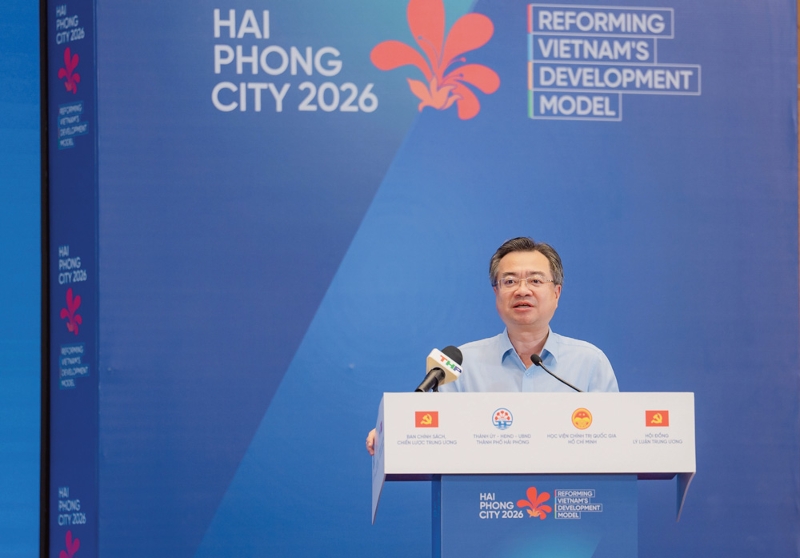
As the Party and people intensify efforts to implement resolutions from the 14th National Party Congress, with the goal of transforming Vietnam into a developed, high-income, peaceful, independent, democratic, prosperous, civilized, and happy nation by 2045 while steadily advancing toward socialism, and as the Central Commission for Policy and Strategy leads the formulation of the “Reforming Vietnam’s Development Model Based on Science, Technology, Innovation, and Digital Transformation” project, for submission to the Party Central Committee at its third session, the national scientific conference on this theme was convened as an important academic forum to strengthen both the theoretical and practical foundations for strategic policymaking in the country’s new development phase.
Driving transformation
After nearly 40 years of “Doi Moi” (Economic Renewal), Vietnam’s development model has gradually evolved, been refined, and improved through successive stages, as reflected consistently in Party documents. Under the Party’s leadership, the country has achieved significant and historic accomplishments, laying a vital foundation for the next phase of development.
From a low-income economy, Vietnam has emerged as one of the world’s most dynamic and fastest-growing economies, ranking 32nd globally in GDP size in 2025 and among the world’s Top 15 trading nations. Income per capita has risen substantially, living standards have steadily improved, and Vietnam’s international standing and reputation continue to strengthen.
However, as the country enters a new development phase, the current growth model is revealing mounting limitations. Growth remains heavily dependent on capital, labor, and natural resource extraction, while productivity, quality, and competitiveness remain constrained. Innovation capacity and technological mastery also remain limited. At the same time, national and social governance, inter-sectoral coordination, and data-driven governance have yet to keep pace with the demands of digital development and the digital economy. Defense, security, foreign affairs, and international integration likewise require further reform to meet new development challenges.
Alongside these domestic constraints, the global environment is changing rapidly under the impact of emerging digital technologies. Breakthroughs in AI, big data, cloud computing, and the Internet of Things (IoT) are fundamentally reshaping production methods as well as models of national, sectoral, and corporate governance. Competition between countries increasingly depends on innovation capacity, technological sophistication, and the quality of human resources. As a result, science, technology, and innovation are no longer merely economic drivers, but have become the foundation of national competitiveness, strategic autonomy, and development security.
Major trends in science, technology, innovation, and digital transformation are profoundly reshaping development models, economic and social structures, governance approaches, and national competitiveness. The challenge is not merely adapting to change, but proactively creating new capabilities, growth drivers, and development spaces.
Against this backdrop, reforming Vietnam’s development model based on science, technology, innovation, and digital transformation is not only an objective necessity but a strategic choice that will shape the country’s future. This is not simply an adjustment of the development model, but a comprehensive transformation of the national development approach to generate new growth drivers, raise labor productivity and national competitiveness, and strengthen strategic autonomy and national resilience.
Primary drivers of a new development model
The documents from the 14th National Party Congress reaffirm the need to reform Vietnam’s development model under a modern, green, digital, and knowledge-based approach, with science, technology, innovation, and digital transformation serving as the primary drivers of rapid and sustainable growth. This vision also includes the development of a digital economy, digital society, and digital citizenship; the creation of a national innovation ecosystem; the establishment of high-tech and strategic industries alongside globally-competitive Vietnamese technology companies; the development of high-quality human resources; and the modernization, digitalization, transparency, and efficiency of national governance.
Party General Secretary and State President To Lam has repeatedly emphasized that Vietnam is standing before a historic opportunity to enter the “era of the nation’s rise.” In this new phase of development, Vietnam must fundamentally reform its development model by placing science, technology, innovation, and digital transformation at the core of growth, while building development on knowledge, technology, data, and the capabilities of the Vietnamese people. At the same time, the country must strengthen an independent and self-reliant economy integrated deeply and effectively into the global system.
This path is also seen as essential to realizing Vietnam’s aspiration of becoming a peaceful, independent, democratic, prosperous, civilized, and happy nation, where people enjoy prosperous and fulfilling lives and the country develops rapidly and sustainably while advancing steadily toward socialism.
In shaping a new development model, the first priority is to clarify the theoretical foundations of Vietnam’s development model for the new era; comprehensively assess the achievements, limitations, and bottlenecks of the current model; and identify emerging global trends and new requirements facing Vietnam.
A key priority is conducting a comprehensive review of Vietnam’s development model across different periods, clearly identifying achievements, limitations, bottlenecks, and their root causes, particularly institutional, technological, data-related, and human resource barriers. This also requires in-depth analysis of implementation outcomes and gaps between actual results and the goals established in Party and State documents across economic, social, cultural, environmental, defense, security, foreign affairs, and international integration policies.
At the same time, deeper analysis is needed of international developments and emerging trends, particularly technological competition, the green transition, digital transformation, rapid and sustainable growth requirements, and Vietnam’s 2045 development targets, in order to identify opportunities, development space, and challenges for the coming period.
Another major priority is proposing the philosophy, structure, and pillars of the new development model, while clarifying the central role of science, technology, innovation, and digital transformation in creating new growth drivers, enhancing labor productivity, strengthening competitiveness, and reinforcing national strategic autonomy.
At the same time, reforming the development model must deliver structural breakthroughs that ensure rapid, sustainable, inclusive, self-reliant, and strategically-autonomous growth, in which today’s development does not undermine the foundations for tomorrow or diminish resources for future generations.
Within this framework, all citizens must benefit from development outcomes, while economic progress must advance alongside cultural and social development, environmental protection, national defense and security, and stronger foreign relations and international integration.
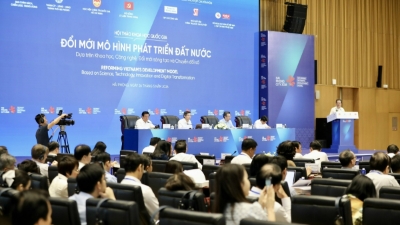
A national scientific conference with the theme “Reforming Vietnam’s Development Model Based on Science, Technology, Innovation, and Digital Transformation,” co-hosted in Hai Phong on May 26 by the Central Commission for Policy and Strategy, the Hai Phong City Party Committee, People’s Council, and People’s Committee, the Ho Chi Minh National Academy of Politics, and the Central Theoretical Council, and co-organized by Communist Review, the National Political Publishing House, the Vietnam Economic Association, and Vietnam Economic Times / VnEconomy, attracted significant attention from leaders, managers, research institutions, policy-making bodies, the business community, domestic experts and scientists, and international delegates.







 Google translate