


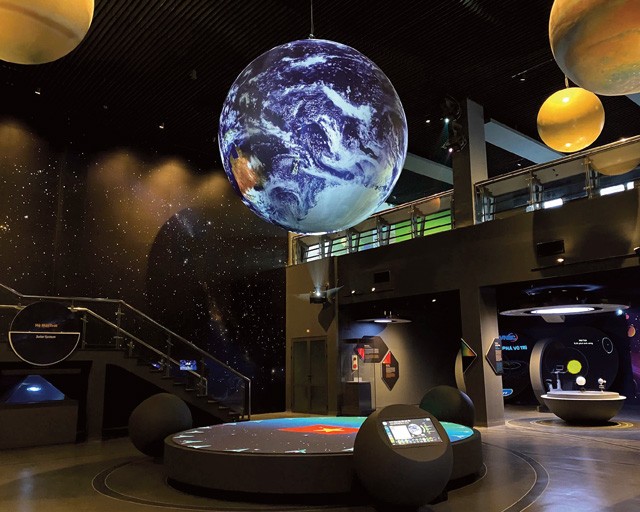
Major economies have increasingly viewed the space economy and the low-altitude economy in recent years as new sources of economic growth. The World Economic Forum forecast that the global space economy could grow from about $630 billion in 2023 to approximately $1.8 trillion by 2035; an increase of nearly 300 per cent and highlighting how growth could outpace many existing economic sectors.
Against this backdrop, as Vietnam targets annual double-digit economic growth, the development of the space and low-altitude economies could provide a powerful new growth driver, according to Professor Hoang Van Cuong, former Deputy to the 14th and 15th National Assemblies and Vice President of the Vietnam Economic Association.
Driving GDP growth
The first possible impact lies in the formation of a high-tech production and services ecosystem. The space economy is not simply about manufacturing equipment or components, but also requires capabilities in technological development, software, data, and other areas.
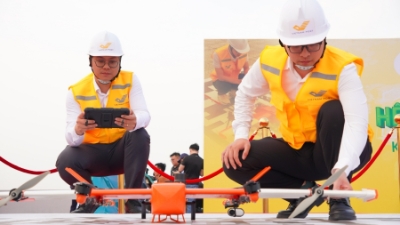
Second, the value generated by the space economy is not limited to the revenue of equipment manufacturers or service providers. It also comes from the ability to raise productivity, expand operational capabilities, and reduce costs for industries using these technologies. For example, an unmanned aerial vehicle (UAV) generates value not only through commercial sales but also by addressing a wide range of challenges across transportation, logistics, urban security, and agricultural production.
In the UK, the space economy’s direct contribution is currently estimated at £7 billion-£7.2 billion ($9.5 billion-$9.8 billion), equivalent to about 0.3 per cent of its GDP. More significantly, a study by PwC in cooperation with the UK Government found that the use of UAVs across the economy could generate approximately £454 billion ($615 billion) in economic value by 2030, equivalent to 18 per cent of GDP.
This suggests that if the space economy is viewed only through the revenue generated by businesses in the sector, its contribution may not appear significant, but as the technology becomes more widely adopted in logistics, agriculture, transportation, urban management, security, and production, its spillover effects could be many times greater.
The third possible impact is the formation of a new business ecosystem. For a UAV or low-altitude system to operate effectively requires the participation of businesses across multiple fields, including in hardware, software, telecommunications, data, AI, logistics, and operational services.
The development of the space and low-altitude economies could therefore foster new business links and ecosystems. “When an ecosystem is formed, opportunities are not limited to large companies but also open to many startups participating in different stages of the value chain,” Professor Cuong said.
Finally, the space and low-altitude economies are also expected to have a direct impact on labor productivity and Vietnam’s employment structure. The development of such sectors could create new jobs, particularly those requiring advanced technological, engineering, and professional skills, accelerating the shift toward occupations with higher levels of knowledge and value-added.
As traditional areas of economic growth face increasing constraints, expanding into low-altitude space is not simply about finding a new market; it also means opening up a new “economic space” to generate resources, jobs, technology, and additional value for the economy. “This is also consistent with Vietnam’s need to transform its growth model, moving from an economy heavily dependent on processing and assembly toward one driven by technology, knowledge, and innovation,” Professor Cuong added.
Impact in Vietnam
Professor Cuong believes that when setting development goals for the space and low-altitude economies, Vietnam should not focus solely on the direct revenue or value-added generated by businesses in the sector, such as revenue from commercialized UAVs or satellite leasing services. “We should not set a target for this direct contribution to account for a certain percentage of GDP,” he emphasized. “If that is the only target, it may not represent what we ultimately want to achieve.”
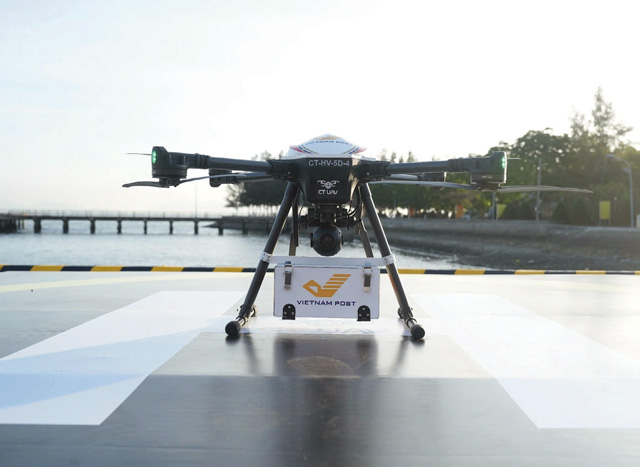
Instead, a more important objective lies in the spillover effects that the space economy can generate across the broader economy. Activities in low-altitude and outer space should be viewed as technological infrastructure capable of changing how other industries operate and improving their efficiency.
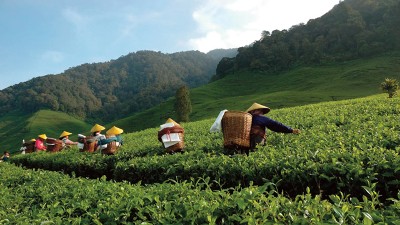
In agriculture, for example, data and equipment from space can support smart farming, production monitoring, and more efficient resource management. In disaster prevention and response, space technologies can assist with monitoring, forecasting, and proactive response. Similarly, the management and utilization of marine resources can be improved through data and remote-sensing technologies.
Colonel and Associate Professor Nguyen Huy Hoang from the Military Technical Academy said that, while developing a strategy for a low-altitude economic ecosystem in southern Tay Ninh province, a survey team assessed the use of UAVs by RTR in rubber plantation management. For a roughly five-hectare plantation of young rubber trees, manually counting dead trees could take workers two to three days. Using a UAV, however, the survey time was reduced to about 12 minutes, allowing data on the number of dead trees to be collected rapidly.
In another case, the survey team examined a ten-hectare rubber plantation with trees approximately three years old to assess the proportion that had developed all three leaf layers. This is important data for identifying slow-growing trees and developing appropriate care regimes, helping the plantation develop more uniformly.
For mature rubber trees - approximately eight years old and already in the harvesting stage - UAVs have also demonstrated significant efficiency in measuring and assessing tree diameters. According to the research team’s survey results, work productivity using UAVs can be about five-times higher than conventional manual methods.
In the central highlands’ Lam Dong province, where local authorities are developing a plan for the low-altitude economy, one business is using UAVs to spray crop protection products, with tanks holding about 200 liters. The cost per tank ranges from VND600,000 to VND700,000 ($23 to $27), depending on the type of pesticide or fertilizer used.
Using manual labor, one worker could take about three days to complete an equivalent task. At a labor cost of around VND700,000 ($27) per day, a plantation owner could spend approximately VND2.1 million ($81). By comparison, using a UAV costs only about VND600,000 to VND700,000 ($23 to $27) for the same amount of work, with the entire process from preparation to completion taking roughly one hour.
These practical examples illustrate why experts argue that the value of the low-altitude economy is not generated solely within the sector itself, but is amplified across the broader economy. The contribution of the space and low-altitude economies to GDP growth should therefore not be measured only by the additional revenue generated by UAVs, satellites, or space services, but should also take into account how much the ecosystem can help other industries reduce costs, improve productivity, create new occupations, and develop new value chains.





 Google translate