


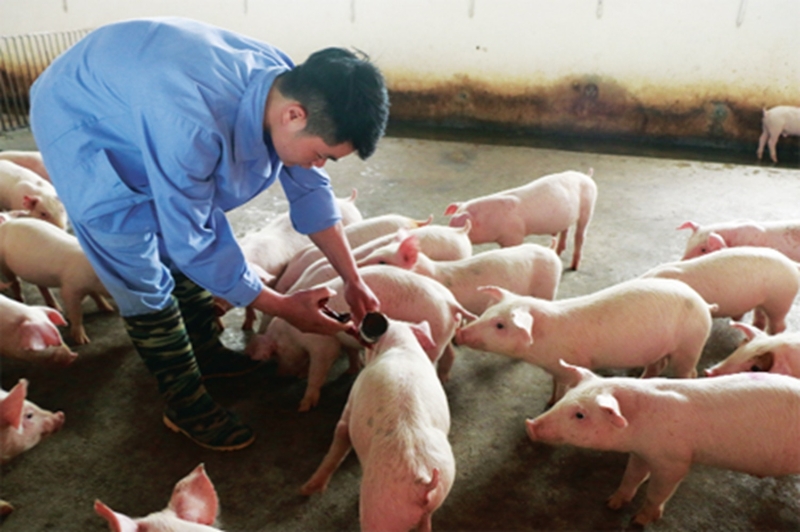
On a six-hectare farm near the headwaters of the Cong River in Pho Yen ward, northern Thai Nguyen province, farmer Tran Xuan Phong has run a commercial pig operation raising 4,000 heads per cycle since 2018, with two cycles a year, equivalent to around 1,000 tons of pork annually. Prior to adopting new technology, he said, his farm had long used biogas digesters but was unable to process all the waste generated. As a result, excess pig waste was discharged into the environment, while methane gas was burned off in an attempt to control the odor.
It wasn’t until early 2024 that Mr. Phong was introduced to a definitive solution to the persistent odor and waste problems: generating electricity using biogas collected from the farm’s manure pits. In addition to greatly reducing the significant environmental damage caused by his farm, he sees that producing electricity onsite using a biogas generator has significantly reduced his operating costs, to roughly half the cost of power purchased from Vietnam Electricity (EVN).
Building trust
Mr. Phong’s success in transitioning his farm to biogas-fueled energy was matched by nearly 100 farms in 24 provinces equipped with biogas-powered generators under the “Bioenergy on commercial farms” project, part of the Australian Government’s Business Partnerships Platform (BPP) in Vietnam.
Funding from the program has supported local companies in developing biogas generators for rental to farms. In partnership with private Vietnamese firms, the project has helped pig farms nationwide convert surplus biogas into affordable renewable electricity since 2021.
Australia has invested A$9.4 million ($6.12 million) through the BPP in Vietnam since 2016, supporting 16 private-sector partners focused on climate action, sustainable carbon markets, and inclusive livelihoods, particularly for women and people with disabilities.
By the time the project concluded in December 2024, it had helped install 120 biogas generators at 98 farms, processed over 3.2 million tons of manure annually, generated more than 16,800 MWh of clean electricity, and created more than 500 jobs, including training a new generation of biogas technicians and operators.
According to Ms. Nguyen Thi Quynh Huong, Project Manager at the Netherlands Development Organisation (SNV) - the project’s technical advisor - the key to its success has been the generator-rental model, called ESCO. Traditionally, companies sold generators directly to farms, but the ESCO approach has demonstrated both the technology’s reliability and the economic viability of biogas power.
In the past, Vietnam’s national biogas program also promoted the use of generators, but many systems malfunctioned or broke down within one or two years of operation, eroding farmers’ trust. The ESCO model addresses this by assisting partner companies like E-Green or Chinh Phat Machinery to invest in and rent out generators at farms that already have biogas storage and processing infrastructure. Before biogas-power technology was available, farms could only burn excess gas or release it directly, which is a major source of methane - a potent greenhouse gas making up about 70 per cent of biogas.
Furthermore, under the ESCO model, biogas electricity remains cheaper than EVN rates even during off-peak hours. After three years of implementation, many farms have shown a strong interest, with some choosing to purchase the generator outright after renting.
Mr. Tong Anh Chinh, CEO of Chinh Phat Machinery, one of the project’s partners, explained that, in the past, farms had no choice but to burn or release biogas. Open-air burning only reaches about 700°C, however, far below the 1,400°C required to fully combust carbon components. Inside generator combustion chambers, however, with a pressure of 10 psi, temperatures can reach 1,800-2,000°C, ensuring much cleaner combustion.
Each generator system costs about VND400-500 million ($15,165-$18,955), only some 15 per cent more than diesel generators. Farms that combine biogas and solar-power systems, thereby further reducing reliance on the grid, may have to outlay around VND600 million ($22,745).
With proper maintenance and a stable biogas supply, generators can run 18-20 hours a day. This model is effective for large-scale farms with at least 3,000 pigs, with farms of 15,000 or more with well-maintained, large-scale digesters, cutting monthly electricity costs by 90-95 per cent. Agreeing, Mr. Phong said that with a properly-maintained generator and a healthy supply of biogas, a farm of his size can recover its investment only 18 months after installation.
Looking ahead, Mr. Chinh emphasized that with continued improvements, biogas generators could also be adapted for use on dairy farms, where milking systems costing VND200-300 billion ($7.69-$11.54 million) require a highly-stable power supply - one of the main challenges in scaling up biogas power. This will open a whole new avenue of development for private companies and start-ups in Vietnam to focus on this technology. Indeed, the BPP project has encouraged Vietnamese generator suppliers to shift from diesel to biogas technology, with Chinh Phat, for example, now earning 70 per cent of its revenue from this segment, compared to almost none previously.
Though 40-50 per cent of hardware components must still be imported, by working with experts at the Hanoi University of Science and Technology, Vietnamese businesses like Chinh Phat have already become self-reliant in key components such as control software and power-quality monitoring systems. While domestic generators cannot yet match US or Japanese equivalents, Mr. Chinh noted that locally-assembled biogas units have proven stable and reliable enough for potential export within Southeast Asia. In the short term, the company aims to expand into Laos and Cambodia.
Explosive expansion needed
Though the use of biogas for power generation at livestock farms in Vietnam has seen some early success, Ms. Huong noted that biogas-powered electricity is currently applied at only around 60 per cent of farms nationwide, leaving vast space for expansion, especially as the government moves to industrialize the livestock sector and gradually phase out small household-scale farming to ensure quality, scale up production, and minimize the environmental impact. In particular, the southern region, home to many large-scale farms, has yet to tap into most of its biogas power-generation potential.
According to Ms. Huong, there are two main reasons why the shift towards biogas-powered electricity has not yet taken off around the country. First, in addition to investing in generators, farms must also put money into building standard-compliant waste-treatment and storage systems to ensure a stable supply of biogas. This creates a cost barrier that makes many farmers hesitate before adopting biogas power generation. Financial support from both the government and international organizations is needed to scale up this model, reduce upfront investment costs and help farms develop a circular-economy approach.
Second, farm owners must still weigh their livestock development strategies. Major livestock corporations operating in Vietnam, such as De Heus, CP, and Hoa Phat, directly own only a handful of large farms and rely heavily on contracted farms. Yet many of these contracted farm owners still do not recognize that they should be required to install biogas generators rather than simply burning off excess gas. This stems from the fact that regulatory authorities have not yet strictly enforced emissions controls at livestock farms.
Ms. Huong expressed hope that State management agencies would introduce stricter regulations to steer the livestock sector towards a more circular model and prevent cases in which some farms continue to discharge waste directly into the environment.

![[Interactive]: Economic overview - September 2026](https://premedia.vneconomy.vn/files/uploads/2026/10/06/9e0f403040dd4384ad690004bc1911ab-124594.png?w=400&h=225&mode=crop)



 Google translate