


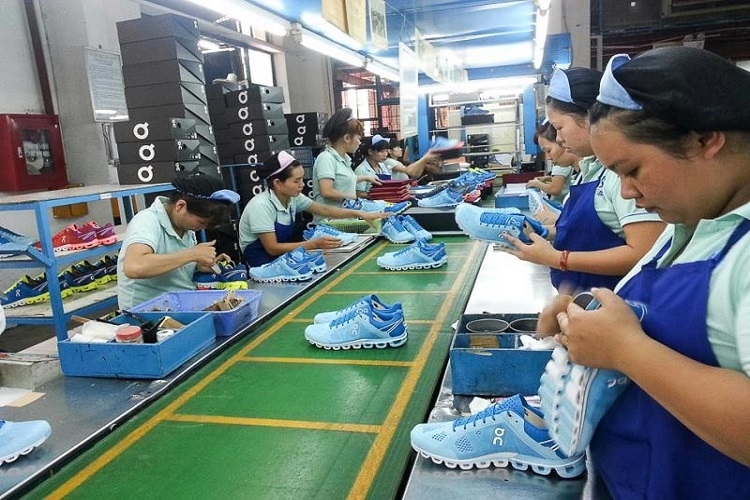
Data for 2024 shows that Vietnam remained the world’s second-largest footwear exporter during the year, with more than $20 billion worth, trailing only China. Despite its position, however, Vietnam faces mounting risks from trade remedies employed in major global markets. To avoid losing momentum, experts believe enterprises must strengthen their response capabilities, improve data transparency, and ensure full compliance with rules of origin.
Rising trade risks
Vietnam’s total footwear export turnover in the first half of 2025 stood at roughly $14 billion, including $12 billion from footwear and about $2 billion from handbags and other leather goods. This marks a 10.1 per cent increase from the same period of 2024.
Vietnam’s key export markets include the EU, the US, and several Asian economies such as China, South Korea, and Japan. The US and the EU are the two largest destinations, but they are also the most likely to impose trade remedies on Vietnamese leather and footwear items.
According to Mr. Pham Phu Dung, Director of the Training Center at the Vietnam Leather and Shoe Research Institute, the industry faces not only challenges related to sustainable development, compliance costs, and the ability to secure its own supply of materials, but also limitations in science and technology applications and R&D.
The industry frequently confronts the risk of trade remedies imposed by major importing markets, including anti-dumping, anti-subsidy, and safeguard actions, as well as tightening standards on sustainability and traceability.
He noted that protectionist trends are rising in many major markets for leather and footwear products, such as the US and the EU, leading to the increased use of trade-remedies. For example, the EU imposed anti-dumping duties on leather shoes beginning around 2006 and ending in 2011; Turkey previously implemented safeguard measures on Vietnamese footwear; and both the US and the EU have applied anti-circumvention measures on sports shoes, with investigations focused on products routed through third countries.
In addition, other countries, including Brazil, Mexico, Turkey and India, have launched investigations or issued warnings about potential trade remedies against Vietnamese leather and footwear products due to concerns over possible “trade diversion” from China to Vietnam.
Mr. Dung outlined five main reasons why Vietnam’s leather and footwear sector faces such measures. First, rapid and sharp export growth. Vietnam’s leather and footwear exports have reached about $20 billion annually since 2018, including footwear and handbags. This rapid expansion has prompted domestic manufacturers in importing markets to allege injury and seek protective action. Second, Vietnamese products are sometimes sold at prices lower than production costs in the importing country, leading to allegations of dumping.
Third, production shifts from countries facing high tariffs, such as China, which maintains extensive trade links with Vietnam in materials and finished goods, may trigger allegations of tariff circumvention if manufacturing in Vietnam fails to meet rules of origin.
Fourth, importing markets argue that Vietnam’s heavy reliance on imported raw materials, such as leather and accessories, makes pricing less transparent. Though Vietnam is the world’s second-largest footwear exporter, most production still follows simple contract manufacturing models.
Additionally, data transparency remains low. Many domestic firms operate as household businesses. The prevalence of small workshops and household-level producers, some working as subcontractors, makes it difficult to provide transparent financial and accounting data to investigating authorities, complicating efforts to prove that products are neither dumped nor subsidized.
Moreover, enterprises face challenges in proving domestic value added, sourcing, and product quality to meet rules of origin; an increasingly important issue as supply chains shift under the pressures of global conflict and disruption.
Fifth, the sector has yet to take proactive steps to prevent potential trade remedies. Responses often occur only after cases arise, leaving the industry without adequate monitoring or early-warning systems to track export fluctuations or detect risks in major importing markets.
Towards full autonomy
Faced with growing trade remedies from major import markets, experts have outlined several strategic directions and solutions for Vietnam’s leather and footwear industry.
First, diversification of markets and products. According to Mr. Dung, the most important requirement is that enterprises avoid excessive dependence on any single market. Rather, they should capitalize on opportunities created by Vietnam’s new-generation free trade agreements to expand into alternative export destinations.
Second, strict compliance with rules of origin. Ms. Nguyen Hang Nga, Deputy Head of the Foreign Trade Remedy and Handling Division at the Trade Remedies Authority under the Ministry of Industry and Trade (MoIT), stressed that compliance with rules of origin means enterprises must both actively localize their supply of materials and ensure clear traceability mechanisms and reliable, transparent certificates of origin. “This is essential to counter claims of tax evasion that often arise during trade remedy investigations,” she said.
Improving accounting transparency and traceability systems is also crucial. Enterprises must maintain clear, transparent bookkeeping and establish robust systems for tracking product origin.
In addition, companies need to modernize technology and develop green products, accelerating digital transformation, adopting green manufacturing processes, using recycled materials and applying circular-economy models, turning risks into competitive advantages.
Beyond enterprise-level efforts, the MoIT and the Vietnam Leather, Footwear and Handbag Association (Lefaso) must strengthen awareness about and capacity for trade remedy responses through training courses, workshops, and outreach programs.
They must also build databases on pricing, costs and product origin, and provide timely responses when investigations arise. Supporting enterprises in meeting market-required certifications will help enhance the industry’s image and credibility. Early warning systems, continuous monitoring, and legal support during investigations are equally vital.
Strategically, Vietnam’s leather and footwear industry should shift from its current Original Equipment Manufacturer (OEM)-dependent model towards Original Design Manufacturer (ODM) production with more control over design. The longer-term goal is full autonomy, from production to design to exporting products under enterprises’ own brands.





 Google translate