


APEC is an economic alliance of economies surrounding the Pacific Ocean, comprising countries and territories with coastlines facing or located within the Pacific. Their combined marine area spans more than 165.2 million sq km, compared with about 62.62 million sq km of land. In other words, the region’s ocean surface is nearly 2.7-times larger than its landmass, offering significant potential for emission reductions, often far greater than what is achievable on land.
Professor Pham Thu Thuy from Flinders University in Adelaide, Australia, noted that the Asia-Pacific region accounts for 30 per cent of global nature-based carbon credits, 70 per cent of net global carbon loss stored in mangroves over the past 25 years, and 77 per cent of the world’s coral reefs. APEC economies contribute 60 per cent of global GDP and 70 per cent of greenhouse-gas emissions, highlighting their scale and influence in driving the green transition.
Blue carbon treasure
Regarding blue carbon market policies, the Professor said integration levels differ widely across APEC economies, from compulsory programs in Australia to voluntary frameworks in Singapore and Thailand. Some economies adopt global standards, such as Indonesia, while others prioritize regional cooperation. Many are also advancing blue economy management, coastal-zone planning, and APEC regional frameworks, while updating strategies in food systems, tourism, and transport to seize opportunities from emerging blue carbon markets.
At COP30, APEC countries refined their domestic strategies with a focus on managing, conserving, and restoring coastal and marine ecosystems; marine spatial planning; establishing climate-adaptive marine protected areas; and promoting sustainable fisheries for long-term food security. A Green Solutions Package proposed among member states features five areas for cross-sector breakthroughs: marine conservation, aquaculture feed, ocean renewable energy, coastal transport, and coastal tourism.
COP30 offered a moment for review and orientation, but substantive progress requires sustained commitment beyond COP31. “Cooperation between countries is essential to advancing blue carbon markets and supporting a sustainable green transition,” Professor Thuy stressed, adding that while forestry-based carbon credit generation has advanced rapidly worldwide, ocean-based emission reductions remain undervalued. “The movement of carbon from land to ocean is often overlooked, leading to miscalculations in carbon accumulation, as studies by Regnier (2022) and Grasset (2025) show,” she said.
Conserving mangrove forests
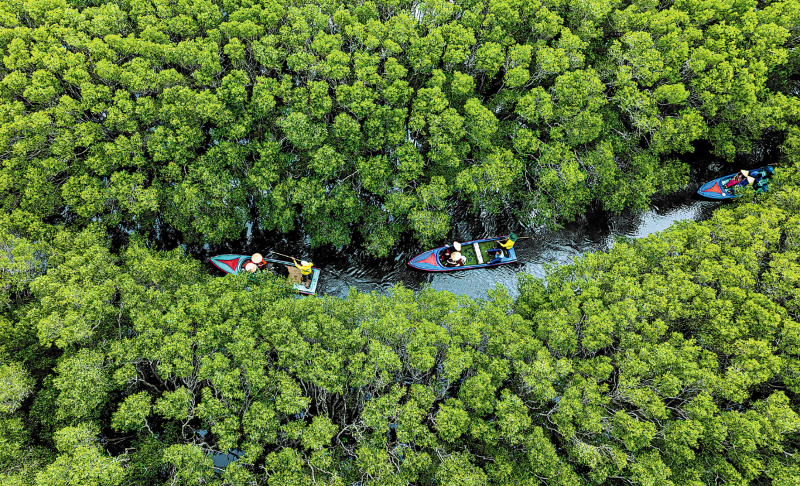
Coastal ecosystems such as mangroves, seagrasses, seaweeds, and coral reefs all demonstrate considerable carbon storage capacity. According to Professor Thuy, blue carbon efforts in APEC economies largely concentrate on mangrove carbon projects, ranging from 42 ha in Senegal to 350,000 ha in Pakistan. Indonesia, Myanmar, and Vietnam lead the way, accounting for 60 per cent of global projects.
Yet only 15 out of 74 projects meet standards and been registered under VCS (Verified Carbon Standard), Plan Vivo, or CAR (Climate Action Reserve) systems as of October 2024, and only three have sold credits. Seagrass projects remain at an early stage, while seaweed cultivation shows promise, with farms ranging from 1 to 15,000 ha, but has so far been commercialized mainly in countries such as Japan. Other coastal ecosystems receive limited attention, except in Australia, the US, and South Korea.
In her presentation at the “Navigating global & Vietnam’s carbon market: Post-COP30 insights and the way forward” seminar, Professor Thuy introduced Indonesia’s standards and methodologies for certifying mangrove blue carbon projects. She said advanced technologies and AI could reduce project costs, improve accuracy, support carbon pricing, and expand access to reliable data. Improving emissions reduction and carbon removal data, particularly for mangroves, remains vital.
She also shared findings from a mangrove restoration project in which 100 ha previously converted into aquaculture ponds had yielded low production. A private organization sought to restore the site through a multi-year mangrove recovery initiative aimed at boosting carbon storage, ecosystem resilience, and shoreline protection.
Research found that CO₂ emissions from converting mangroves into aquaculture over a decade were 53-times higher than emissions from seagrass loss. Restoration reversed the emissions trend, turning the area into a carbon sink; however, it could not fully compensate for losses from mangrove destruction during 2016-2024. She recommended prioritizing policies that prevent mangrove conversion, particularly in the Mekong Delta, and treating seagrass protection as a complementary approach.
Marine-based emissions reduction
Discussing Vietnam’s capacity for green carbon from forest and marine ecosystems, Mr. Nguyen Khac Pho, Director of Con Dao National Park, said Con Dao Island is not only a major tourist destination but also a natural reserve of significant ecological value. It includes more than 6,462 ha of forests and forestry land, nearly 93 per cent of which are natural forests.
With an average timber reserve exceeding 130 cu m per ha, Con Dao’s forests form a large carbon reservoir storing nearly 430,000 tons of carbon. The surrounding marine areas can also store more than 300 tons, with a further 15 tons from seagrass beds.
To maximize this potential, Con Dao is strengthening forest protection and curbing the illegal extraction of forest and marine resources; promoting afforestation; and restoring marine ecosystems, especially seagrass, which can store far more carbon than terrestrial forests. Seagrass restoration also protects coastlines, prevents erosion, enhances marine biodiversity, improves water quality, and supports local livelihoods.
Accurate assessments of carbon credit potential, Mr. Pho said, are critical to developing a circular economy model that can position Con Dao as an example of green development and contribute to Vietnam’s commitment to achieve net-zero emissions by 2050.
Vietnam’s marine emissions reduction potential also extends to seaweed. According to Mr. Dinh Xuan Lap, Deputy Director of the International Collaborating Centre for Aquaculture and Fisheries Sustainability (ICAFIS), Vietnam is home to more than 887 species of seaweed, including 90 with economic value. “Seaweed is a natural material that absorbs atmospheric carbon and helps neutralize ocean acidity,” Mr. Lap explained. “It is increasingly seen as a promising solution for environmental restoration. Each sq km of seaweed can store up to 1,500 tons of greenhouse gases.”
Growth rates are 30-60 times faster than those of terrestrial plants, enabling it to absorb CO₂ at 2.4-times the rate of trees. Seaweed can also be integrated easily with aquaculture systems such as oysters, marine fish, and lobsters, helping create stable ecosystems and improve productivity. In Vietnam, the “Blue Ocean - Blue Foods” program is fostering responsible participation in climate mitigation, marine environment improvements, and community livelihood enhancement.
A key focus of the program is linking businesses across the aquaculture value chain with seaweed farming, helping form a circular economy of investment, cultivation, processing, and consumption. Experts say that if a carbon credit mechanism for seaweed is established, its economic value would rise significantly, opening new development pathways for the blue economy.




 Google translate