



As part of a tourism familiarization trip organized by the Government of Maharashtra in cooperation with the Embassy of India in Vietnam, an international delegation of journalists and travel industry representatives recently spent six days exploring key destinations across Maharashtra.
The delegation included representatives from Vietnam Economic Times (VnEconomy), who joined a journey through several of the state’s most significant cultural and historical sites.
The itinerary began in the historic city of Chhatrapati Sambhajinagar, formerly known as Aurangabad, which serves as the gateway to two of India’s most remarkable archaeological treasures: the Ellora Caves and the Ajanta Caves.
Both sites are recognized as UNESCO World Heritage Sites and are widely regarded as masterpieces of ancient Indian art and architecture.The caves, carved directly into basalt rock cliffs, contain hundreds of sculptures, monasteries, temples, and murals dating back more than two millennia.
The journey continued to the sacred city of Nashik, one of India’s important religious centers, before concluding in Mumbai, the country’s financial capital and one of the most dynamic metropolitan hubs in Asia.
Beyond visiting iconic heritage landmarks, the delegation also took part in meetings with tourism authorities, local travel operators, and industry stakeholders to learn more about Maharashtra’s strategy for developing international tourism markets.
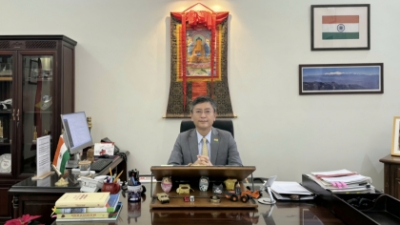
On this occasion, Vietnam Economic Times (VnEconomy) conducted an interview with Mr. Vijay Jadhav, Deputy Director of the Directorate of Tourism under the Government of Maharashtra, to discuss the state’s plans to strengthen tourism cooperation with Vietnam and promote Maharashtra as a destination for cultural and Buddhist pilgrimage travel.

Vietnam - an emerging and promissing tourism market
According to Mr. Vijay Jadhav, Southeast Asia has become an increasingly important region for Maharashtra’s international tourism promotion strategy, with Vietnam emerging as one of the most promising markets. Vietnam’s rapidly growing middle class and increasing interest in cultural travel make the country an important market for Maharashtra’s tourism promotion efforts.
“We see growing interest from Vietnamese travelers in destinations that offer cultural depth, historical significance, and spiritual experiences,” he said.
“Maharashtra has a unique combination of these elements. Our heritage sites, particularly Ajanta and Ellora, hold deep connections to the history and spread of Buddhism, which makes them especially meaningful for visitors from countries with strong Buddhist traditions such as Vietnam.”
The Ajanta cave complex is famous for its exquisite Buddhist murals and paintings, many of which date back to the 2nd century BCE. These artworks depict scenes from the life of the Buddha as well as stories from the Jataka tales, offering rare insights into early Buddhist culture and philosophy.
Meanwhile, the Ellora caves represent an extraordinary example of religious coexistence. The site is also home to the famous Kailasa Temple, a massive monolithic structure carved from a single rock and considered one of the greatest architectural achievements of ancient India. Within a single complex, visitors can explore Buddhist monasteries, Hindu temples, and Jain shrines carved into the same cliffside over several centuries.
“This unique cultural and spiritual landscape is something travelers cannot easily find elsewhere in the world,” Mr. Jadhav noted.
Tourism experiences tailored to international visitors
Tourism authorities in Maharashtra believe that Vietnamese travelers would be particularly interested in a variety of experiences the state has to offer, ranging from heritage tourism to modern urban exploration.
UNESCO heritage tourism remains the centerpiece of the state’s tourism offerings. Ajanta and Ellora attract scholars, historians, artists, and spiritual travelers from across the globe.
“These caves are not merely archaeological sites,” Mr. Jadhav explained. “They are living cultural monuments that reflect centuries of artistic achievement, philosophical thought, and religious devotion.”
Beyond heritage sites, visitors can also experience the vibrant urban life of Mumbai. The city is home to India’s largest financial district and is widely known as the center of the country’s film industry, Bollywood.
Tourists can explore famous landmarks such as the Gateway of India, colonial-era architecture, lively markets, and the iconic Marine Drive promenade along the Arabian Sea, often referred to as the “Queen’s Necklace.”
For those seeking nature and relaxation, Maharashtra also offers scenic hill stations such as Mahabaleshwar and Lonavala, known for their cool climate, green valleys, and panoramic viewpoints.
Meanwhile, the long stretch of the Konkan Coast features pristine beaches, fishing villages, and coastal culture that remain largely untouched by mass tourism.
“These diverse tourism products allow visitors to experience different facets of Maharashtra-from ancient heritage to modern city life and natural beauty,” Mr. Jadhav said.

Expanding promotion in Vietnam
Following the familiarization trip, Maharashtra Tourism plans to intensify its engagement with the Vietnamese market.
According to Mr. Jadhav, several initiatives are under consideration to promote the state more effectively in Vietnam. These include partnerships with Vietnamese travel agencies, participation in regional tourism fairs, and expanded media collaborations.
Digital marketing campaigns targeting Vietnamese travelers are also expected to play an important role.
“We believe that raising awareness is the first step,” he said. “Many travelers in Vietnam may not yet be fully familiar with the incredible heritage sites we have in Maharashtra. Once they discover these destinations, we are confident that interest will grow.”
The state is also working to develop structured heritage circuits for international visitors, including routes linking Mumbai with Chhatrapati Sambhajinagar and the Ajanta-Ellora region.
Direct air connectivity as a key driver
Air connectivity is another factor expected to significantly influence tourism growth between Vietnam and Maharashtra.
Mumbai serves as one of India’s major international aviation hubs, with extensive connections to cities around the world.
Improved flight connections between Vietnam and Mumbai could help reduce travel time and make Maharashtra more accessible for both leisure travelers and business visitors.
“Direct or convenient flight routes can make a huge difference,” Mr. Jadhav said.
“Better connectivity allows travelers to combine cultural tourism with business trips, conferences, or extended journeys across India.”
Protecting ancient heritage for future generations
While tourism promotion is a priority, authorities emphasize that protecting Maharashtra’s ancient heritage remains equally important.
Conservation efforts at Ajanta and Ellora are carried out in cooperation with the Archaeological Survey of India, the national body responsible for preserving historical monuments.
Strict measures are in place to regulate visitor numbers, control lighting conditions inside the caves, and maintain appropriate humidity levels in order to protect the fragile murals and sculptures.
Flash photography is restricted in many areas, and ongoing research programs are conducted to ensure the long-term preservation of the sites.
“These caves have survived for more than 2,000 years,” Mr. Jadhav said.
“Our responsibility is to protect them so that future generations can continue to experience their beauty and historical significance.”
Looking ahead to stronger tourism links
As cultural exchanges and travel between India and Vietnam continue to expand, Maharashtra hopes to play a larger role in welcoming Vietnamese visitors.
Tourism officials believe that the shared cultural connections rooted in Buddhism provide a natural foundation for deeper tourism cooperation.
“We see great potential for stronger people-to-people connections between Maharashtra and Vietnam,” Mr. Jadhav said.
“With our heritage sites, vibrant cities, and diverse landscapes, we hope to welcome many more Vietnamese travelers in the years ahead and strengthen tourism ties between India and Vietnam.”


 Google translate