


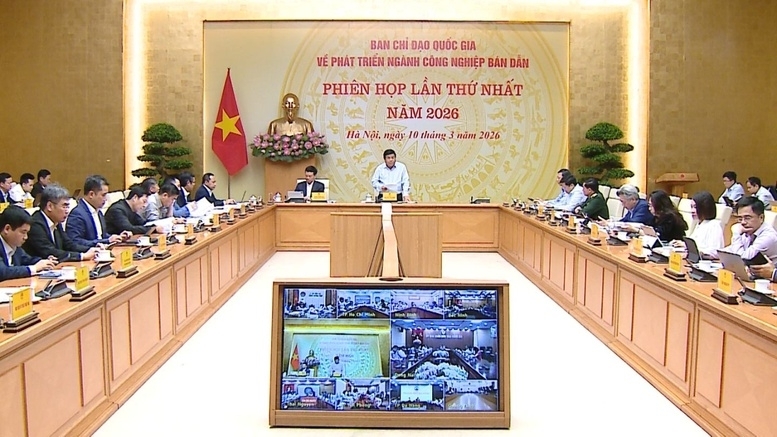
The global semiconductor industry is undergoing robust growth and profound restructuring across both technology and supply chains, Deputy Prime Minister Nguyen Chi Dung stated during the first 2026 meeting of the National Steering Committee for Semiconductor Industry Development on March 10.
He noted that the rapid advancement of Artificial Intelligence (AI) and emerging digital technologies continues to solidify the foundational role of semiconductors in the global digital economy—particularly in sectors such as AI, cloud computing, the Internet of Things (IoT), and big data.
"Currently, Southeast Asia, and Vietnam in particular, is emerging as a vital link in the global value chain, especially in the chip assembly, testing, and packaging segments," the Deputy PM said.
To date, many of the world’s leading tech corporations have invested in or expanded their operations in Vietnam, focusing primarily on Assembly, Testing, and Packaging (ATP).
Simultaneously, Vietnamese enterprises have gradually integrated into the global value chain, enhancing their expertise in design, production, and services. Notably, a chip manufacturing plant project has already been initiated.
Vietnam now maintains a presence in every stage of the global semiconductor value chain. The country has attracted more than 50 chip design firms employing approximately 7,000 engineers, alongside numerous large-scale packaging and testing projects.
Total Foreign Direct Investment (FDI) in the semiconductor sector has reached over $14.2 billion across 241 projects.
In terms of human resources, the country boasts more than 240 universities, graduating approximately 134,000 engineering students annually, including about 6,000 specialized integrated circuit (IC) design engineers.
A milestone was reached on January 16, 2026, with the groundbreaking of Vietnam’s first high-tech semiconductor fabrication plant.
Regarding the implementation of the Vietnam Semiconductor Industry Development Strategy to 2030 and vision for 2050, Deputy PM Dung proposed the selection and development of 3 to 5 strategic semiconductor chip lines.
He suggested piloting State procurement mechanisms for products utilizing Vietnamese-made chips in the sectors of defense, security, and digital transformation.
He also called for selecting and supporting specific institutes, universities, and enterprises based on a "Triple Helix" model (State-Academia-Industry) to establish and scale up domestic chip design units. Furthermore, the National Semiconductor Prototyping Center will be operationalized to facilitate the trial production and commercialization of these products.
Additional priorities include strengthening domestic and international partnerships in training to enhance the quality of the semiconductor workforce and accelerating technology transfer.





 Google translate