


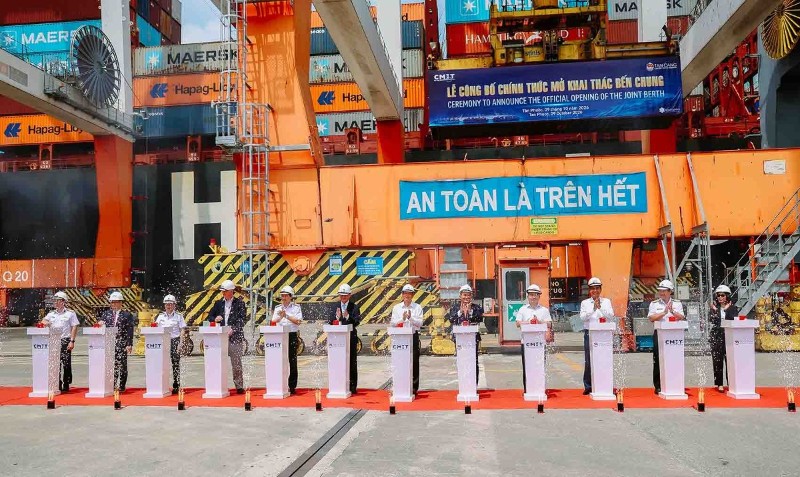
Two deep-water ports in Ho Chi Minh City, Cai Mep International Terminal (CMIT) and Tan Cang-Cai Mep Thi Vai Terminal (TCTT), officially began commercial operations at a shared berth on October 9, 2026, establishing a connected quay system stretching 1,200 meters.
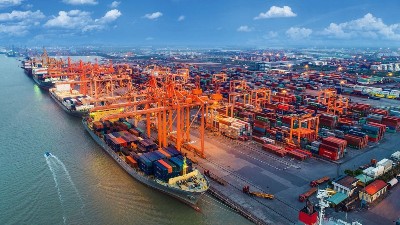
The cooperation allows the two terminals to jointly accommodate three large container ships simultaneously, creating additional capacity at the Cai Mep-Thi Vai deep-water port complex.
Under the model, the ports link their infrastructure to create an integrated operating area rather than managing separate berthing zones. They also coordinate equipment, staffing and vessel scheduling to improve operational efficiency.
According to the two operators, the shared berth is expected to increase handling capacity at each terminal by approximately 30-40%, equivalent to an additional 400,000-500,000 TEUs annually per port. The combined additional capacity is estimated at nearly 900,000 TEUs a year. These figures represent projected capacity, not actual cargo throughput since commercial operations began.
Before the official launch, the terminals tested the arrangement on September 7-8, 2026, using ZIM shipping line’s mother vessel SHENZHEN. The vessel, measuring more than 335 metres long with a deadweight tonnage of 102,517 tons, was handled jointly by the two ports. Approximately 3,200 TEUs of cargo and empty containers were loaded and unloaded in nearly one day, and the vessel departed as scheduled.
The successful trial provided an important operational test ahead of regular commercial services.
The CMIT-TCTT shared berth also highlights an alternative approach to logistics infrastructure development: improving the use of existing assets through cooperation, rather than relying solely on new construction. For neighbouring ports with compatible technical conditions, integrated operations could expand service capacity without requiring each facility to undertake separate infrastructure expansion.


 Google translate