


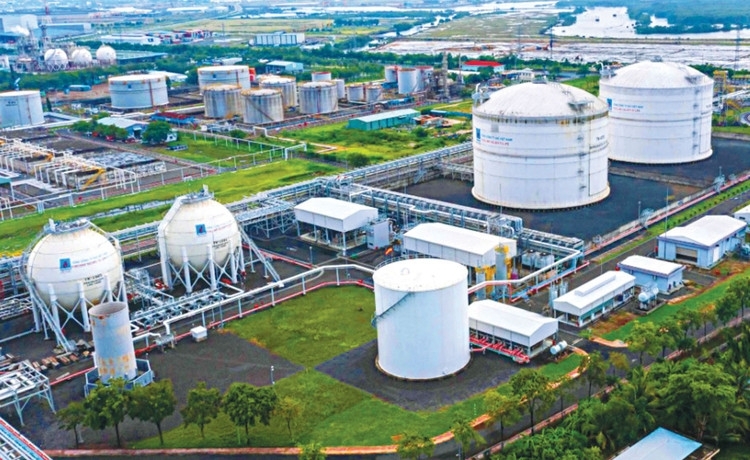
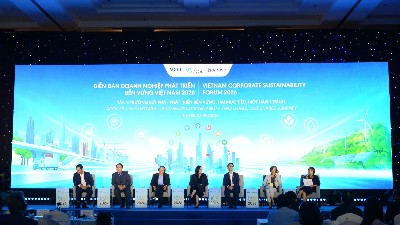
At a forum titled "Strategy and Development Trends of the Natural Gas Market (CNG, LNG, and LPG) in Vietnam and the ASEAN Region," held on December 23, pricing mechanisms and transmission infrastructure were identified as significant challenges to the development of LNG power in Vietnam.
During a discusssion at the forum, experts emphasized the critical role of natural gas as a transitional energy source, bridging traditional energy with renewables. With its extensive coastline and potential import ports, Vietnam is poised to attract investors to this value chain.
According to Power Plan 8, LNG is set to replace coal to ensure energy security and support renewable electricity in Vietnam. By 2030, the capacity of gas-fired power is expected to reach 30,000 - 39,000 MW, accounting for 25% of the total electricity output. Key projects like Nhon Trach 3 and 4 gas-fired power plants in southern Dong Nai province have been inaugurated, while Hiep Phuoc and Son My gas-fired power plants (in Ho Chi Minh City and the south-central province of Lam Dong, respectively) are underway, with operations anticipated between 2027-2030. Additionally, the LNG terminal at Thi Vai port in Ho Chi Minh City has also put into operation, with plans to increase capacity to 3 million tons per year.
Despite such a potential, the implementation of gas-fired power projects still faces numerous obstacles. Dr. Nguyen Quoc Thap, Chairman of the Vietnam Petroleum Association, highlighted that the biggest challenge lies in mindset and the lack of synchronization in execution solutions. While there is consensus on strategy, current regulations are overlapping, creating barriers for businesses.
Moreover, LNG prices fluctuate with global energy prices and geopolitical tensions, while policy mechanisms are still being developed. Investing in LNG infrastructure requires substantial capital and long payback periods. If investors perceive high risks or lack of opportunities, they will withdraw. From power plants to terminals, all face difficulties.
Another significant challenge is the risk associated with electricity pricing, gas pricing, and power purchase agreements (PPA). Currently, no LNG power plant, except for the Hiep Phuoc project, has reached a final investment decision (FID).
Resolution 71 and current regulations require investors to bid on electricity prices, but these prices are capped or fixed at the time of bidding. The time from bidding to project realization takes at least 7-10 years, during which cost and price fluctuations make it difficult for investors to decide.
Transmission and distribution infrastructure is severely lacking in synchronization. A paradox exists where Vietnam's installed capacity is about 90GW, but actual mobilization is below 60%. The gap between invested capacity and actual mobilized capacity is significant due to inadequate transmission systems. Without resolving transmission issues, new investments in LNG or offshore wind power will face deadlock.
Mr. Pham Hoang Luong, former Vice Rector of Hanoi University of Science and Technology, identified four major challenges:
First, high fuel costs due to LNG being a safe fuel source used by many countries. The current import price of LNG is quite high (about $14.05 /million BTU). Adding transportation and regasification costs, the production cost of electricity can exceed VND3,000/kWh, putting significant pressure on electricity prices and overall production costs.
Second, infrastructure investment costs, such as building terminals and regasification pipeline systems, require enormous capital. To optimize costs, power plant clusters need to reach a scale of 3,000 – 4,000 MW, posing a difficult planning challenge.
Third, current standards and technical regulations for LNG in Vietnam are not yet fully synchronized, causing confusion in implementation and operational management.
Fourth, dependence on the international market. Transitioning from coal to LNG inadvertently increases national energy security dependence on global gas price fluctuations and supply sources.
To address these challenges, breakthrough policy mechanisms and a suitable fuel transition roadmap to green hydrogen by 2050, as committed at COP26, are needed. Dr. Nguyen Quoc Thap proposed two groups of solutions.
First, policy solutions. According to Dr. Thap, a National Energy Law integrating existing laws (Electricity, Minerals, etc.) should be developed. Synchronize LNG terminal, power plant, and transmission system planning. Avoid building too many standalone terminals, which increase output costs.
Moreover, simplify investor selection procedures (BOT, IPP). A government guarantee mechanism (GGU) is needed for key projects. Currently, state-owned enterprises like PVN, EVN, or TKV, despite being large, do not have full control over their cash flow or the ability to mortgage it, making investors wary without GGU.
Regarding transmission infrastructure, private investment should be allowed, and transmission fee calculations should be changed. Transmission fees should operate flexibly like transportation infrastructure (with high-cost highways, low-cost roads) so investors can recover capital. Keeping low fees as they are now discourages investment in transmission.
A flexible LNG electricity price framework, market-approaching, and suitable take-or-pay commitments are particularly needed. Currently, the draft regulation sets a minimum take-or-pay level of 65% - 75%, while investors want 85% - 90%. Without resolving this take-or-pay bottleneck, projects will stall.
Second, solutions to attract investment and support the development of LNG power projects to meet Power Plan 8 objectives.
Dr. Nguyen Quoc Thap believes that attracting and encouraging industrial park investors and factories to commit to long-term electricity consumption along with the LNG power plant - LNG terminal chain is necessary.
Additionally, effectively maintaining and exploiting domestic gas sources, combined with importing LNG from international/regional markets to diversify supply sources, is essential. At the same time, legal procedure obstacles should be removed, and the progress of ongoing LNG power projects like Son My 2, Bac Lieu, Ca Na should be accelerated. Allow LNG power plant investors with capacity to proactively invest in connection infrastructure with power plants after reaching agreements with the electricity buyer.

 Google translate