


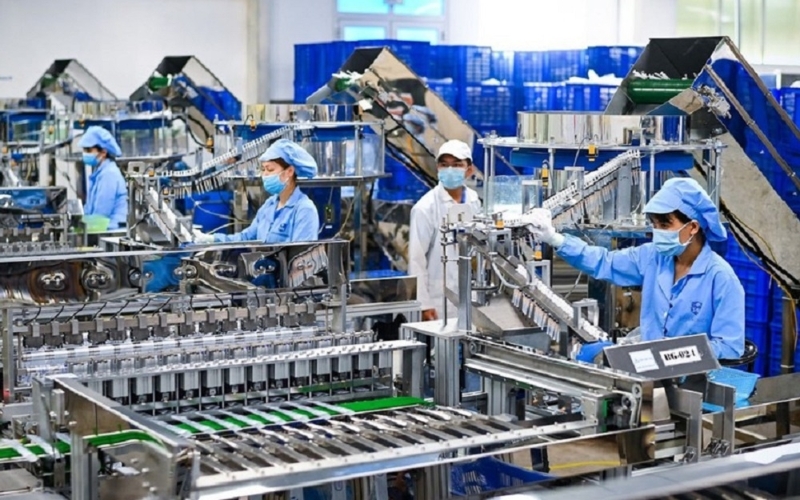
The latest report from the National Statistics Office (NSO) at the Ministry of Finance noted that industrial production maintained strong momentum in the fourth quarter of 2025, with the Index of Industrial Production (IIP) up 9.9 per cent year-on-year as businesses ramped up output to meet year-end consumption and export demand.
For the year as a whole, the IIP rose 9.2 per cent against 2024, when it came in at 8.2 per cent, marking the strongest growth since 2019. This result not only reaffirmed industry’s role as a key growth engine and Vietnam’s position as a regional manufacturing hub but also laid a solid platform for the country’s next stage of development.
Broad-based gains
Within overall industrial performance last year, the manufacturing and processing sector continued to act as the main driver, posting impressive growth of 10.5 per cent, up from 9.5 per cent in 2024 and contributing 8.4 percentage points to overall growth. This underscored the effectiveness of Vietnam’s strategy to focus on modern manufacturing industries.
Certain segments made positive contributions. Electricity production and distribution rose 6.7 per cent, contributing 0.6 percentage points, while water supply and waste and wastewater management increased 7.8 per cent, adding 0.1 percentage points. Notably, the mining sector, which contracted sharply in 2024, by 6.3 per cent, exhibited early signs of recovery, with a 0.5 per cent increase and contributing 0.1 percentage points.
At the local level, the industrial production picture was broadly positive, with the NSO reporting that the IIP increased year-on-year in all of Vietnam’s 34 cities and provinces. Several localities recorded strong growth driven by manufacturing and processing and by electricity production and distribution. Conversely, others saw more modest increases due to weaker performance or declines in manufacturing, electricity, or mining.
Consumption remained a key pillar supporting industrial growth. The consumption index for the manufacturing and processing sector rose 9.9 per cent in 2025, which while lower than the 11.4 per cent increase recorded in 2024 still represented solid growth and helped sustain cash flow at businesses. Average inventory levels, however, stood at 81.1 per cent for the year, up from 77.1 per cent in 2024, indicating that inventory pressures persisted and underscoring the need for more flexible supply chain management strategies.
In terms of employment, the NSO reported that as of December 1, the number of workers employed at industrial enterprises had risen 0.8 per cent compared to November 1 and 2.4 per cent year-on-year. Employment in State-owned enterprises (SOEs) increased 0.2 per cent month-on-month but declined 0.6 per cent year-on-year; non-State enterprises saw increases of 0.8 per cent and 0.3 per cent, respectively; and foreign-invested enterprises (FIEs) recorded gains of 1 per cent month-on-month and 3.3 per cent year-on-year.
By sector, employment in mining was unchanged from November and rose 1.1 per cent year-on-year. Manufacturing and processing employment increased 0.9 per cent month-on-month and 2.4 per cent year-on-year, while employment in electricity, gas, steam, hot water, and air conditioning supply rose 0.1 per cent and 2.9 per cent and in water supply and waste and wastewater management by 0.4 per cent and 0.7 per cent, respectively.
Business confidence
Vietnam’s industrial success in 2025 was closely tied to strong FDI inflows, with manufacturing and processing continuing to act as a magnet for international investors.
According to the NSO, as of December 31, the manufacturing and processing sector had attracted the largest volume of newly-licensed FDI, with registered capital of $9.8 billion, accounting for 56.5 per cent of total newly-registered capital. Including both newly-registered and additional capital, total FDI into the sector stood at $18.59 billion, representing 59.2 per cent of all newly-registered and additional capital.
The inflow of foreign capital, together with macro-economic stability, helped strengthen business confidence. An NSO survey in the fourth quarter showed broadly optimistic sentiment, with 75.8 per cent of enterprises reporting that business conditions had improved or remained stable compared with the third quarter (25.4 per cent reporting improvement and 50.4 per cent stability). Manufacturing and processing led this optimism, with 79.1 per cent of enterprises assessing conditions as improved or stable (35.2 per cent improved and 43.9 per cent stable).
By ownership type, SOEs and FIEs had the highest levels of confidence. The share of enterprises reporting improved or stable business conditions in the fourth quarter compared to the third reached 78.7 per cent among SOEs (26.8 per cent improved and 51.9 per cent stable) and 77.2 per cent among FIEs (28.1 per cent improved and 49.1 per cent stable). Non-State enterprises also expressed optimism, with 75.3 per cent reporting improved or stable conditions (24.9 per cent improved and 50.4 per cent stable).
The overall balance index - a key indicator measuring business trends in the fourth quarter compared with the third and determined by positive responses minus negative responses - stood at 1.2 per cent, while manufacturing and processing alone posted 14.3 per cent.
By contrast, construction and trade and services continued to face challenges, with balance indices of 0.8 per cent and minus 2.5 per cent, respectively. These figures highlighted industry’s role as a key pillar of economic growth, helping to spread confidence to other sectors and create a more favorable environment for long-term business planning.
Sustained momentum
The December Purchasing Managers’ Index (PMI) for the manufacturing and processing sector, released by S&P Global in early January, provided timely and encouraging signs on sectoral development, with the PMI standing at 53.0 in December, marking the sixth consecutive month of expansion.
Manufacturers extended output growth for the eighth consecutive month, supported by recovering demand and improved operating conditions. While the pace of new order growth slowed slightly towards year’s-end due to a mild decline in export orders, domestic demand remained strong enough to keep factories running at high capacity.
The PMI report, however, also pointed to ongoing challenges. Lingering impacts from natural disasters and flooding earlier in the year disrupted supply chains in Vietnam, while shortages of raw materials and delivery delays persisted. These factors pushed input costs up by the fastest rate since June 2022. Even so, from a long-term perspective, many enterprises increased purchasing activity at the fastest rate for 16 months in preparation for an anticipated production upswing in 2026.
S&P Global’s survey found that business confidence at the end of 2025 had reached its highest level since March 2024. Nearly half of respondents expect output to grow strongly in 2026, underpinned by expectations of broader recovery in global demand, more diverse new product launches, and significant investments in capacity upgrades made over the past year.
Building on the solid foundations established in 2025, economists at S&P Global Market Intelligence forecast Vietnam’s industrial output growth at 6.7 per cent in 2026. This projection is considered realistic and achievable as supply chain bottlenecks ease and major FDI projects enter stable operations.
With renewed momentum, stronger confidence, and hard-earned experience in navigating challenges, Vietnam’s industrial sector is well positioned to sustain robust growth in 2026 and beyond.




 Google translate