


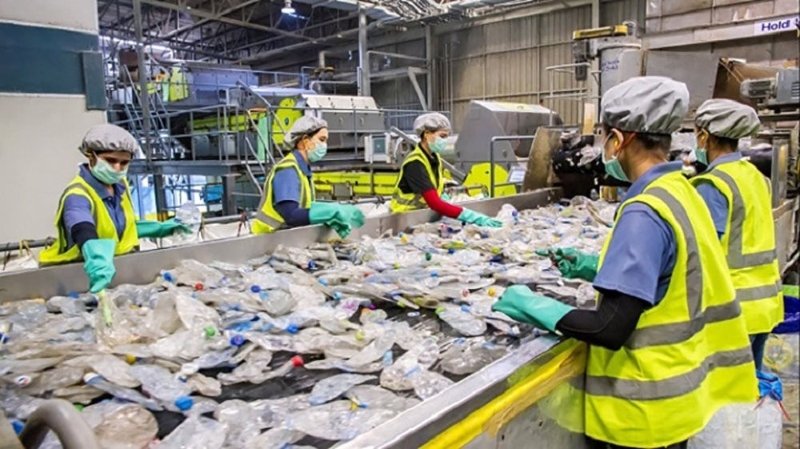
The implementation of Extended Producer Responsibility (EPR) recycling obligations not only helps reduce waste and promote sustainability but also enables businesses to keep their products competitive and maintain export capability in international markets. Moreover, it contributes to the gradual formation of a recycling industry in Vietnam, which is viewed as highly promising and increasingly attractive to foreign enterprises.
Adopting EPR
Vietnam’s plastic recycling sector has received increased attention following the introduction of the EPR policy. Under the draft EPR decree, producers and importers are required to collect, recycle, and treat packaging starting from this year, with mandated recycling rates.
At the Green Economy Forum (GEF) 2025, Mr. Nguyen Thanh Yen, Deputy Head of the Policy and Legal Affairs Division in the Department of Environment at the Ministry of Agriculture and Environment, noted that Vietnam still faces significant data gaps regarding plastic waste generation, as most plastic materials are recycled within the informal sector. Only around 10-20 per cent is recycled by formal enterprises such as Duy Tan Recycling and An Phat.
According to Mr. Yen, high-value plastic waste, such as PET bottles, is often picked up by informal waste collectors even if it reaches landfill sites, because for them, this type of plastic is “money.” As a result, the plastic waste that remains uncollected is typically the kind that is difficult to recycle. However, even this category of waste is gathered by municipal environmental companies in major cities with high consumption levels, such as Hanoi, and transported to waste treatment facilities.
In practice, the responsibility for collecting and recycling packaging is already outlined in Decree No. 08/2022, which provides detailed guidance for implementing the Law on Environmental Protection 2020. Under this regulation, businesses were required to begin fulfilling their collection and recycling obligations last year or, alternatively, make financial contributions to the Environmental Protection Fund.
Many companies, Mr. Yen continued, have opted for the financial contribution route simply because it is easier to execute. As a result, the Fund has accumulated several trillion VND but there is still no clear mechanism for how the money should be used. He added that Vietnam is, in many ways, ahead of the curve in Asia when it comes to adopting EPR. “We’ve had EPR in place since 2022, but there is still no workable mechanism for using the contributions companies make,” he said. “The implementation process is also demanding and costly.”
Goals and challenges
Vietnam’s path towards a true circular economy is being shaped by collaboration between private sector leaders, informal waste collectors, non-government organizations (NGOs), and government policymakers. Today, more than 200 organizations are involved in efforts to turn plastic waste into valuable resources and strengthen the country’s recycling systems.
“We work with around a hundred informal waste collectors to help gather and recycle post-consumer plastics,” said Ms. Nhi Le, Head of Communication, Corporate Affairs, and Sustainability at Unilever Vietnam. “The high-quality recycled resin we produce goes back into manufacturing new bottles, while other recovered materials are repurposed into construction items, household baskets, and more.”
But the road towards sustainability remains challenging. According to Ms. Nhi, a key barrier is the lack of proper infrastructure for waste sorting and processing. Many informal waste collectors still have to manually separate contaminated waste, which requires large amounts of water and labor to clean. This not only drains resources but also reduces the quality of recyclable materials. As a result, producing high-quality recycled plastics ends up costing significantly more than using virgin plastic.
Policy also poses obstacles. “Current EPR policies don’t include enough incentives for companies to use recycled materials,” she explained. “When a company like Unilever needs to purchase recycled content, the price is much higher than for regular plastic. The systems for reporting and data collection are also not fully established.”
Mr. David Adasme, Director of ESG (Environmental, Social, and Governance) at VinFast, laid out the company’s goals to 2027, with a strong emphasis on innovation in both plastics management and the automotive sector. “We have established internal workflows and KPIs [key performance indicators] that support our global growth plans,” he said, underlining VinFast’s commitment to strong governance and continuous strategic review. As part of this global approach, the company is forming partnerships to seize emerging market opportunities and apply best practices in sustainability.
As an electric vehicle (EV) brand, the potential for battery recycling is enormous. He explained that VinFast is already working closely with global partners, creating clear agreements around battery recovery and recycling; an area he believes holds significant opportunities for the industry. “We have proposed to the government the development of a nationwide EV-battery recycling program, moving towards second-life applications such as BESS energy storage systems,” he noted, referring to Battery Energy Storage Systems, which can extend the life-cycle of used EV batteries.
As VinFast expands internationally, aligning with global regulations becomes essential. “As a global company, we must build a unified strategy across markets, especially when it comes to EPR policies and regulatory requirements,” Mr. Adasme said, underscoring that EPR will play a critical role in how VinFast manages batteries sustainably throughout their full life-cycle.
Engagement with sustainability
Environmental responsibility now plays a defining role in shaping brand perception and market performance, Ms. Nhi observed. “We’re seeing that a large share of young consumers genuinely care about how responsible a brand is,” she said. “They gravitate towards products that are not only innovative but also truly sustainable.”
This shift in expectations is pushing companies to rethink their entire operating model, especially around packaging. “Thanks to the momentum created by EPR regulations, our brands are redesigning packaging to make it more recyclable and to cut down on virgin plastics,” Ms. Nhi explained. “We’re increasing the use of recycled materials so consumers can clearly see that their choices contribute to a healthier environment.”
Another priority highlighted was the rollout of a waste education campaign aimed at strengthening public awareness. As Ms. Nhi explained, “When we involve consumers and communities in educational efforts, we create a shared commitment to action that genuinely benefits the environment.” Though such initiatives may increase short-term costs, the team believes they help build stronger and more resilient relationships with consumers.
Meaningful engagement with sustainability, she added, is now a core driver of consumer loyalty. “Sustained, purpose-driven interaction, especially around shared environmental values, not only secures long-term consumer trust but also helps attract new talent who want to work for responsible, forward-thinking brands,” Ms. Nhi said.
Mr. Adasme noted that environmental responsibility is becoming a defining factor in how the next generation evaluates brands. “To attract future customers, we need to rethink the entire process of building a car, from the materials we choose to the energy sources that power production,” he said. “Our goal isn’t simply to comply with regulations, but to genuinely align with the environmental standards and expectations shaping the industry’s future.”
He added that this focus on sustainability is not just a market requirement, but a strategic advantage. “With continuous innovation and a clear commitment to responsible practices, we can strengthen our position in both domestic and global markets,” he affirmed.





 Google translate