


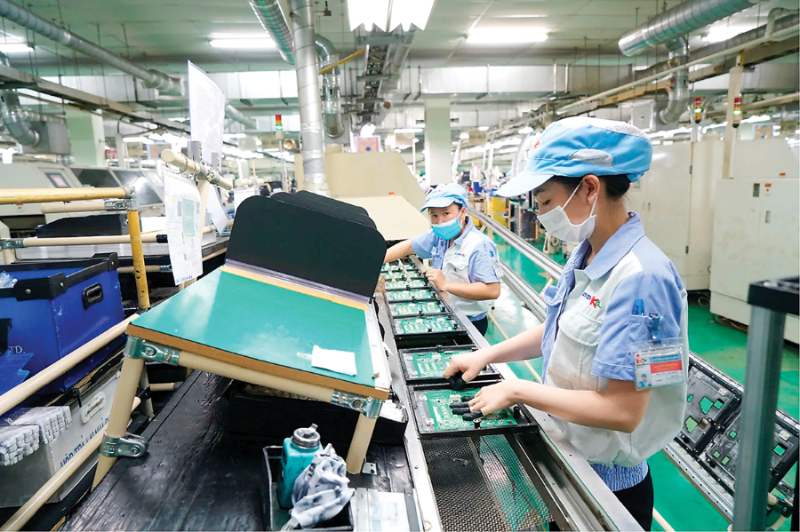
Amid complex global geopolitical tensions, from trade disputes between major powers to regional conflicts, the global supply chain faces serious disruption and Vietnam, as a key electronics manufacturing hub, is not immune.
To maintain their position in the global supply chain, Vietnamese electronics companies must pursue green transformation, from production models to the adoption of energy-saving technologies and the establishment of transparent environmental, social, and governance (ESG) management systems to enhance their competitiveness and achieve long-term sustainable growth.
Pressure from green shift
At the recent “Electronics transformation under geopolitical pressure: Developing green and sustainable supply chains” seminar, organized jointly by the Vietnam Electronic Industries Association (VEIA), Vinexad, and Green In, Ms. Do Thi Thuy Huong, Vice President of the Vietnam Association of Supporting Industries (VASI) and Member of the VEIA Executive Committee, underscored that major export markets, including the EU, the US, and Japan, are tightening their green standards.
She pointed to key regulations, from the EU’s Carbon Border Adjustment Mechanism (CBAM) to net-zero commitments made by global giants such as Apple, Samsung, and Intel. “Without undertaking a green transformation, Vietnamese electronics companies risk being excluded from the global supply chain,” she warned. “Companies must act immediately to transform their production models, from adopting energy-saving technologies to building transparent ESG management systems, to stay competitive and sustainable.”
Ms. Nguy Thi Giang, Chairwoman and CEO of Green In, also noted that companies are now confronting increasingly stringent international green standards. One example is the Electronic Product Environmental Assessment Tool (EPEAT) ecolabel, managed by the Global Electronics Council (GEC). Applied globally across electronics like computers, monitors, TVs, and mobile phones, EPEAT encourages manufacturers to cut greenhouse gas emissions, design energy-efficient products, extend product lifespans, and improve recycling across the supply chain.
Electrical and electronic exports to Europe must also comply with Restriction of Hazardous Substances (RoHS) standards, which prevent toxic chemicals from polluting the environment and protect workers during manufacturing and recycling. Meanwhile, the EU’s Waste Electrical and Electronic Equipment (WEEE) directive focuses on reducing electronic waste through reuse and recycling. European standards (EN standards) also set product-specific requirements, ensuring quality, safety, and compliance with energy and eco-design benchmarks.
A major upcoming requirement is the Digital Product Passport (DPP) under the EU’s Ecodesign for Sustainable Products Regulation (ESPR). From 2026 to 2030, many products sold in the EU, including electronics, will need a DPP attached as an NFC chip, QR code, or RFID card, linked to a cloud-based passport system for full global traceability.
Domestically, the Vietnamese Government is signaling that the green transformation represents the “new rules of the game” in global trade. Economic growth is expected to align with green development, circular economy principles, resource efficiency, emission reductions, and environmental protection, creating strong incentives for companies to invest in research and development (R&D) - the backbone of sustainable transformation.
Driven by tech giants
According to Dr. Bui Thanh Minh, Deputy Director of the Office of the Research and Development Board for the Private Economic Sector (Board IV), several international models of successful green transformation can serve as references for Vietnamese electronics companies.
Samsung Electronics has set a goal of achieving net-zero emissions across the entire group by 2050. Notably, its Device eXperience Division, which includes consumer electronics, aims to reach net-zero earlier, by 2030. The company is committed to a phased transition to renewable energy for its Device eXperience Division as well as overseas manufacturing sites. Samsung also targets an average reduction of 30 per cent in energy consumption for its key product lines by 2030.
To achieve these goals, Samsung has implemented programs to reduce emissions in operations and manufacturing, including controlling emissions during production. The company has focused on the circular economy and recycling initiatives, implements internationally-certified environmental management systems, and publishes annual sustainability reports with climate, energy, and material indicators. It also offers solutions to help customers reduce emissions in information technology (IT) infrastructure operations.
Sony, meanwhile, through its global “Road to Zero” plan, aims for a zero environmental footprint across the entire product lifecycle and operations by 2050. The plan breaks down goals into four environmental dimensions and six lifecycle stages, with periodic updates.
Panasonic aims to achieve a cumulative “emission reductions impact” of at least 300 million tons of CO₂ by 2050 through three layers of impact: within its own value chain, across the extended value chain, and via technologies that help society avoid emissions. By 2030, the company targets internal net-zero emissions and a 110-million-ton reduction across its value chain.
For its part, Apple plans to achieve deep emission reductions across the full product lifecycle by 2030, build a supplier network powered by tens of GW of renewable energy, and significantly increase the use of recycled materials in critical components such as rare earths, aluminum, lithium, tungsten, gold, and cobalt.
Intel has established a focused action framework called “People-Sustainability-Technology”, integrating emission reduction, sustainable water use, and improved product energy efficiency to cut value chain emissions. Its 2030 goals emphasize enhancing computing platform energy efficiency to reduce indirect emissions from customers.
Dell has set a ten-year roadmap with four pillars: driving sustainability, fostering inclusion, transforming lives, and upholding ethics and privacy. The company emphasizes measurement systems, goal setting, and regular progress reporting.
And HP has integrated sustainability into the design, packaging, and energy use of printers and computers, publishing a “Sustainable Impact Report” alongside policies on environmental management, responsible supply chains and minerals, and eco-labeling for enterprise customers.
“The use of ESG labels is gradually declining,” Mr. Minh noted. “Instead, electronics companies are shifting towards a more substantive approach through measurable actions and specific initiatives.”
Key steps
During its green transformation process, Mr. Minh emphasized that Vietnam’s electronics industry still faces significant challenges. Ninety-five per cent of the sector’s export value comes from FDI, while domestic content accounts for only 5-10 per cent. Some 2,000 companies operate in the electronics industry, representing 54.8 per cent of all businesses in the sector, but most are of small and medium-size.
For a successful green transformation, Mr. Minh outlined three key recommendations for electronics companies. First, on emissions tracking and carbon management, companies need a comprehensive system covering all three scopes of greenhouse gas emissions, set reduction targets, and implement regular monitoring.
Second, regarding green technology and renewable energy, the goal is to reduce electricity and water consumption, minimize waste and emissions, and increase renewable energy use. Achieving this requires replacing high-energy equipment with high-efficiency alternatives, optimizing processes, adopting cleaner production, electrifying operations where possible, deploying rooftop solar or purchasing renewable energy certificates, investing in waste treatment (especially e-waste), and installing real-time emissions and wastewater monitoring systems.
Third, on digital transformation for transparency and traceability, companies should digitize operations to optimize resources, enhance traceability, and meet market data requirements. This includes implementing enterprise resource planning (ERP) and manufacturing execution system (MES) systems, building supply chain databases, deploying customer relationship management (CRM) systems linking component origins, and using industrial Internet of Things (IoT) and big data analytics to monitor electricity, water, and emissions in real time. Businesses should also prepare data infrastructure for machine-readable sustainability reporting.
Financing, however, remains the biggest hurdle. Mr. Minh stressed the need for green credit policies, tax incentives, and technical support to help companies, especially small and medium-sized enterprises, participate sustainably in the global supply chain.






 Google translate