



Resolution No. 21-NQ/TW from the 14th Party Central Committee, signed recently by Party General Secretary and State President To Lam, outlines views and orientations for amendments to the Land Law and related legislation and calls for reforming land valuation mechanisms based on data, scientific methods, openness, and transparency, while strengthening links between land data and relevant databases to curb price manipulation and the creation of artificial prices.
The Resolution also calls for limiting land subdivision and plot sales in urban areas as much as possible, introducing regulations on the use period of high-end apartments, and completing policies to curb speculation and encourage the more efficient use of land.
Toward actual use value
Ms. Do Thi Thu Giang, National Head of Valuation at Savills Vietnam, said shortcomings in land valuation and land-related financial mechanisms have been among the bottlenecks in implementing land legislation in recent years. In some cases, specific land prices have been determined without sufficient and transparent data, potentially creating a gap between actual value and market prices while increasing financial pressure on investors.
Resolution No. 21 is expected to gradually address these shortcomings. One important element is a clearer division of responsibilities between the central and local governments in determining, appraising, and deciding land prices, with the central government to establish framework criteria, principles, methodologies, and inspection and oversight mechanisms while local governments will determine land prices.
At the central level, the financial authority will be responsible for State management of land prices, while at the local level the financial authority will take the lead, coordinating with agricultural and environmental authorities and relevant agencies in developing land price tables and land price adjustment coefficients. The Resolution also requires land valuation to be based on data and scientific, open, and transparent methods, with interoperable links between land data and relevant sectoral databases, preventing price manipulation and the creation of artificial prices. At the same time, land-related financial policies must ensure a balance of interests between the State, land users, and investors.
Ms. Giang said that when land data becomes more complete and transparent and financial and tax tools are appropriately designed, this could help reduce the amount of land left vacant or land that has been slow to be put into use while encouraging land resources to be utilized more efficiently. In addition, orientations under Resolution No. 21, including limiting land subdivision and plot sales in major urban areas, increasing the cost of holding unused land, and improving transparency in land prices and transactions by connecting land, planning, tax, banking, notarization, and real estate data, will help tie real estate values more closely to actual development and use. This could promote a more transparent and efficient market.

Mr. Tran Quang Trung, Business Development Director at OneHousing, emphasized that Resolution No. 21 sets out important orientations that provide a basis for the government to address shortcomings in the Land Law, the Law on Housing, and the Law on Real Estate Business. It also introduces a new perspective on real estate value, with construction quality, infrastructure, legal status, and actual development potential becoming increasingly important. In particular, the policy of limiting land subdivision and plot sales in major urban areas is driving demand toward well-planned projects with integrated infrastructure designed to address population pressures.
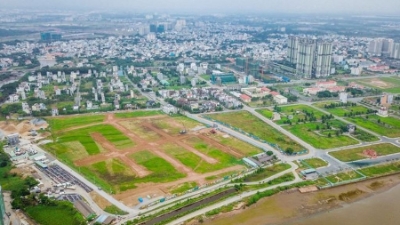
According to Mr. Trung, over the years, subdividing land and developing housing spontaneously in some areas has caused population density to grow faster than infrastructure capacity, placing additional pressure on transportation, schools, healthcare, and public spaces. This issue is becoming more significant as, under Hanoi’s 100-year master plan, the city’s population is projected to reach around 14-15 million by 2035, creating increasingly significant demands on urban planning and infrastructure capacity. Therefore, controlling land subdivision and plot sales needs to be considered as part of the broader urban development equation, helping curb spontaneous growth in areas that already have high population densities.
This orientation will also have a significant impact on housing demand. Projects and urban areas with clear planning, convenient infrastructure connections, and integrated services will be better positioned to attract buyers. This approach is also consistent with Hanoi’s goal of developing a polycentric, multi-centered urban structure, in which residents, employment, and services are gradually distributed across new development areas rather than remaining overly concentrated in the urban core.
Long-term benefits
From an investment perspective, instead of focusing solely on expectations for capital appreciation, investors will need to pay greater attention to whether a property can generate cash flow, whether there is actual demand for it, and whether it has genuine potential for use and exploitation.
The provision on the use period of high-end apartments in Resolution No. 21 underscores the importance of a building’s life cycle, encouraging buyers to pay greater attention to developer reputation and operational capabilities than worrying about losing ownership rights, according to Mr. Trung.
From a market perspective, he continued, this will also make construction quality a more important consideration when buyers select properties. Buyers will need to look more closely at factors that directly affect a building’s ability to maintain its quality over time, including the developer’s reputation, design standards, materials, construction quality, and post-handover management and operational capabilities. For owner-occupiers, the value of a property is increasingly tied to its ability to meet their living needs over many years, from transportation and education to healthcare, the environment, and amenities.
From an investment perspective, instead of focusing solely on expectations for capital appreciation, investors will need to pay greater attention to whether a property can generate cash flow, whether there is actual demand for it, and whether it has genuine potential for use and exploitation.
On this issue, many observers also believe that policy changes are introducing a different perspective on real estate value. As these changes take shape, the market is shifting toward greater emphasis on genuine demand, with real estate value increasingly tied to how an asset is actually used rather than simply to expectations of future price increases.
A recent survey by the Vietnam Association of Realtors (VARS) found that demand remains present but is increasingly selective and concentrated on projects with transparent legal status, reliable implementation progress, and good quality, while also meeting genuine housing needs and offering potential for use and cash flow generation. However, Resolution No. 21 currently only sets out views and orientations that will need to be further institutionalized in the coming period. For these provisions to be effectively implemented, several important issues still need to be clarified.
Regarding the use period of apartments based on a building’s service life, these include criteria for determining a building’s service life based on technical standards; the conditions, procedures, and authority responsible for determining when a building has reached the end of its service life; mechanisms for fulfilling financial obligations when reconstructing apartment buildings; owners’ rights after a building is reconstructed; and solutions for cases where owners do not agree or lack the financial capacity to participate.
“Regulating the use period of apartments based on the service life of the building is an appropriate orientation for modern urban development and building life-cycle management, and could help remove bottlenecks in the renovation and reconstruction of old apartment buildings,” a VARS representative said. “However, to ensure the effectiveness of the policy, it is important to safeguard property rights, ensure transparency in implementation mechanisms, and build confidence among residents and the market.”






 Google translate