


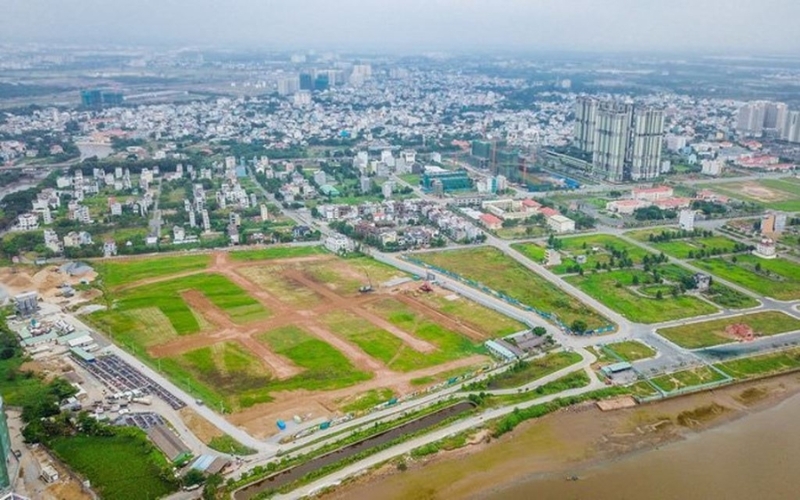
More than a year after the Land Law 2024 and its guiding documents took effect, several new policies have begun delivering results, helping unlock land resources for socio-economic development. But new issues have also emerged in practice, prompting the need for a National Assembly (NA) resolution to further institutionalize the Party’s directions and resolve difficulties in legal enforcement.
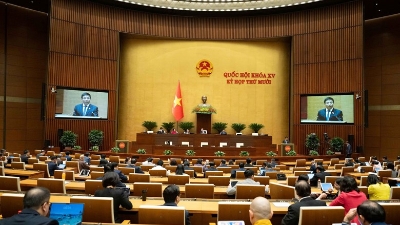
On the afternoon of November 18, Minister of Agriculture and Environment Tran Duc Thang presented to the NA a submission on a draft resolution outlining mechanisms and policies to address obstacles in implementing the Land Law. According to the submission, the resolution aims to fully and promptly reflect the Party and State’s views on land policy; remove emerging bottlenecks; and support socio-economic development goals. It also seeks to strengthen the effectiveness of land management and create momentum for Vietnam to move towards high-income, developed-country status.
Reworking the rules
The draft resolution proposes adding three cases in which the State may reclaim land for socio-economic development in the national or public interest. The first involves projects to develop free-trade zones or International Financial Centers, while the second applies to projects that require agreements on land-use rights but fail to complete negotiations by the legal or extended deadline, and the third allows the State to create a land fund for payment under build-transfer (BT) contracts or to lease land for continued operations by organizations whose land is being reclaimed.
The draft also details the legal basis for land reclamation tied to a project’s implementation schedule or to the progress of compensation, support, and resettlement. Compensation and resettlement prices would be calculated using a land price table and adjustment coefficients. Land-use fees, land rents, and compensation values would also be based on the price table, the adjustment coefficient, and applicable rates for each type of land.
To address bottlenecks highlighted in Notice No. 08-TB/BCDTW, the draft adds a provision allowing land reclamation for national defense and security purposes, establishing drug rehabilitation facilities managed by the armed forces.
The draft sets a ten-day public disclosure period for compensation and resettlement plans, and a 30-day deadline for holding dialogue with people who may not agree with such plans.
It also clarifies conditions for investor selection through bidding for land-use projects - urban and rural residential projects must have an approved zoning plan or general plan where detailed plans are not required. The land price table would be used to calculate land-use fees, land rents, land repurposing fees, recognition of land-use rights, and land-use extensions.
Notably, the draft does not require parcel separation when only part of a land parcel is being repurposed. When parcels are merged, they are not required to share the same land-use purpose, land-use form, or land-use term.
Resetting the approach
To further ease obstacles in enforcing the Land Law, the draft resolution outlines a series of targeted fixes.
On land reclamation, compensation, and resettlement, the draft addresses the deduction of advance payments made by investors; timelines for reclamation notices; cases where land compensation does not apply; compensation for asset losses; and transitional measures to close implementation gaps.
On land allocation, leasing, and land-use conversion, it proposes clearer conditions for allocating or leasing land and approving land-use changes. It also adds situations where land may be allocated or leased without auctions or investor bidding, and allows land-use terms to be adjusted to match project timelines when new investors take over dissolved, bankrupt, or transferred projects.
On land finance and pricing, the draft seeks to clarify how land-use fees and land rents are calculated, when input data should be selected, and how land price tables, adjustment coefficients, valuation councils, and fee exemptions should be revised.
Mr. Phan Van Mai, Chairman of the NA’s Economic and Financial Committee, said most NA delegates view expanded land reclamation powers as a way to unlock stalled socio-economic projects that depend on negotiated land-use rights. The mechanism would help investors who have secured most of the required land but are unable to complete site clearance.
However, the Committee called for clearer justification of the proposed 75 per cent consent thresholds and for a more detailed mechanism to handle remaining land in a way that protects constitutional rights and minimizes disputes.
The Committee agreed with the government’s approach to calculating land-use fees, land rents, and compensation, but emphasized that using the land price table in place of project-specific valuations must ensure fairness, transparency, and avoid placing extra burdens on citizens and businesses.
It also questioned whether land price tables and adjustment coefficients can adequately reflect market conditions, noting that while adjustment coefficients are simple to apply, their basis remains unclear.
On land valuation principles and methods, the Committee underscored the need for a market-based approach but said implementation must be cautious and backed by stronger data and independent oversight.
Regarding land price tables and adjustment coefficients, the Committee supported the State’s role in setting land prices but urged a review of transitional rules and clearer guidance on determining adjustment coefficients to prevent future bottlenecks.
Aligning interests
NA Deputy Tran Van Khai from northern Ninh Binh province said multiple problems have surfaced more than a year into the implementation of the Land Law 2024, with land valuation emerging as a major bottleneck. He expects the draft resolution’s valuation reforms to ease many of these obstacles. A more market-aligned land price table would boost State revenue and ensure fairer compensation, reducing grievances and helping stabilize livelihoods after land is reclaimed. Investors would benefit from faster, clearer pricing procedures, while a more transparent land-pricing system would, over time, curb rent-seeking and speculation.
A key provision of the draft allows the State to reclaim remaining land when investors have secured agreements with more than 75 per cent of the land area and affected land-users, a measure seen as crucial to unblocking long-delayed projects hindered by a small number of holdouts.
NA Deputy Nguyen Van Huy from northern Hung Yen province said the mechanism would help resolve persistent bottlenecks and avoid wasting resources, especially in infrastructure and urban redevelopment projects. He proposed safeguards to ensure that compensation for the reclaimed portion is not lower than the average negotiated price or a separate market benchmark.
Some lawmakers urged the drafting committee to carefully calibrate valuation rules to protect residents’ rights. Deputy Tran Thi Kim Nhung from northern Quang Ninh province called for clearer justification for the proposed 75 per cent threshold and for a transparent mechanism to handle the remaining land while safeguarding constitutional rights and limiting disputes. She also stressed the need for compensation rules that fairly balance interests, noting that applying land price tables and adjustment coefficients could leave some residents with payouts below average negotiated levels.
Several deputies also asked the government to assess the broader impacts of reclaiming land under this mechanism, warning that because the measure directly affects citizens’ property rights, it must be approached with caution.







 Google translate