


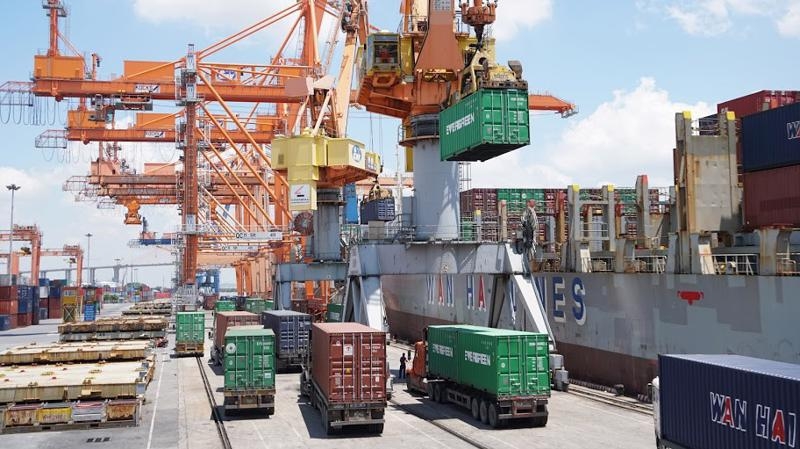
Exports have remained a rare bright spot for Vietnam’s economy in recent years, according to the Ministry of Industry and Trade (MoIT). In the first ten months of 2025, Vietnam posted a trade surplus of nearly $20 billion, with total trade turnover surpassing $762 billion, up 17.4 per cent year-on-year; a strong sign of the economy’s resilience and its capacity to expand into new markets in the months ahead.
Despite record-breaking export figures, however, regulators and experts argue that the value captured by Vietnamese enterprises remains limited, with businesses still circling a handful of easy markets. They believe Vietnam needs to revamp its export model, accelerate the green transition, upgrade value chains, make better use of its free trade agreements (FTAs), and strengthen legal and tariff risk management - all essential steps for Vietnamese enterprises looking to “Go Global”.
Raising Vietnam’s global game
At the “Vietnam Export Promotion Forum 2025: Winning International Markets”, Mr. Vu Ba Phu, Director General of the Trade Promotion Agency (Vietrade) at the MoIT, said the number of enterprises exporting directly remains modest, and Vietnam still falls short in meeting international standards, brand building, supply chain management, and digital commerce. Major markets with strong potential, including the US, the EU, Japan, and the Middle East and Africa, remain far from fully tapped.
To expand Vietnam’s global footprint, integrate more deeply into value chains, and elevate the national brand, speakers maintained that companies must innovate and accelerate both digital and green transformations to optimize supply chains and enhance the value of exported goods.
Mr. Tran Huy Hoan, Senior Officer at MoIT’s Planning and Finance Department, said Vietnam must reposition itself in global supply chains by moving into product research and design and connecting directly with customers - bypassing intermediaries, much like successful Chinese companies. He urged businesses to view global markets not only as destinations for exports but also as sources of resources and investment opportunities.
Companies, he continued, should shift from passive participation (low-value assembly) to active engagement in R&D, design, and direct buyer relationships, while the government strengthens not only trade agreements but also investment and investment protection frameworks to support overseas expansion.
Mr. Nguyen Manh Ha, Director of AHT Tech, said Vietnam lacks the complete ecosystem needed for successful global expansion, namely skilled talent, capital, and strong support in market connections. To overcome this, he counseled greater government assistance in helping firms reach end-users and understand local cultures and business models. Companies, he added, should be ready to hire local talent abroad to guide and support entry into new markets.
“Finance is necessary, but people and a mindset for connection are decisive,” according to Mr. Nguyen Quoc Khanh, Executive Director of Research and Development at Vinamilk. When facing technical challenges, Vinamilk leverages not only internal capabilities but also external expertise through research partnerships and collaboration with multinational corporations. Environmental standards in Europe and tariffs in the US, he noted, pose challenges but also create opportunities to strengthen brand value.
Ms. Doan Thi Bich Ngoc, CEO of Canifa, called on the government to focus on three pillars to support Vietnamese companies going global: trade promotion; tax and administrative reform; and unlocking green finance. “Green transition demands patience and significant financial resources,” she said. “If sustainable development is a priority, capital must be channeled into these core areas so that businesses can invest long term, from research through to finished products.”
Turning agreements into advantages
Speakers at the forum broadly agreed on one point: with 17 FTAs now in force, Vietnam has a rare opening to push its “Go Global” agenda. Yet according to Mr. Ngo Chung Khanh, Deputy Director General of the Multilateral Trade Policy Department at MoIT, businesses are still far from fully capitalizing on these agreements. Utilization rates remain modest, at nearly 10 per cent for the Comprehensive and Progressive Agreement for Trans-Pacific Partnership (CPTPP), around 38 per cent for the UK-Vietnam FTA (UKVFTA), and about 35 per cent for the EU-Vietnam FTA (EUVFTA).
The reason, he explained, is a lingering mindset of sticking to what is “near and easy.” Many firms remain content exporting a few dozen containers a year or achieving steady but limited revenue, believing “that’s enough.” This mindset keeps companies locked into familiar markets and stifles innovation. To compete globally, Mr. Khanh urged businesses to be willing to play the “Go Global” game and stop being selective. Fear of difficult markets or substantial barriers, he warned, has unnecessarily held back many capable companies.
To break into major destinations such as the EU via the EUVFTA, he said, companies must “think big”, with brand building as the ultimate goal. That requires a detailed strategy - what businesses will do, and how central and local authorities will support them. Every step must be precise and actionable.
Mr. Khanh also emphasized the need for dedicated FTA teams inside companies, but findings from the FTA Index show that not a single Vietnamese enterprise has such a unit. As a result, they often have nowhere to turn when confronted with foreign market standards. “Businesses are willing to spend heavily on sales and marketing, but hesitate to pay far less for experts or consultants who can help them take advantage of FTAs,” he said.
He added that connections are the most critical factor. The MoIT is proposing an “FTA Ecosystem” that links all stakeholders - domestically and with FTA partners - to help businesses use the agreements more effectively.
Mr. Dan Martin, Assistant Manager of International Business Advisory at Dezan Shira & Associates, said Vietnam’s ambitious FTA network is underutilized because many small and medium-sized enterprises (SMEs) lack the systems, expertise, and capital to benefit. To tap into these agreements, companies must upgrade sourcing practices, traceability, and record-keeping. Compliance, he argued, should be seen as a competitive advantage, not a burden. He also stressed the need for stronger collaboration between the government, business associations, and foreign-invested enterprises (FIEs) to turn FTAs from policy documents into practical gains.
He outlined three core factors for Vietnamese companies seeking to “Go Global”. First, quality must outweigh cost. Vietnam’s next development phase depends on trustworthiness and reliability rather than cheap labor. Foreign investors prioritize safety, transparency, and consistent quality - the key to entering global supply chains.
Second, people matter as much as technology. Businesses must invest in training to turn talent into applied skills, from repair engineers to compliance-minded managers, to fill widening technical gaps.
Finally, Vietnam must strengthen its local platforms. Exports remain heavily dependent on FIEs, and low local sourcing is a long-term vulnerability. Going global must start at home, by helping local SMEs grow alongside FIEs through faster certification and supplier development programs.





 Google translate