


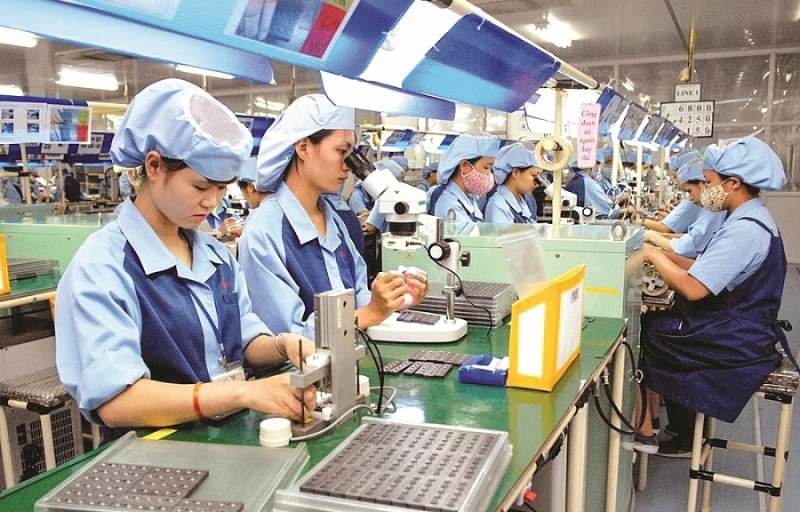
Vietnam’s support industry sector has seen a much brighter picture in recent years compared to the past. The country is now home to nearly 7,000 support industry enterprises, most of them concentrated in five key sectors: mechanical engineering, automobiles, electrical-electronics, textiles and garments, and high technology.
Some 300 domestic companies have already secured a place in the supply chains of major foreign-invested manufacturers such as Samsung, Honda, Toyota, and LG. But limited technological capability remains a major hurdle, keeping many Vietnamese support industry companies on the sidelines of global supply chains.
Stalled by low tech
At the recent “Increasing Technological Content and Enhancing Competitiveness for Support Industry Products” seminar, Mr. Chu Viet Cuong, Director of the Industrial Development Support Center (IDC) at the Ministry of Industry and Trade (MoIT), said the localization rate in many support industry sectors in Vietnam remains low, hovering at around 30-40 per cent; still far below the government’s target of 50-60 per cent. He added that price competitiveness is limited, and the technological capability of enterprises remains only average. Their ability to apply scientific research and conduct R&D also remains quite poor.
Meanwhile, shifting conditions at home and abroad are posing new challenges, from financial pressure to technological gaps and a lack of high-quality human resources, all of which fall short of the requirements of major global corporations. In addition, collaboration between institutes, universities, technical centers, and businesses is still rather limited, creating another major hurdle for the development of support industries in Vietnam.
According to industry experts, the core problem is that many enterprises still operate with low technological capability and lack investment in machinery upgrades, equipment modernization, and R&D. Access to advanced technologies from FDI companies remains limited, while the technical workforce is not yet equipped to handle technology transfers. R&D capacity within support industry companies has yet to take shape in any substantial form.
Additionally, only a small number of companies have laboratories or teams of engineers dedicated to product improvement. Most continue to depend on customer or FDI designs and lack the ability to independently design and develop new products.
Mr. Nguyen Van, Vice President of the Hanoi Supporting Industry Business Association (HANSIBA), noted that most players are small and medium-sized enterprises (SMEs) and therefore constrained by limited capital, technology, management capacity, and high-quality human resources. “We have had nearly 40 years of economic reform, but support industries have only existed for just over a decade,” he emphasized. “In many places, companies still do not truly prioritize innovation. So to break into the value chains of major corporations, domestic support industry enterprises must make real breakthroughs in innovation.”
Of a similar mind, Mr. Cao Van Hung, Director of International Market at Smart Vietnam, said that to become a supplier for global corporations, companies must invest in high-tech machinery, which can cost up to millions of US dollars. “This enormous upfront investment is a major burden, and the payback period is long,” he said.
Beyond that, he continued, Vietnam lacks high-quality personnel, especially in R&D and new product development; fields that are essential in helping Vietnamese companies move beyond low value added contract manufacturing. Retaining talent is also difficult due to fierce competition from FDI companies for skilled workers.
Another obstacle is technical certification. For example, to participate deeply in Boeing’s supply chain, companies must obtain sector-specific certifications such as AS9100. But obtaining such certifications requires significant cost and time, creating yet another barrier that prevents enterprises from advancing past the technical threshold.
Racing to upgrade
To get on to the radar of multinational corporations, Mr. Hung said Smart Vietnam plans to intensify its investments in innovation to create momentum and boost competitiveness. “We are targeting key markets such as the UK, Australia, and the US,” he told the seminar. “We will certainly invest more deeply so that Smart can not only supply components but also deliver fully-finished products to our customers.”
However, despite having been in the support industry sector for many years, Smart has yet to gain access to government credit packages. Mr. Hung said he hopes to be able to access preferential capital sources to invest in technological upgrades and strengthen the company’s competitiveness.
In response to these challenges, Mr. Cuong said the MoIT will focus on four major groups of solutions in the time ahead.
First, the government will work to improve enterprises’ innovation capacity through support for technology transfer, R&D for new products, the machining and production of high-precision components, and assistance in meeting international certification standards. The Ministry will also roll out digital transformation programs to help firms optimize production processes.
Second, it is building top-tier technical support centers that function as regional hubs, such as the IDC Development Support Center and the IDCS Center in Ho Chi Minh City. These centers serve as focal points for technology transfer consulting and for technical training for staff and even management training for mid-level and senior managers at enterprises.
Third, efforts will be stepped up to promote links in value chains between FDI enterprises and domestic investors. MoIT regularly organizes international fairs such as VIMEXPO and dispatches Vietnamese business delegations to international exhibitions. Through these fairs, exhibitions, and seminars, B2B connections between buyers and sellers can be strengthened to promote value-chain integration.
And fourth, Vietnam will continue developing a high-quality technical workforce, especially in mechanical engineering, automotive, electronics, and high technology. This is being carried out through enterprise demand surveys and training programs tailored to specific needs, from software training to upskilling technicians and supporting digital transformation.
However, Mr. Cuong stressed that resolving these challenges requires coordinated efforts on “three sides and four fronts.”
The “three sides” include the State, which must create open policies to support businesses through tax incentives, credit access, land, and infrastructure; enterprises, which must proactively upgrade technology, participate in scientific research and new product development, and join training programs that improve workforce quality; and institutes, universities, and technical centers, which act as focal points for technology transfer and capacity building.
The “four fronts”, meanwhile, include these three elements plus business associations such as HANSIBA, which act as bridges helping enterprises access policies and accelerate R&D and technological innovation.
According to Mr. Cuong, increasing technological content and strengthening the competitiveness of support industry enterprises in global supply chains is a long journey, but one that cannot be delayed. Only when Vietnamese enterprises master technology and proactively join global supply chains can Vietnam build an autonomous and sustainable technological foundation.





 Google translate