


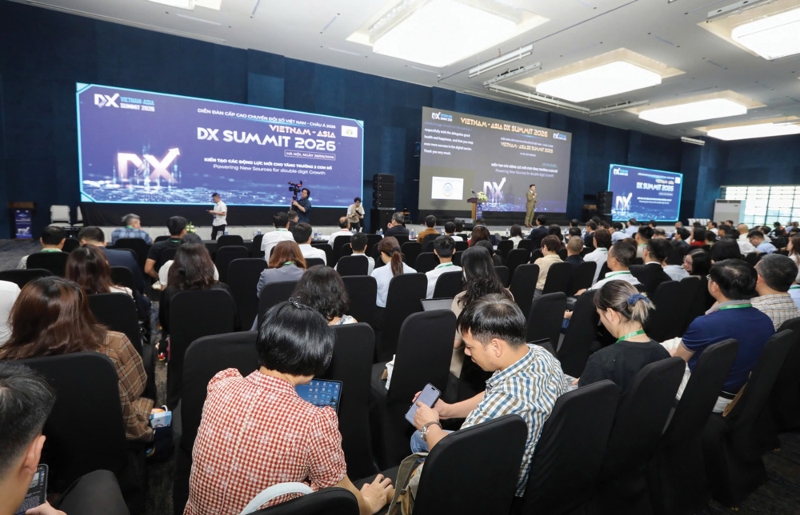
The Vietnam Software and IT Services Association (VINASA) hosted the Vietnam - Asia DX Summit 2026 in Hanoi on May 27-28, with the theme “Powering New Sources for Double-Digit Growth”, bringing together thousands of delegates, including government leaders, ministries, local authorities, CEOs, CIOs, and CTOs of major enterprises, AI and technology experts, and leading Vietnamese and international technology corporations.
Opening the Summit, Mr. Ngo Dien Hy, Vice Chairman of VINASA and Deputy CEO of the Vietnam Posts and Telecommunications Group (VNPT), said Vietnam is entering a new phase of development, targeting double-digit economic growth in the 2026-2030 period. This, he noted, is not only about growth rates but also about transforming the country’s development model. In that context, science and technology, innovation, and digital transformation are becoming the most important new growth drivers.
Proud strides forward
Mr. Hy stressed that Vietnam’s digital technology community must be capable of shaping and leading strategic frontiers of the future, including AI, the low-altitude economy, robotics, and quantum technologies - emerging fields expected to generate major “technology surpluses” and shape Vietnam’s standing in global supply chains.
He further noted that Vietnamese digital technology firms have already taken notable steps forward. “We have demonstrated the ability to fully master our application, digital transaction, and digital infrastructure layers,” he believes. “We have moved beyond passive technology adoption toward mastering core technologies under the ‘Made in Vietnam’ strategy, from AI and cloud infrastructure to localized large language models, automated agent systems, full-process digital public services, and land resource data integration in key localities.”
However, he also warned that as businesses enter a new acceleration phase, they must confront mounting challenges, including the limits of traditional labor-driven growth, growing pressure on physical infrastructure and clean energy, and legal gaps for deep tech and emerging technologies.

Deputy Minister of Science and Technology Bui Hoang Phuong said 2025 marked a major breakthrough in institutional reform under the guiding principle that “institutions must lead the way.” Vietnam, he noted, has reviewed, amended, and supplemented nearly its entire legal framework for science and technology, innovation, and digital transformation.
“For the first time, we now have the Law on Digital Transformation, the Law on Digital Technology Industry, the Law on AI, and the Law on Data, together with implementation guidelines that are gradually creating a synchronized legal framework for a new development space,” he continued. “Vietnam is now among the few countries globally to establish a relatively comprehensive legal framework for these sectors.”
He added that the priority for 2026 is to translate these institutional foundations into tangible outcomes. Policies on digital transformation, he said, must deliver practical benefits for citizens and businesses.
To achieve this, the Ministry of Science and Technology is calling on ministries, sectors, and especially digital technology enterprises to proactively identify the daily challenges faced by citizens, businesses, and public agencies at both the central and local levels, rather than waiting for problems to be formally proposed.
Businesses, he added, should actively propose breakthrough solutions, models, and approaches for applying digital technologies to practical challenges while also recommending adjustments to procedures and regulations to enable wider technology adoption. He emphasized that implementation should focus on solving concrete and practical problems first. Once proven effective, however, successful models should be scaled up quickly to accelerate digital transformation across society.
Toward interoperable data
Local leaders reaffirmed that science, technology, innovation, and digital transformation are emerging as key growth drivers in Vietnam’s new development phase. However, many localities continue to face difficulties, with the digital economy’s contribution to gross regional domestic product (GRDP) still below expectations, especially in localities lacking strong technology ecosystems, such as Hue in the central region and south-central Khanh Hoa province. In response, local governments are developing dedicated policies to support domestic technology firms while investing in shared digital infrastructure and platforms to improve the efficiency of the broader digital ecosystem.

We have demonstrated the ability to fully master our application, digital transaction, and digital infrastructure layers.
Mr. Nguyen Thanh Ha, Vice Chairman of the Khanh Hoa Provincial People’s Committee, said the Provincial People’s Council is expected to issue a resolution in the second quarter of this year to implement provisions of the new Law on Science, Technology and Innovation. Support measures will include assistance for establishing technology firms and improving access to financing through specialized funds.
The province is also working to establish a Science and Technology Fund and a venture capital fund to support the growth of local technology businesses. At the same time, Khanh Hoa is partnering with major institutions, including the Vietnam National University Ho Chi Minh City and the Ho Chi Minh City University of Economics, to help local businesses adopt digital transformation, improve productivity, and strengthen resilience.
Meanwhile, Mr. Nguyen Duong Anh, Deputy Director of the Hue Department of Science and Technology, said many technology infrastructure systems built years ago are becoming outdated and overloaded amid the demands of digital transformation and AI. The rapid rise of AI, he noted, is driving significantly greater demand for data, processing capacity, and governance, making infrastructure upgrades increasingly urgent despite limited investment resources.
Acknowledging the infrastructure and data challenges facing both businesses and localities, Mr. Hoang Huu Hanh, Deputy Director General of the National Authority of Digital Transformation at the Ministry of Science and Technology, said the Ministry has been tasked with reviewing and upgrading the national shared digital platform system.
The goal, he said, is a system that requires one-time investment but can be used consistently from the central to local levels. Functions already developed centrally should not need to be duplicated by local governments, while all platforms must meet unified technical standards and ensure interoperability with national databases.
After two days of discussions spanning institutions, infrastructure, data, energy, and AI, one message consistently emerged from the Summit: science and technology, innovation, and digital transformation are no longer supporting tools but core growth drivers for the economy. In the next development phase, digital transformation must move beyond isolated digitization efforts toward data-driven operations, interoperable data systems, and nationally-shared digital platforms. Cooperation between government, technology firms, and local authorities, delegates said, will determine how quickly Vietnam can achieve new breakthroughs in the decades ahead.









 Google translate