


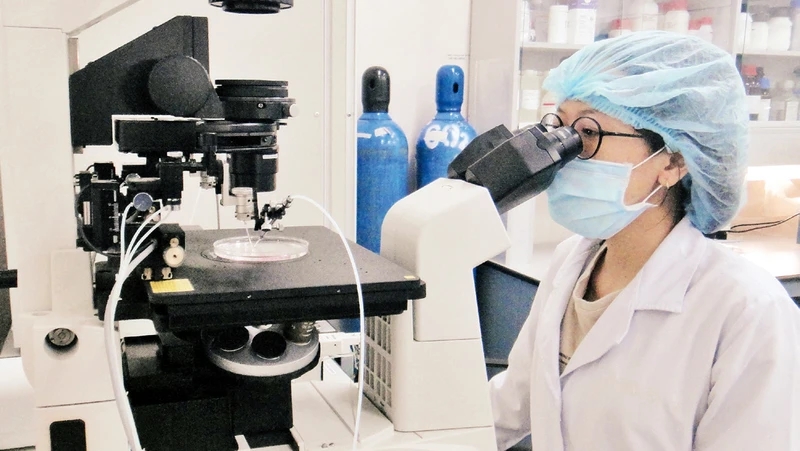
As climate challenges in Vietnam and around the world intensify, initiatives that harness technological solutions and cross-sector collaboration are becoming increasingly vital. At a panel discussion entitled “How STEM Sparks Sustainable Solutions”, held during Sustainability Week 2025 at RMIT Vietnam, experts from academia, research, and industry explored how innovation in science, technology, engineering, and mathematics (STEM) could accelerate Vietnam’s progress toward the United Nations Sustainable Development Goals (SDGs) and support its shift to clean energy and digital transformation.
The speakers noted that stronger partnerships between industry and universities position STEM as both a catalyst and a backbone for innovation, helping turn research into real-world solutions for clean water, renewable energy, and sustainable infrastructure, and opening the way to new opportunities and transformative impact.
Inspiring sustainable solutions
According to Dr. Nguyen Thanh Dien, Head of the Research Management and International Relations Office and Lecturer at the School of Biotechnology at Tan Tao University, environmental engineering principles play a crucial role in addressing climate change and pollution challenges in Vietnam. “There are two key concepts to focus on: mitigation and adaptation,” he explained. “We need to apply environmental engineering solutions such as waste-to-energy systems and industrial air filtration to reduce pollution.”
Mr. Dong Mai Lam, Cluster President for Schneider Electric Vietnam and Cambodia, shared his insights into the role of STEM in building sustainable enterprises. “Schneider Electric is a technology company, but STEM is not just about science or engineering,” he said. “It is about analytical thinking, critical reasoning, and decision-making skills. We apply STEM in every aspect of our operations, from manufacturing and supply chains to data management, to enhance energy efficiency, digitalize operations, and advance sustainable electrification.”
On renewable energy adoption, particularly rooftop solar, he noted that electricity prices in Vietnam remain relatively low due to subsidies, so the investment incentive is not yet substantial. However, interest in solar energy is growing rapidly in the country, driven by improved regulatory frameworks and rising awareness about sustainability. “The benefits of solar power are clear,” he continued. “Technology is enabling a future where energy is distributed better and is more accessible. When regulation, mindsets, and community motivation align, rooftop solar will become a familiar sight around Vietnam.”
From the perspective of water management, Ms. Nguyen Thi Kim Hoang, South Corporate Affairs Manager at the La Vie LLC, part of Nestlé Waters Vietnam, spoke of how the company has embedded the Alliance for Water Stewardship (AWS) framework into its operations for over three decades, earning international certification for sustainable water management.
Meanwhile, Dr. Phan Cong Hoang, Lecturer in the Food Technology and Nutrition Program at RMIT Vietnam, highlighted the role of STEM education in cultivating critical thinking and problem-solving skills, equipping students to become future leaders in sustainable development. With multi-sector collaboration, STEM is a catalyst and the backbone for innovation to unlock new possibilities and opportunities.
Dr. Dien underscored the need for stronger industry-university collaboration. “We need to hear more industry-defined problems,” he told the panel discussion. “Instead of academics pushing theoretical technology to industry, we need industry pulling solutions from academia by co-funding applied research that addresses specific, real-world operational challenges.”
Speakers agreed that scientific thinking and technological innovation are central to achieving clean water, renewable energy, sustainable infrastructure, and inclusive growth both in Vietnam and globally. STEM, they noted, is the catalyst for innovation and cross-sector collaboration, unlocking new opportunities to advance sustainability across education, business, and the wider community.
Driving sustainable change
Discussing water management, Ms. Hoang described a detailed framework for companies seeking water stewardship certification. “Achieving certification is not simple; it requires every step, each linked to a specific outcome,” she explained. There are five key outcomes for water stewardship.
The first is compliance and collaboration, meaning companies must comply with regulations and work with partners to collectively improve water practices. The second is water efficiency, where internal processes need to maximize efficiency while also supporting local water sustainability projects. The third outcome is water quality. The fourth is the protection of critical water areas. And the fifth focuses on sanitation and hygiene, ensuring that both employees and surrounding communities have access to freshwater and proper sanitation.
Turning to sustainable investment, Mr. Lam addressed common misconceptions. “Many still believe that sustainable investment is costly, but with today’s technological advances, the payback period for green solutions has been significantly shortened,” he said. “Businesses can start with small, practical steps and scale up as they see tangible results.”
He noted that businesses need to look beyond immediate financial returns. A green building, he explained, may cost 3-5 per cent more in upfront capital, but its long-term value is much higher. Certified green projects also tend to attract better tenants and higher valuations. Beyond profit, companies must also embrace their environmental and social responsibility.
Regarding the intangible values reflected in environmental, social, and governance (ESG) reports, he added that sustainable development goals such as carbon emission reductions have become essential components of corporate value. “Every kWh saved translates into reduced emissions, contributing to higher company valuations, especially for listed firms,” Mr. Lam noted.
In closing, Ms. Hoang discussed urban flooding and climate risks, stressing the importance of early warning systems, improved drainage infrastructure, and clear response plans for businesses. “Sustainability means partnership,” Ms. Hoang said. “Protecting water resources requires collaboration with government, communities, like-minded partners, and internal cross-functional teams, especially factory and supply chain teams.”
Balancing tech and impact
As Vietnam accelerates its digital transformation, the growing demand for AI and data centers presents a critical question: how can technological progress move forward without overwhelming the country’s energy and environmental systems?
Dr. Dien highlighted both the potential of and the challenges facing resource-intensive data centers. “Data centers consume tremendous amounts of power,” he said. “AI is transforming every field, from energy and society to scientific research. We must balance technological progress with its social and environmental impact through responsible governance and fair negotiation.”
Addressing concerns that the current global AI boom could become an economic bubble similar to 2008, and the potential implications for Vietnam, Mr. Lam said AI must be viewed from multiple perspectives. “It brings significant efficiency improvements across operations,” he explained. “At Schneider Electric, we have fully integrated AI into our energy solutions.”
He cited EcoStruxure, Schneider Electric’s connected energy management platform, as an example of how AI and data analytics help businesses optimize operations, predict equipment failures, reduce electricity consumption, and cut carbon emissions. “The key is to turn ‘invisible energy’ into something visible so that companies can measure, monitor, and improve their energy performance,” he emphasized. “AI delivers remarkable efficiency in operations and production, but data centers must also be designed to use electricity more efficiently.”
He further added that AI can optimize energy use, anticipate equipment failures, and enhance operational efficiency, but it must be applied responsibly. “AI should empower people, not replace them,” he stressed. “Human creativity and accountability remain irreplaceable



 Google translate