


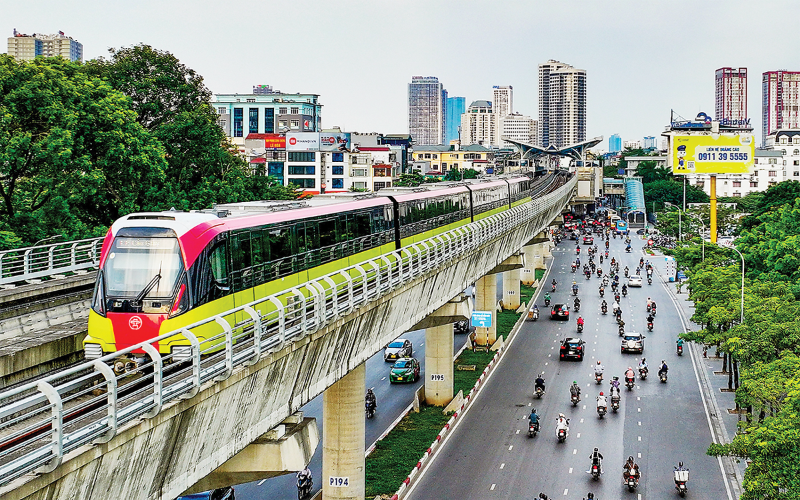
Hanoi has completed a comprehensive master plan for its urban railway network over recent years, outlining clear implementation phases. Vietnam’s capital aims to complete 96.8 km of Metro Lines 2, 3.1, and 5 by 2030, while preparing investment for another 301 km spanning Metro Line 1, the extended Metro Line 2A, and Metro Lines 4, 6, 7, and 8, as well as the Son Tay - Hoa Lac - Xuan Mai corridor. Between 2030 and 2035, it expects to complete an additional 301 km, followed by 200.7 km in the 2036-2045 period. If achieved as planned, the city will ultimately operate more than 619 km of urban rail.
Modest progress
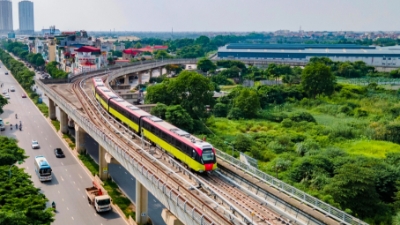
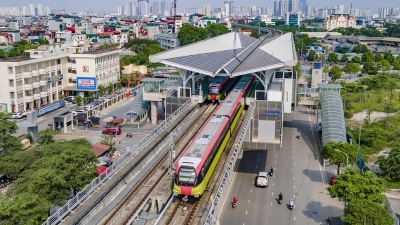
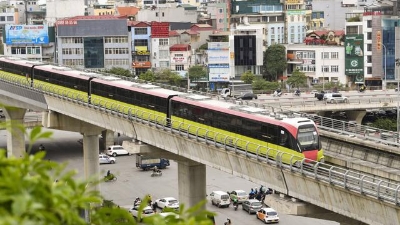
In practice, progress has been far more modest to date. Hanoi has so far brought only two segments into commercial operation with a combined length of 21.5 km: Metro Line 2A, Cat Linh - Ha Dong, and the elevated portion of Metro Line 3.1, Nhon - Hanoi Station. Together, they account for just 3.5 per cent of the planned network.
At the construction site of the Nhon - Hanoi Station line, the TBM1 tunneling machine completed its passage through four underground stations on December 1, 2025. The Hanoi Metropolitan Railway Management Board hailed the milestone as a “significant turning point for the project,” crediting the achievement to close coordination between contractors. Representatives from the contractor consortium said the complex geological conditions in Hanoi’s inner districts required strict adherence to safety standards.
Yet when placed against the nearly 620-km target, what has been completed remains only a fraction, underscoring the sizeable gap between ambition and reality. That gap carries heavy implications for resource allocation, project management, and the choice of financing models suitable for a system of such scale and complexity.
Hanoi’s renewed push to expand its urban rail network signals not only momentum towards a high-capacity public transport backbone but also a rising set of demands involving capital, planning, and execution. These pressures are magnified by the city’s long-term vision: a multi-center urban structure linking the core districts with satellite towns and unlocking new corridors of economic growth.
New pressures
The most immediate challenge is the sheer volume of financial resources required. According to Mr. Le Trung Hieu, Deputy Director of the Hanoi Department of Finance, more than 400 km of urban rail, including 100 km of underground sections, must be completed before 2035. The estimated investment stands at $53 billion, or roughly VND1,400 trillion.
Between 2026 and 2030 alone, the city needs $12 billion, equivalent to about VND500 trillion. “In 2025, Hanoi’s State budget revenue is estimated at VND517 trillion ($19.88 billion), with the city retaining just over VND100 trillion ($3.84 billion),” Mr. Hieu noted. “Comparing these figures shows that relying solely on public investment would create a substantial shortfall. Hanoi needs a different structure and different sources of capital to meet its project timelines.”
Capital is not the only constraint. Ensuring consistency across layers of planning is now more critical than ever. As metro lines extend outwards, the alignment of routes, station locations, technical corridors, and emerging development poles will determine how effectively Hanoi can implement Transit-Oriented Development (TOD). Experts warn that if these components are not aligned and advanced in parallel, preparation phases could drag on and overall costs could climb due to repeated adjustments.
Execution capacity is an equally pressing issue. The involvement of numerous municipal departments and international consultants requires a unified coordination mechanism to keep procedures and timelines on track. The establishment of dedicated coordination units is a meaningful step, but effectiveness will depend on standardized workflows, particularly regarding land clearance, technical appraisals, and land value capture strategies.
Land availability and social infrastructure preparation also play a foundational role. Lines extending from the city center to suburban districts require substantial land for depots, underground and elevated stations, and resettlement sites. Without early and proactive preparation, projects risk delays. The technical complexity of urban rail, especially when tunneling through dense existing neighborhoods, demands thorough site readiness and risk forecasting.
Most importantly, Hanoi faces rising expectations regarding technological readiness and operational capacity. The adoption of advanced methods such as tunnel boring machines requires a highly-skilled workforce and rigorous oversight. As more complex phases commence, ensuring quality and safety will be inseparable from maintaining project momentum.
New urban landscape
As Hanoi works towards completing hundreds of kilometers of metro lines over the next three decades, its ambitions extend beyond higher public transport capacity: it is also preparing for a fundamental shift in its development model.
Each metro line, each station, and each depot will function as a new nucleus in the city’s spatial structure, supporting a transition toward multi-center development and reducing long-standing pressure on the urban core. These transit nodes will create fresh growth areas and help expand the city’s footprint in a more balanced manner.
Planned investments in 2025-2030 reflect a decisive shift towards suburban districts, which offer greater land availability and are better suited for modern TOD. Once connected by a full metro network, they could evolve into dynamic growth poles with flexible, well-linked spatial structures.
Such a transformation brings new demands in urban management. As metro lines become the backbone of mobility, clusters of commercial activity, services, and employment are expected to form around major stations. This could give rise to semi self-contained urban districts and reduce cross-city travel demand, easing pressure on already congested roads. A well-executed “city within a city” model could help Hanoi distribute growth more evenly.
Simultaneously, the city is strengthening its multi-center planning approach and positioning TOD as a key investment strategy. This was underscored by Standing Vice Chairman of the Hanoi People’s Committee Duong Duc Tuan in recent meetings with international partners, where he emphasized that cooperation must deliver “substantive progress and contribute directly to Hanoi’s transport infrastructure goals.” Ensuring adequate resettlement land and social infrastructure is therefore vital for creating vibrant, integrated living-working-service environments that attract infrastructure, technology, and real estate investors.
At a broader level, new metro lines will reshape real estate dynamics, employment patterns, and Hanoi’s overall growth model. International experience, including that of Seoul, South Korea, reinforce this trend.
According to Mr. Eun Lee from the Asian Development Bank, major cities have successfully captured part of the land value uplift generated by station area redevelopment, helping fund metro projects and catalyze new urban centers. As Hanoi advances its network, shifts in land value, capital flows, and socio-economic activity will require close monitoring to ensure balanced benefits and long-term sustainability.
In this complex interplay of infrastructure, planning, and development, the metro network is not merely a transport system; it is an instrument for reorganizing urban space - the foundation upon which Hanoi’s next chapter will be built.




 Google translate