



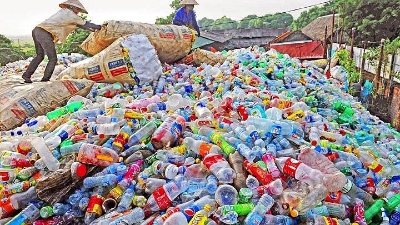
For much of the past decade, plastics pollution in Vietnam has been treated as an environmental externality - visible, costly, but largely disconnected from mainstream economic planning. That framing began to change decisively after 2020. Over the five-year period to 2025, plastic waste moved from the margins of policy discussion to the center of Vietnam’s green growth and innovation agenda, reshaping how businesses, investors, and regulators engage with the plastics economy.
According to the recently-released “Vietnam Plastic Innovation Shift 2020 - 2025” report from the United Nations Development Programme (UNDP), Vietnam’s plastics innovation ecosystem underwent a structural transformation during this period, shifting from fragmented, largely voluntary initiatives to a policy-driven, investment-backed system aligned with circular economy principles. This evolution has implications far beyond waste management. It touches on industrial competitiveness, capital allocation, startup development, and the country’s ambition to position itself as a regional hub for circular innovation.
From fragmentation to framework
The most important catalyst behind Vietnam’s plastics innovation shift was regulatory clarity. Prior to 2020, the policy environment relied heavily on guidance and incentives, with limited enforcement mechanisms. Innovation existed, but it lacked scale and predictability. That changed with the passage of the Law on Environmental Protection, which formally embedded circular economy principles into national legislation and established the legal basis for Extended Producer Responsibility (EPR).
This legal shift altered risk perceptions across the market. For manufacturers and brand owners, plastic waste management became a quantifiable compliance obligation rather than a discretionary sustainability effort. For investors, it created a clearer demand signal for recycling infrastructure, alternative materials, and supporting services.
The UNDP report shows that nearly 90 per cent of total funding for plastics-related innovation between 2020 and 2025 was deployed during the 2022-2023 period alone, following the issuance of detailed EPR implementation guidelines. Capital flowed into new programs supporting recycling capacity, alternative materials manufacturing, and technology-enabled waste management systems. Public funding, international development finance, and private capital increasingly converged around similar priorities, reinforcing the sense that plastics innovation had become a legitimate investment theme.
This surge in funding coincided with measurable operational changes. Participation in product take-back schemes expanded, while the national plastics recycling rate increased compared with pre-2020 levels. Though still modest relative to total waste generation, these gains signaled that policy-backed investment could begin to move the needle at scale.
However, the distribution of capital also revealed structural imbalances. Large, capital-intensive projects, particularly those aligned with multinational supply chains or export markets, were better positioned to attract funding. Smaller enterprises and early-stage innovators often struggled to access the same financial pipelines, despite playing a critical role in experimentation and local adaptation.
Innovation without scale
Small and medium-sized enterprises (SMEs) sit at the heart of Vietnam’s plastics innovation story. The UNDP analysis identifies 99 SMEs that had reached the ready-to-scale or early commercialization stage by 2025, operating across the full plastics value chain. These enterprises range from upstream material innovators such as An Phat Bioplastics, which produces industrial-scale biodegradable packaging under its AnEco brand, to smaller startups like ECOSOI, which converts pineapple leaf fiber into bio-based materials for fashion and packaging applications.
Other enterprises focus on leveraging Vietnam’s agricultural by-products to create new material streams. Companies including Buyo and AirXCoffee transform organic waste such as coffee grounds into bioplastics, composites, and consumer products, aligning circular innovation with Vietnam’s strengths in agriculture and food processing. These upstream and midstream enterprises reflect a broader trend towards redesigning plastics use at source, rather than relying solely on end-of-life solutions.
Downstream, a growing group of SMEs is investing in recycling, upcycling, and value added recovery. Companies such as Duy Tan Recycling and VietCycle have introduced advanced mechanical recycling processes to improve the quality and consistency of recycled plastic pellets, while others, including UpGreen Vietnam, focus on transforming low-value plastic waste into furniture, construction materials, and design products. In parallel, digital platforms like mGreen and VECA aim to improve collection efficiency and traceability through technology-enabled incentive systems.
Notably, many of these enterprises were founded after 2018, reflecting the rapid growth of sustainability-driven entrepreneurship following Vietnam’s policy shift toward the circular economy and EPR. Yet scale remains elusive. Roughly 80 per cent of plastics innovation enterprises remain at an early or nascent stage of development, even after entering the market. This is not due to a lack of ideas or technical capability, but rather to a combination of financial, infrastructural, and market barriers.
One of the most persistent challenges is the “valley of death” between pilot testing and commercial expansion. Many innovations emerge from competitions, university programs, or donor-funded challenges, which typically provide short-term grants lasting six to 18 months. These resources are sufficient for proof-of-concept testing, but rarely adequate for building production capacity, securing certifications, or developing distribution channels. Once initial funding ends, enterprises often face a sharp drop-off in support.
Upstream innovators producing biodegradable plastics or plant-based alternatives face production costs significantly higher than conventional plastics, while policy incentives to close this gap remain limited. Midstream enterprises offering refill or reuse models encounter slower-than-expected consumer uptake, particularly in the post-pandemic period when convenience and price sensitivity increased. Downstream recyclers, meanwhile, struggle with unstable feedstock supply due to weak collection and sorting systems, leading to underutilized capacity and volatile margins.
The report estimates that Vietnam loses a large share of high-quality recyclable plastics each year because of inadequate sorting and recovery systems. For SMEs, this translates into higher input costs, inconsistent material quality, and limited ability to meet the standards required by large buyers.
As a result, many enterprises turn outwards. Enterprises with international certifications and competitive products often prioritize export markets, where demand for recycled or bio-based materials is stronger and price premiums are more predictable. While this strategy supports firm-level growth, it also highlights a gap in domestic market readiness and the need for coordinated demand creation at home.
Investment gaps
The contrast between rising capital flows and persistent SME bottlenecks points to a structural financing gap. On one end, large-scale projects aligned with EPR compliance and multinational supply chains attract substantial funding. On the other, early-stage innovators benefit from grants and competitions. What remains underdeveloped is the patient and risk-tolerant capital that supports enterprises through the transition from pilot to scale.
The UNDP report notes that while Vietnam has a growing number of startup support organizations, only a small fraction focus on social impact businesses or plastics innovation specifically.
This gap has broader economic implications. Plastics innovation depends on system-wide coordination: collection infrastructure, standardized inputs, predictable offtake, and regulatory enforcement. Without targeted investment in these shared assets, individual enterprises, particularly SMEs, bear disproportionate risk. Addressing this imbalance will require not only more capital, but better-designed financial instruments, including blended finance facilities and replication funds tailored to circular economy models.
Multinational corporations have emerged as important system builders within Vietnam’s plastics innovation ecosystem. Rather than focusing solely on product-level changes, many are engaging in broader collaborations that link design, collection, recycling, and reuse.
This approach reflects a shift from isolated corporate social responsibility initiatives towards strategic engagement with circular economy infrastructure. By committing to recycled content targets, redesigning packaging for recyclability, and supporting collection systems, large firms help create the market conditions that smaller innovators need to scale.
The experience of the past five years suggests that plastics innovation in Vietnam is less about any single technology or startup than about how the system functions as a whole. Regulation has set the framework, capital has accelerated activity, and collaboration has helped reduce fragmentation across the value chain. Where these forces align, environmental pressures have begun to translate into economic activity, investment opportunities, and new forms of industrial organization.
![[Interactive]: Economic overview - September 2026](https://premedia.vneconomy.vn/files/uploads/2026/10/06/9e0f403040dd4384ad690004bc1911ab-124594.png?w=400&h=225&mode=crop)





 Google translate