


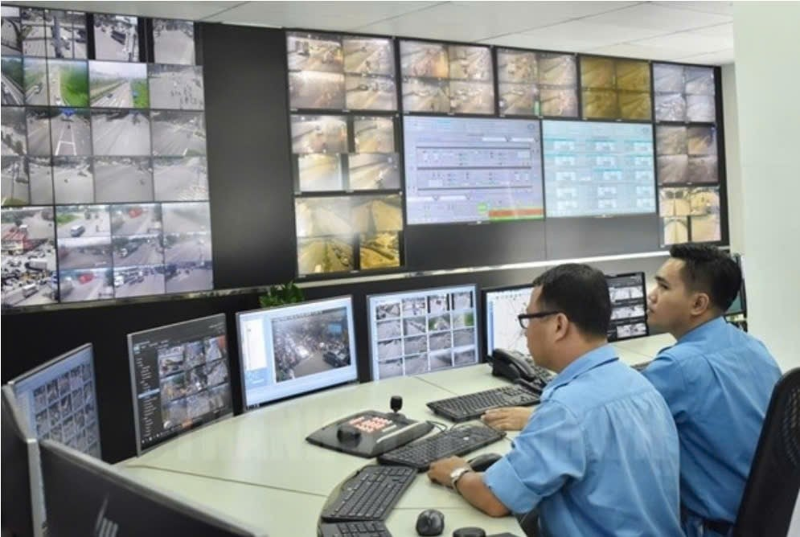
Artificial intelligence is being integrated into traffic management across Ho Chi Minh City, from adaptive traffic signal control to vehicle flow analysis and congestion forecasting, while paving the way for smart city knowledge sharing with fellow ASEAN members.
According to the municipal Department of Construction, the city is piloting AI deployments at several major intersections, including Hang Xanh, Nga 5 Dai Liet Sy, as well as along Pham Van Dong, Vo Van Kiet, and Mai Chi Tho boulevards. The technology is leveraged to count and analyze vehicle volumes, assist in optimizing traffic signal timing, and forecast traffic conditions.
Deploying AI aims to shift traffic management from a reactive posture—responding only after bottlenecks have formed—to a data-driven approach that detects risks early and enables proactive regulation. However, overall efficiency still hinges on data quality, system interoperability, and seamless coordination among operating agencies.
The city is exploring solutions to link traffic signal systems inside Ring Road 2 with the Urban Traffic Management and Operation Center. Concurrently, under the 2026–2030 smart city development plan, the city plans to synthesize data from traffic lights, surveillance cameras, and live traffic movements, leveraging AI to anticipate congestion, traffic collisions, and road incidents.
By 2027, the goal is to link traffic signals and monitoring equipment along key corridors and major intersections to the centralized management system. By 2030, at least 70% of key urban intersections are targeted to run on intelligent signal control, with major arterial routes monitored in real time.
Beyond road traffic management, the city is also adopting digital twin technology for urban traffic and public passenger transit management, as well as testing AI-powered construction monitoring at the An Phu and Tan Van interchanges.
Regional engagement with ASEAN cities focuses primarily on sharing experiences and identifying appropriate technological solutions. In 2026, the city Department of Science and Technology met with a delegation from Thailand’s Chulalongkorn University to discuss smart city strategies and the "One ID" system, sharing insights on tech deployment and urban data integration.
Strengthened connectivity with ASEAN should currently be understood as bilateral cooperation, knowledge sharing, and technology benchmarking, rather than direct, real-time integration between the city’s traffic operations center and regional counterparts.
For the 2025–2030 period, the city has identified 98 key traffic and technical infrastructure projects. Alongside hard infrastructure investments, integrating AI and data-driven operations serves as a crucial avenue to maximize the operational capacity of the existing network, while laying the foundation for ongoing smart city collaboration with partners across ASEAN.





 Google translate