


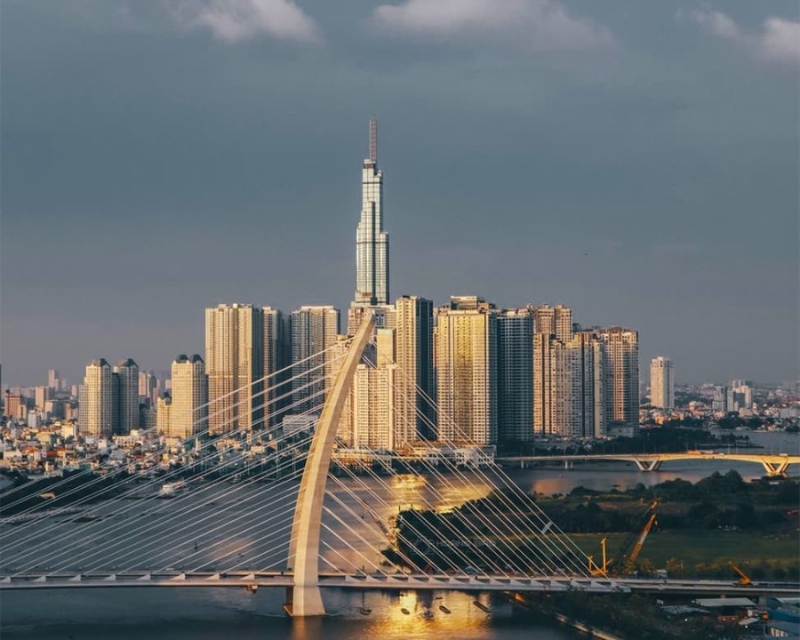
With more than 14 million residents and accounting for nearly 25 per cent of national GDP, Ho Chi Minh City remains Vietnam’s economic locomotive and a major center of commerce, finance, industry, education, healthcare, and international trade. But the stature of an “international metropolis” is defined not only by population size or economic weight but also by the quality of growth, connectivity, governance, innovation, and the overall living and working environment.
Speaking at CEO 500 - Tea Connect, part of the Autumn Economic Forum 2025, Secretary of the Ho Chi Minh City Party Committee Tran Luu Quang said the southern city, following its recent administrative merger, is entering a new stage of development with a broader vision and bold ambitions to become a modern, dynamic, and livable urban center with global competitiveness.
Blueprint for dual transformation
According to Mr. Quang, the city is rolling out a strategy to re-organize its development space and shape a multi-polar, multi-center urban model built around three growth zones and a series of economic corridors.
The plan is anchored in five strategic pillars: high-tech industry and innovation, driven by digital technology, semiconductors and big data; logistics and free trade connected to seaports, airports, and free-trade zones; the development of an International Financial Center (IFC); tourism, and the cultural industry, generating added value from creative culture, the arts, and international events; and education, healthcare, and science and technology aligned with regional and global standards.
The city, however, faces no shortage of challenges. Governance pressures continue to mount in a mega-city with rapid economic expansion. Financial resources, technology, infrastructure, and high-quality human capital remain insufficient, while logistics and transport networks still require substantial upgrades. At the same time, improving public services, accelerating administrative reform, strengthening digital governance, and competing with rising regional economic hubs are becoming increasingly urgent.
For that reason, Mr. Quang stressed that internal reforms must go hand-in-hand with deeper cooperation and stronger engagement from experts, scholars, and businesses both at home and abroad. A city with global ambitions, he noted, must be built on extensive partnerships, international knowledge networks, and a dynamic business ecosystem fit for the digital age.
Mr. Pham Binh An, Deputy Director of the Ho Chi Minh City Institute for Development Studies, said the city has been selected as a case study for integrating digital transformation and green transition, known as the “dual transformation”. Ho Chi Minh City aims to become a mega-city by 2050 and a leading regional hub for the green economy with low-carbon development. The strategy seeks to harness digital technologies to address environmental issues while advancing sustainable green growth.
The dual transformation framework rests on three pillars. The first is the Twin Data Ecosystem, which connects environmental, energy, and urban data to improve the accuracy and timeliness of policy decisions. The second is the Two-tier Green Governance System, designed to strengthen governance capacity from the city level down to districts. And the third is the development of Green Digital Citizens, encouraging residents to embrace green initiatives and adopt digital tools in everyday life.
Despite institutional and infrastructure hurdles, Ho Chi Minh City has positioned itself as a reliable partner, working with businesses, international organizations, and local communities to shape a greener, smarter, and more prosperous future for both the city and the region.
Where finance meets opportunity
Ho Chi Minh City is increasingly emerging as a magnet for some of the world’s largest technology and financial corporations. Many of them have signaled strong interest in deeper cooperation with Vietnam, arguing that the city has the right conditions to evolve into a new-generation IFC in Asia.
Mr. Yang Peng, CEO of Ant International, said he sees clear potential for Ho Chi Minh City to take the lead in three future-facing financial segments: trade finance, small and medium-sized enterprises (SME) finance, and on-chain finance built on digital assets. If the city can capitalize on technologies such as general AI, blockchain, and digital identity, he noted, its IFC could become a regional trade finance hub not only for Vietnam but for Southeast Asia. Ant International is considering making Ho Chi Minh City its “home base” for regional digitalization programs.
Meanwhile, international capital markets are also expressing interest. Mr. Will Ross, Chief Marketing and Distribution Officer at Dragon Capital, said the proposed IFC could help unlock long-term capital flows, lower Vietnam’s cost of capital, and increase the contribution of domestic investors to the country’s development.
In his address, Prime Minister Pham Minh Chinh thanked businesses and investors for their cooperation, support, and valuable contributions, stressing the principle of shared benefits and shared risks. He reiterated that Vietnam’s immediate priorities are to safeguard macro-economic stability, control inflation, maintain key economic balances, and promote growth. In this effort, he said, international partners, including investors and enterprises, continue to play an important role.
The Prime Minister added that he hopes Ho Chi Minh City will continue to innovate, strengthen self-reliance, and draw lessons from both achievements and setbacks, enabling it to remain Vietnam’s economic engine.
Designing the city of tomorrow
Experts believe Ho Chi Minh City’s bid to become a smart, globally-competitive metropolis will rely not only on advanced technology but also on strong governance, coherent coordination, and long-term partnerships with the private sector.
Professor Vu Minh Khuong from the Lee Kuan Yew School of Public Policy at the National University of Singapore noted that successful smart cities begin from the “upstream” - a clear governance philosophy and institutional design - rather than scattered technological fixes. The true measure of a smart government, he said, is its ability to understand and meet citizens’ needs. When residents trust their government, when institutions operate cohesively, and when people feel proud of their city, the foundation of a smart governance ecosystem naturally takes shape.
He emphasized that an effective system must operate across three levels. The “midstream” requires an integrated data system, a central coordinating body acting as a “conductor,” and a transparent, problem-driven regulatory framework. The “downstream,” where citizens directly benefit, demands fully online public services, shared digital platforms, and clear accountability for each application or business proposal.
Mr. Warrick Cleine, Chairman and CEO of KPMG Vietnam and Cambodia, added that smart-city development rests on two core principles: participation and intelligence - each essential for building a productive partnership between government and the business community. He highlighted four drivers of success: inclusiveness through open public-private dialogue; long-term ambition aligned with Vietnam’s 2045 development goals; intelligence in action, especially through innovation and strategic investment in AI; and sustainability, which requires decade-long commitments rather than short budget cycles.
He noted that Vietnam is already taking meaningful steps, from developing a National Data Center to integrating AI into urban management. But real progress, he argued, will depend on aligning public and private-sector strategies and maintaining a shared vision for a smart, green and resilient city.
Professor Khuong and Mr. Cleine underscored a common message: Ho Chi Minh City’s smart city future will be shaped not simply by adopting new technologies but by building strong institutions, fostering collaboration, and ensuring that every innovation ultimately improves the lives of its residents.
![[Interactive]: Economic overview - September 2026](https://premedia.vneconomy.vn/files/uploads/2026/10/06/9e0f403040dd4384ad690004bc1911ab-124594.png?w=400&h=225&mode=crop)

 Google translate