


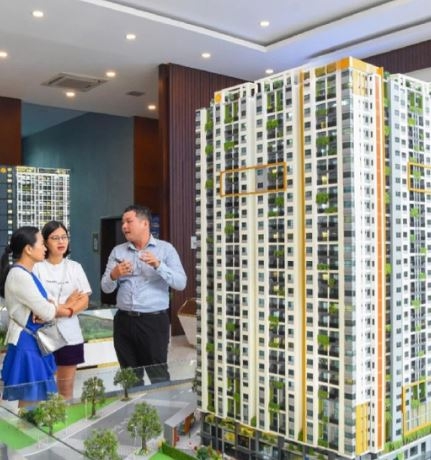
Vietnam’s real estate market has been buzzing since the beginning of the year with new project launches and home-sale openings, particularly across suburban belts in Hanoi and Ho Chi Minh City. Yet the persistent mismatch between supply and demand shows little sign of easing. Most newly-introduced projects in the two cities now come with price tags above VND100 million ($3,845) per sq m, while apartment prices in outlying districts also continue to climb, leaving many homebuyers increasingly discouraged.
Stretched beyond reach
According to the Vietnam Association of Realtors (VARS), more than 100,000 housing units entered the market in the first three quarters of 2025, a 22 per cent increase over all of 2024. Of these, 86,000 were newly-launched products, or 1.3-fold last year’s total, while the remainder came from inventory being re-offered. Supply has continued to diversify, expanding from urban cores to satellite towns and second-tier cities with abundant land.
Even with rising supply, the market remains dominated by major developers catering to financially-strong buyers. In Hanoi, average primary apartment prices have reached VND95 million ($3,655) per sq m, with more than 43 per cent of new launches priced above VND120 million ($4,615) per sq m. In Ho Chi Minh City, meanwhile, the average stands at VND91 million ($3,500) per sq m; slightly lower than in Hanoi thanks to cheaper inventory in outlying districts.
These elevated prices have pushed genuine homebuyers, especially young families, out of central districts and into the suburbs in search of affordability and better transport links. Yet prices in provinces surrounding Hanoi have also surged, stretching far beyond the reach of most workers. New projects in Bac Ninh and Hung Yen provinces are now asking VND60-70 million ($2,310-$2,690) per sq m, on par with a number of developments in the capital.
For many, the path to homeownership is slipping only further away. Mr. Hoang Anh Tu, an engineer in Hanoi, said he and his wife have saved more than VND1 billion ($38,460) after a decade in the city, hoping to buy a small home. “But we could not find a two-bedroom unit for VND2-3 billion,” he said. “Even projects far from the center are priced from VND60 million to over VND100 million ($2,305 to over $3,845) per sq m, so we are still renting.”
Elsewhere, Ms. Mai Lan from Hung Yen said she tried to sell her more than 100 sq m Ecopark apartment last year for VND5.9 billion ($226,925) but found no buyers. “Now someone is offering VND7.3 billion ($280,770),” she said, “but I will not sell because I may not be able to afford anything else.”
In southern Vietnam, Savills has reported that prolonged supply shortages in Ho Chi Minh City - of only 4,300 new units in the first nine months of this year, 60 per cent of which are in the high-end segment - pushed the absorption rate to 91 per cent. Demand remains strong but is driven mainly by investors and high-income buyers. Those seeking standard two-bedroom units increasingly must move farther out. This has accelerated the suburban shift, with neighboring provinces gaining appeal through mid-range projects priced around VND50-60 million ($1,925-$2,310) per sq m.
Experts say several forces are driving this market revival. First, the restructuring of administrative boundaries under the two-tier governance model; second, major infrastructure investment, with a wave of large projects approved early this year, third; expanding regional connectivity, as new inter-provincial roads boost mobility and open opportunities for transit-oriented development; and fourth, the growing role of the private sector, with developers being allocated large land banks in provinces near major cities, helping increase supply and transactions.
On the demand side, though end-users remain important, investment activity is rising sharply. Looser liquidity, concerns over inflation, and aggressive sales campaigns have drawn more investors back into the market. Meanwhile, rising land costs continue to push apartment prices higher. In provinces surrounding Hanoi, limited central land banks and improving transport links to the capital are prompting both investors and homebuyers to accept higher prices to secure well-located properties.
Growth with vulnerabilities
According to Mr. Nguyen Van Dinh, Chairman of VARS, the market is displaying encouraging signs of growth, with clear improvements in supply, prices, and liquidity. “But behind the upbeat headlines, several bottlenecks and risks remain that could undermine stability and long-term sustainability,” he said.
Prices have risen rapidly in a short span and, in many cases, now outpace real value, Mr. Dinh noted. Some developers, together with distribution agents, are deliberately releasing units in small batches to create artificial scarcity and stir up “fear of missing out.” Most transactions now come from second-home buyers or investors betting on continued price increases, while younger buyers are losing motivation as the gap between housing costs and incomes widens.
Mr. Dinh predicted that prices in major cities will continue to climb as land banks shrink and demand stays high. With central urban prices already stretched and offering limited room for further growth, only financially-strong buyers can access these homes, pushing investors towards suburban markets. But liquidity in some outlying projects may stall due to incomplete infrastructure or weak developers unable to deliver basic amenities. In others, rising prices have simply dampened demand. “Overall demand remains high, and investment appetite is strengthening as cheaper capital circulates,” he explained. “Transactions will increase in line with supply but become more selective, focusing on legally-sound projects with strong connectivity and reputable developers. As supply in satellite-cities accelerates, infrastructure and urban amenities, including transport, hospitals, schools, and sports facilities, will be decisive in shaping investment decisions.”
At the recent 7th Standing Committee meeting of the Vietnam National Real Estate Association, Ms. Hoang Thu Hang, Deputy Director of the Department of Housing and Real Estate Market Management at the Ministry of Construction (MoC), said the market will continue to face both opportunities and challenges. She urged the Association and businesses to boost supply, especially affordable commercial housing and social housing, to help cool prices and stabilize the market.
She also emphasized the need for close coordination with the Ministry in policy consultation and legal reform to avoid regulatory bottlenecks and ensure efficient implementation. Transparency and professionalism, she stressed, are essential to building a healthy, sustainable real estate market.
Ms. Hang added that the MoC is working with VARS to develop a State-managed Real Estate Trading Center model, a proposal being closely followed by the Prime Minister. The latest directive tasks the Ministry with preparing a pilot resolution for submission to the National Assembly’s 10th session. Once established, the center would streamline transactions, reducing time, effort, and cost for buyers; in stark contrast to the current process, which often requires visiting multiple offices.
The center would also allow the State to vet all properties before they reach the market, ensuring buyers no longer struggle to confirm legal eligibility. “People would simply access the platform to search for and purchase homes without worrying about fraudulent or ‘ghost’ projects,” she explained.






 Google translate