



As traditional growth drivers near their limits, institutional barriers have emerged as the greatest obstacle to development, meaning that institutional reform is not merely about removing bottlenecks and has become a “vital imperative” - the key to creating new growth momentum and guiding Vietnam into a phase of rapid and sustainable development.
The 15th National Assembly (NA) is currently holding its final session, during which it is expected to review and pass 49 draft laws and four resolutions. Once again, institutional reform is placed at the heart of all development efforts. In a global economy increasingly driven by productivity, knowledge, and innovation, Vietnam’s growth trajectory will be difficult to sustain unless institutions themselves become a source of dynamism. The Party and the State are urgently transitioning from an administrative system to a facilitative one - the foundation for new drivers and vitality of growth.
Bottlenecks a barrier
Nearly four decades of “Doi Moi” (Economic Renewal) have proven that institutions are the decisive factor shaping a nation’s development capacity. The institutional reforms of the early 1990s opened up market space, unleashed productive potential, and fueled an economic miracle that has lasted for almost 40 years. However, in this new phase of development, when traditional growth drivers such as capital, labor, and land are gradually running out, institutions themselves have become the bottleneck to progress.
The root causes behind this “bottleneck of all bottlenecks” lie in three key aspects: First, management thinking remains heavily administrative and top-down, while a market economy requires the State to play a facilitative and service-oriented role. Second, policy formulation and implementation processes lack coordination and consistency. Third, accountability and enforcement oversight remain weak, creating a large gap between “laws on paper” and “laws in practice”. When transparency and enforcement efficiency are low, even the most well-intentioned reforms struggle to translate into tangible outcomes.
These institutional “bottlenecks” not only constrain the business and investment environment but also distort market signals, reduce Total Factor Productivity, and prolong the economy’s dependence on traditional growth drivers. Therefore, to achieve sustainable growth, Vietnam must move beyond a patchwork approach to institutional reform and instead treat it as a foundational breakthrough - the pillar that underpins future economic dynamism.
Growth imperative
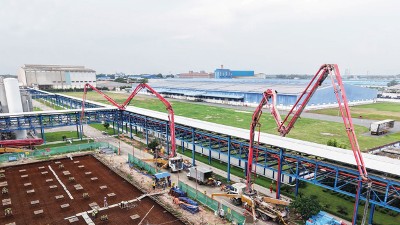
Public investment is considered a vivid illustration of the “institutional paradox”. During the 2021-2025 period, in the aftermath of the Covid-19 pandemic, public investment became regarded as a key driver of economic growth. But in reality, year-after-year, the disbursement of allocated capital has fallen short. The funds are available, but “locked up” in procedures, legal overlaps, and the cautious mindset of implementing agencies.
Despite numerous directives and repeated urgings from the Prime Minister to accelerate progress, the situation lingers like a “chronic illness”. The reason lies in the fact that fundamental institutional bottlenecks have yet to be removed. When a project must pass through countless layers of appraisal and approval, and when decision-makers fear accountability, no project can begin, even when capital is ready.
Public investment thus stands as the clearest and most vivid evidence of this paradox: abundant resources that remain untapped, and opportunities missed for growth.
At its core, institutional reform is about renewing the “rules of the game” to unlock and safeguard business freedom, promote fair competition, and strengthen confidence in the rule of law. At the macro-economic level, it means restructuring the balance of power between the State, the market, and society - clarifying the boundaries of public intervention and placing citizens and enterprises at the center of policy-making.
International experience shows that no country has ascended to a higher stage of development without institutional reforms that match the sophistication of its economy. South Korea, Singapore, and China each underwent periods of “great institutional reform” that triggered breakthroughs in productivity. Vietnam now stands at a similar juncture, as its growth model based on public investment and natural resource exploitation has reached its limits.
Institutional reform is therefore not merely about amending laws, it is about transforming the mindset and governance model of development. Every law passed at this NA session should not be seen simply as a “legal document” but as “institutional energy” - a force that builds trust, activates social resources, and turns development visions into concrete action.
If public investment is seen as a “mirror” reflecting the institutional bottlenecks, the key lesson is clear: Vietnam can no longer afford to delay institutional reform. Without it, all development efforts will remain mere “firefighting” measures. The economy needs a true breakthrough, one that is fundamental, comprehensive, and coherent.
Institutional breakthroughs are not only about removing barriers for the private sector or improving the investment climate, they are about creating new growth drivers grounded in science and technology, the digital economy, the green economy, and the circular economy - the pillars of sustainable development in the new era.
To achieve this, reform must continue across three core pillars: First, improve the legal framework governing property rights, business rights, and the right to innovate - these are the “first conditions” for markets to function efficiently. Second, reform the administrative apparatus towards greater streamlining, transparency, and accountability, with a decisive shift from ex-ante control to ex-post supervision. Third, enhance the quality of policy-making under the principle of “one policy - multiple benefits”, avoiding parochial or short-term thinking and placing national and citizen interests at the center.
In parallel, strengthening policy evaluation capacity and expanding social consultation mechanisms are also vital to reduce “institutional lag” and ensure that policies are truly practical and effective in real economic life.
The NA must maximize its legislative and oversight roles. It should truly act as the “guardian of institutions” and gradually become the “architect of institutions”, ensuring that laws and sub-law documents align with the Constitution and embody the spirit of reform, free of vested interests and market distortions.
There can be no sustainable growth without institutional breakthroughs, and no institutional breakthroughs without the courage to innovate, to take responsibility, and to relinquish the privileges of the old system.
Institutions are now the foundation of development. A comprehensive, consistent program of institutional reform, underpinned by independent oversight and strong political commitment, must therefore be initiated and implemented. Every law passed should help reduce transaction costs, enhance transparency, and strengthen market confidence, because only when institutions are unblocked can all resources flow freely.
Institutional breakthroughs are not a mere technical exercise in governance, they are a vital imperative for development. Only by dismantling both visible and invisible constraints and creating a transparent, enabling legal framework can Vietnam fully unlock its potential. The NA, the government, and the entire political system must act together to turn institutions from “the bottleneck of all bottlenecks” into “the driver of all drivers”. This is the key for the economy to seize valuable opportunities in deeper global integration and to advance towards a new phase of rapid, sustainable, and modern growth.
(*) Dr. Nguyen Bich Lam is the former Director General of the General Statistics Office (now the National Statistics Office under the Ministry of Finance)







 Google translate