

Historically, the ocean has been viewed primarily through three functions: a source of resources, a transportation space, and a strategic domain. Today, this perception is changing. The same ocean space now accommodates shipping and logistics, fisheries and aquaculture, oil and gas extraction, offshore renewable energy, tourism, marine industries, telecommunications infrastructure, scientific research, biotechnology, biodiversity conservation, and an expanding range of data-driven services. The ocean is therefore being repositioned from a space primarily used for resource extraction to one that drives growth, innovation, and strategic competition.
This is the new context in which Vietnam’s marine economy must be understood. Developing this economy is no longer simply about making better use of the resources Vietnam already possesses. It is also about establishing the country’s position within the evolving structure of the global ocean economy.
Vietnam’s maritime advantages should therefore be viewed as a multilayered portfolio of marine assets, comprising at least five categories: (1) positional assets, (2) spatial assets, (3) natural resource and ecological assets. (4) connectivity assets, and (5) human-created assets, including infrastructure, data, enterprises, science and technology, institutions, and international maritime relations. These assets do not exist independently but interact with and reinforce one another.
Turning geography into economic value
Vietnam has more than 3,260 km of coastline, a maritime area and exclusive economic zone (EEZ) covering more than 1 million sq km, and more than 3,000 islands. Its network of river mouths, bays, gulfs, islands, and archipelagos provides multiple access points from the mainland to the sea. Particularly important is Vietnam’s position, which lies on maritime routes connecting Northeast Asia with Southeast Asia, South Asia, the Pacific Ocean, and the Indian Ocean. Vietnam is also adjacent to major manufacturing and trading centers in East and Southeast Asia. This geographic position gives the country the potential to connect maritime flows with its land-based economy.
Moreover, Vietnam not only faces the ocean but can also connect its maritime space with an extensive economic hinterland. River mouths, bays, gulfs, and inland transportation corridors leading to the coast allow seaports to serve as gateways for domestic production centers. This gives Vietnam’s positional assets their distinctive character. On the one hand, the country has access to maritime flows; on the other, it can connect those flows with production, consumption, and services on land.
Vietnam’s positional advantage therefore lies in its ability to connect the land-based economy with the ocean economy while channeling value generated by maritime activities into the domestic economy. This asset cannot be relocated or depleted, but its economic value can rise or fall depending on the quality of infrastructure, logistics, institutions, and economic organization.
Geographic location is only a potential asset. A ship passing through Vietnamese waters generates virtually no direct economic value for the country. Value emerges only when location is translated into functions such as port operations, transshipment, logistics, transportation, ship repair, fuel supply, technical services, finance, data, and other maritime services.
Spatial assets
The second category of assets is not a specific resource but maritime space itself. This space extends from coastal areas, river mouths, bays, lagoons, and nearshore islands to more distant offshore waters. These spaces differ in topography, geology, hydrology, and ecosystems. Their diversity creates opportunities for different economic functions to be developed and located across the maritime domain.
The National Report on the State of the Marine and Island Environment for 2021-2025 records 114 river mouths, more than 3,000 islands, and a highly-diverse coastal landform system, providing favorable conditions for seaport development and other marine economic activities.
The value of spatial assets lies in the ability of a single maritime area to accommodate multiple types of assets, including biological resources, minerals, energy, landscapes, and ecosystems. It can also support several functions simultaneously, such as shipping, fisheries and aquaculture, oil and gas, renewable energy, tourism, conservation, submarine cables, scientific research, national defense and security, and emerging marine economic activities.
The value of marine spatial assets depends on the capacity to accommodate and coordinate multiple economic, ecological, and strategic functions within a finite area. Their value depends heavily on marine spatial planning. A well-organized area can generate multiple compatible value streams, while conflicting uses may allow one industry to expand at the expense of another. As technology advances, the number of functions that can be accommodated at sea continues to grow, making maritime space itself an increasingly scarce resource that requires deliberate, science-based, and long-term integrated management.
Natural resource assets
Natural resource assets comprise the physical resources and energy that can be extracted or harnessed from the sea, ranging from biological resources, oil and gas, and minerals to large-scale renewable energy. This category most closely reflects the traditional understanding of marine resources, but its composition is changing rapidly.
The National Report on the State of the Marine and Island Environment records more than 11,000 marine species in Vietnam’s waters. Fisheries resource surveys conducted during 2011-2020 estimated the standing stock of fisheries resources across Vietnam’s maritime area at approximately 3.95 million tons, with an estimated exploitable volume of 2.834 million tons.
Biological and fisheries resources are renewable assets, but they are not unlimited. Marine Spatial Planning documents identify a declining trend in both species composition and resource quality, associated with overfishing, pollution, and socio-economic pressures. The value of biological assets therefore cannot be measured solely by annual catch volumes. It must also account for the capacity to preserve the underlying natural capital that generates income in the future.
The second category comprises oil, gas, and mineral resources. A substantial resource base has been established on the continental shelf, while further potential remains in deeper waters. Among Vietnam’s marine resources, oil and gas have been the assets most extensively surveyed, explored, and converted into economic value over the past several decades. However, their potential is not evenly distributed and is associated with sedimentary basins across the continental shelf and Vietnam’s offshore waters.
Vietnam’s oil reserves are estimated at approximately 4.4 billion barrels, ranking the country 28th among 52 countries with proven oil reserves worldwide and first in Southeast Asia. Its proven natural gas reserves stand at approximately 600 billion cu m, ranking it third in the region.
Beyond oil and gas, Vietnam’s diverse geological structure supports a relatively broad portfolio of marine and coastal minerals. Notable resources include coastal titanium-zircon placer deposits, construction materials, and potential strategic minerals in deep-sea areas. The National Report on the State of the Marine and Island Environment for 2021-2025 records approximately 35 types of minerals in Vietnam’s maritime area and continental shelf. These include titanium and zircon placers, certain rare-metal minerals, and marine and coastal construction materials.
Geological and mineral surveys in selected maritime areas have initially identified and delineated 62 titanium-zircon-rare earth (Ti-Zr-RE) placer zones, with total forecast resources of approximately 164 million tons, as well as 50 prospective construction-material zones with forecast resources totaling approximately 200 billion cu m.
These figures are based on preliminary surveys in selected maritime areas, but they demonstrate that Vietnam’s marine mineral assets extend from coastal waters to the deep sea. Most, however, remain classified as forecast resources or prospective deposits rather than commercially recoverable reserves. This presents both a strategic opportunity and a need for further investigation, including assessments of extraction feasibility, economic viability, and environmental impacts, before these resources can be converted into genuine economic assets.
The third category of natural resources gaining prominence is offshore renewable energy, particularly wind power. This emerging asset class is being transformed from natural potential into economic value through technological advances and is becoming an important driver of the energy transition.
The revised National Power Development Plan VIII (PDP8) estimates Vietnam’s technical offshore wind potential at approximately 600,000 MW. It also projects offshore wind capacity for producing new energy at around 15,000 MW by 2035 and approximately 240,000 MW by 2050. These figures indicate that wind resources could support not only electricity generation but also hydrogen, ammonia, and new energy value chains.
What distinguishes Vietnam’s marine resource portfolio is the coexistence of three fundamentally different categories: finite resources such as oil, gas, and minerals; renewable biological resources that can deteriorate under unsustainable exploitation; and renewable energy resources whose exploitable potential can expand with technological progress.
These categories require three distinct approaches to management: efficient extraction and value conversion for finite resources; preservation of the underlying natural capital for biological resources; and the development of industries, infrastructure, and institutions for renewable energy.
Sustaining multiple streams of value
While mineral resources primarily generate value through extraction or use, the fourth category of assets has a different characteristic: economic value can be generated while the underlying assets remain intact. These assets include ecosystems, biodiversity, landscapes, and marine heritage.
Seas and oceans support high levels of biodiversity and provide essential ecosystem services for socio-economic development, including fisheries, carbon absorption and storage, coastal protection, tourism, and cultural and social benefits. Mangrove forests, coral reefs, seagrass beds, tidal flats, river mouths, and islands simultaneously provide multiple benefits, including habitats and breeding grounds for marine life, fisheries resources, coastal protection, carbon storage, tourism, landscapes, and cultural and social values.
The Red River Delta Biosphere Reserve, recognized by UNESCO, covers a total area of 105,558 ha, including 39,235 ha of marine area. It encompasses river mouths, wetlands, mangrove forests, alluvial flats, beaches, and seagrass beds, while lying along an important migratory route for waterbirds.
Geological and geomorphological landscapes constitute another distinctive layer of natural capital. Vietnam’s maritime space features diverse landforms, including river mouths, deltas, lagoons, bays, tidal flats, sand dunes, rocky coastlines, karst formations, and varied island systems. Its beaches, cliffs, bays, and scenic landscapes have become foundations for tourism development.
The value of these assets lies in their uniqueness and their capacity to generate sustained benefits when landscapes and environmental quality are protected, maintained, and used appropriately. This category also includes marine cultural heritage, such as the history of maritime trade, coastal communities, fishing traditions, festivals, indigenous knowledge, trading ports, architecture, and historical sites associated with the exploration, management, and protection of the country’s seas and islands.
The key consideration for these ecosystems is that their use must go hand-in-hand with conservation and protection to generate additional value beyond the intrinsic worth of natural resources. If exploitation degrades ecological assets in exchange for short-term income, the economy is effectively consuming and eroding its underlying capital.
This is why conservation and development are not necessarily opposing objectives. In many cases, conservation is the means of preserving assets so they can continue generating value in the future. Decisions on the use of natural capital must therefore be based on its overall value, rather than solely on the direct revenue generated by individual investment activities.
Connectivity and created assets
The first four categories of assets largely derive from geographic and natural conditions. The fifth is fundamentally different: these are assets that people can deliberately create, accumulate, and upgrade. They include seaports, logistics networks, transportation infrastructure, coastal economic zones and industrial parks, cities, energy infrastructure, marine data, surveying capabilities, science and technology, enterprises, and institutions for marine governance.
This is the layer that increasingly determines how much economic value can be generated from the preceding four categories of assets. The relationships are straightforward: location becomes a logistics advantage only when supported by ports and transport networks; wind becomes electricity and industrial activity only when supported by surveys, transmission infrastructure, ports, supply chains, and capital; and marine resources become high-value food supply chains only when combined with improved breeding stock, processing, cold-chain logistics, standards, and branding.
Ports and logistics: Turning location into value
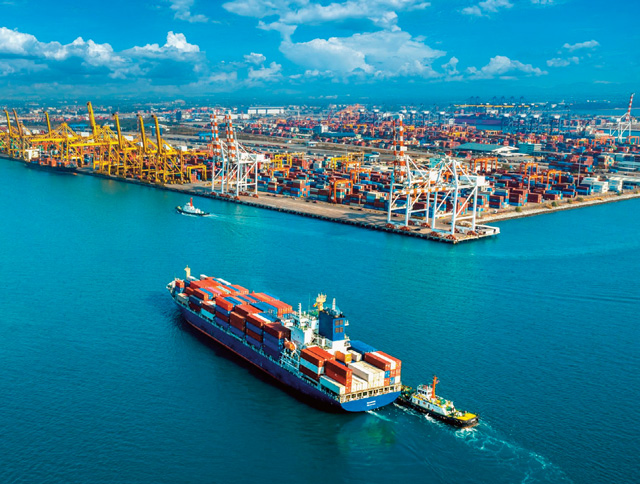
Vietnam has developed a network of ports along its coastline. In 2025, total cargo throughput at seaports and inland waterway ports was estimated at approximately 1.17 billion tons, up 12 per cent from 2024, while container throughput reached an estimated 34.36 million TEUs, an increase of 11 per cent.
The distinctive value of the port system lies not merely in the number of berths or the volume of cargo handled. Ports also serve as bridges connecting three types of space: international maritime routes, coastal economic corridors, and inland production centers. When ports are integrated with logistics networks, industrial parks, cities, and hinterland transportation, a single flow of goods can generate additional value through manufacturing, processing, warehousing, trade, ship repair, insurance, and other services.
Data: Turning unknown maritime space into a manageable asset
Ocean data is becoming an increasingly important category of created assets. As of the end of 2025, approximately 38.7 per cent of Vietnam’s maritime area had undergone baseline geological and mineral surveys.
Data does not create additional wind, oil, gas, or mineral resources, but it reduces uncertainty about those assets. This supports better planning, risk assessment, resource valuation, capital mobilization, and investment decisions. Data is therefore an asset that increases the value of other assets and provides the foundation for turning potential into reality.
Infrastructure, industry, enterprises, and institutions: Turning resources into value chains
Offshore wind will remain a source of untapped natural energy potential without suitable ports, transmission grids, mechanical engineering industries, service vessels, surveying capabilities, operations and maintenance services, and project financing. Once these capabilities are established, the asset is no longer simply wind but an entire offshore industrial ecosystem.
Institutions are also part of this layer of human-created assets. A maritime space governed by clear plans, open data, stable use rights, and transparent licensing mechanisms can attract more capital and investment, even when the underlying natural resources remain unchanged.
The fifth layer of assets increasingly determines the value of the other four. Nature may create resources, but a country’s capabilities largely determine their economic value. A country cannot change its geographic location, but it can improve the quality of its ports. It cannot create a new natural ecosystem within a short period, but it can protect or destroy an existing one.


 Google translate