


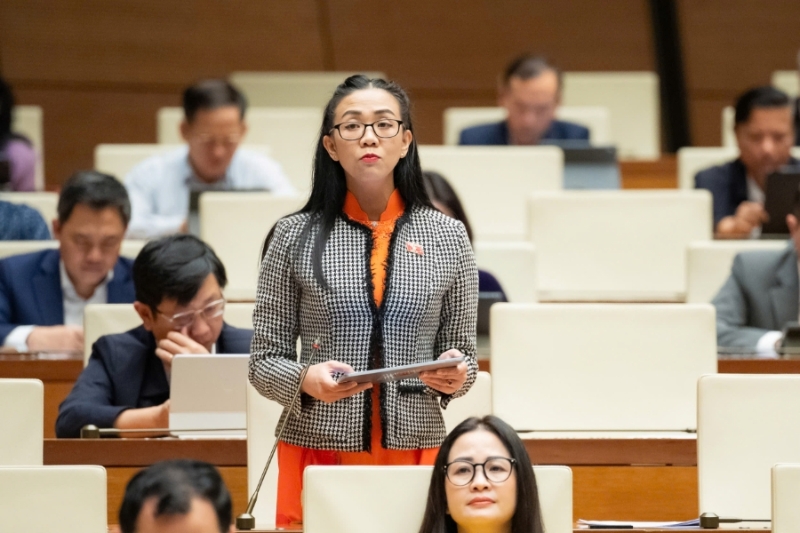
The 15th National Assembly deputies on December 8, discussed the draft Resolution on mechanisms and policies for national energy development for the 2026-2030 period. A key topic raising interest among deputies was the proposal to encourage both State-owned and private enterprises to participate in the research and investment of Small Modular Reactors (SMRs).
According to deputy Trinh Thi Tu Anh of Lam Dong province, Vietnam is entering a period of extensive energy transition. Meanwhile, the demands for ensuring energy security, reducing emissions, and maintaining high economic growth are becoming increasingly urgent. These challenges require long-term strategic choices, among which SMRs represent a direction worth considering that aligns with Vietnam's specific conditions.
"SMRs offer advantages such as flexible scaling and small-to-medium capacity. They can be deployed in modular forms with shorter construction times, ensuring high passive safety standards. They are particularly suitable for replacing or phasing out old coal power sources or supplementing stable baseload capacity for the national grid," she said.
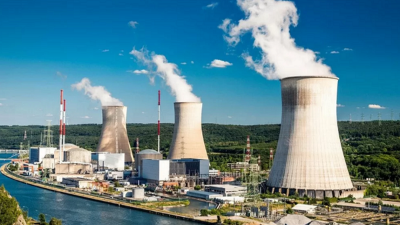
Globally, SMRs are no longer merely experimental projects. Many countries have already commercialized the technology or are advancing rapidly, including the US, Canada, France, and the UK. Several Asian nations with conditions similar to Vietnam are also selecting SMRs for use in areas with weak infrastructure, islands, and remote regions.
A common trend among these nations is that the investment burden is not placed solely on the State. Instead, they mobilize participation from energy corporations, manufacturing industries, and environmental technology firms.
Given this reality, Ms. Anh expressed her support for regulations encouraging State-owned and private enterprises to participate in the research and investment of SMRs, noting that this opens up a mechanism far more flexible than traditional approaches.
"In the past, nuclear power was almost exclusively a State undertaking, characterized by massive project scales, long investment timelines, and extremely strict technical requirements. With SMRs, the new approach allows for the mobilization of technical innovation, increased localization capabilities, and technological autonomy," the deputy emphasized.
This sector requires vast resources, high technology, and a long-term supply chain, therefore, relying solely on the state budget makes it impossible to create a modern nuclear industrial ecosystem. Mobilizing both State-owned and private enterprises will help diversify resources, share risks, and promote innovation.
Furthermore, she noted that many countries have proven the high efficiency of the public-private model. Private enterprises possess investment drive and the ability to access technology quickly, while state-owned enterprises play a leading role, ensuring security, safety, and strategic direction. This synergy helps shorten the time required for research, testing, and project deployment.
"Encouraging enterprises to research and invest in SMRs also means opening opportunities to establish a domestic module manufacturing industry, creating high-quality jobs, and elevating Vietnam’s scientific and technological position within the global nuclear value chain," she added.
Piloting before expanding SMRs
However, the deputy argued that SMR development must be contingent on three conditions: safety, responsibility, and transparency. Nuclear power always demands the highest standards of safety, security, and risk management. Encouraging enterprise participation does not mean "opening the door completely," but rather proceeding based on three key pillars.
First, a specific legal framework for SMRs must be established, covering design licensing, technology appraisal, operational supervision, and radioactive waste control.
Second, clear requirements regarding financial capacity, technological capability, and environmental responsibility must be set for every participating enterprise, ensuring the State retains the ultimate controlling role.
Third, implementation must be cautious and follow a roadmap—starting with research, testing, and demonstration projects—accompanied by thorough social and environmental impact assessments and transparent public consultation.
"Encouragement does not mean laxity; it means creating a legal corridor for capable entities to genuinely develop new technologies, while the State retains the role of supreme regulator and supervisor," Ms. Anh said.
Agreeing with this view, deputy Nguyen Thi Lan of Hanoi stated that selecting SMR technology is appropriate for the current period. However, the immediate goals should focus on serving research, training human resources, and gradually mastering the technology, rather than expecting immediate short-term economic returns.
Therefore, the initial phase requires State leadership.
She recommended a cautious approach: only after Vietnam has accumulated sufficient experience, ensured safety controls, perfected the legal framework, and mastered core technologies should the scale be gradually expanded to attract private investment. A roadmap moving from small to large modules is a prudent approach that aligns with international practices and Vietnam's practical conditions.
Sharing the perspective on the need for caution in SMR investment, deputy Pham Van Hoa of Dong Thap province emphasized that this field harbors potential high risks regarding the safety of life and property should an incident occur. Therefore, he suggested that only pilot implementation be permitted initially.
Furthermore, he argued that the current regulations encouraging State and private enterprises to participate in research and investment are still too general, and the drafting agency needs to clarify this content.
Deputy Nguyen Thi Le Thuy of Vinh Long province noted that expanding participation to the private sector as currently stipulated in the draft Resolution is merely a general encouragement lacking a specific policy framework.
"Energy is the lifeblood of the economy. In the context of the approaching Net Zero 2050 commitment and increasing power demand, we need 'pushes' that are bold yet scientific. SMRs represent an opportunity for Vietnam to both ensure energy security and gradually master high technology," she said.


 Google translate