


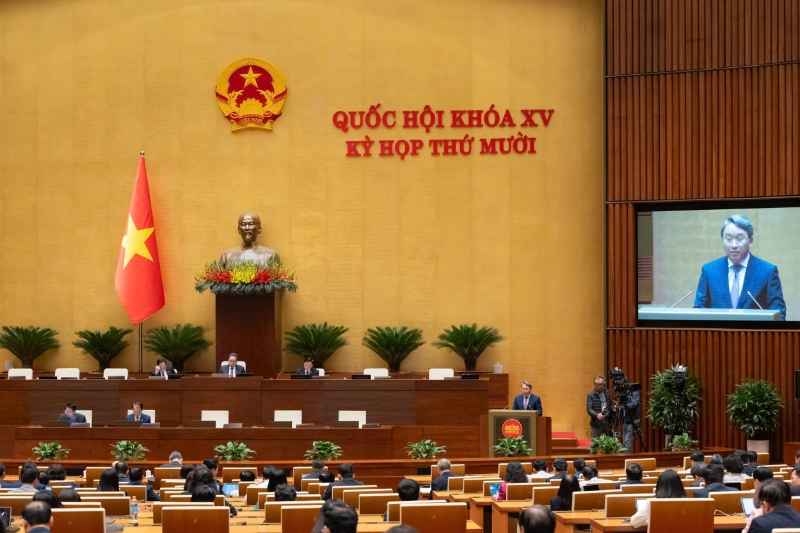
The National Assembly (NA) on December 5 voted to pass the amended Law on Judicial Expertise, expanding the scope for establishing judicial expertise offices in certain fields and specialties.
Electronic voting results showed that 439 out of 443 delegates present voted in favor, accounting for 92.81% of the total number of deputies. Thus, the NA has officially passed the amended Law on Judicial Expertise.
Earlier, Minister of Justice Nguyen Hai Ninh presented a summary report on the explanation, assimilation, and revision of the draft law.
During discussions, some NA deputies suggested not permitting the establishment of judicial expertise offices for DNA, document, digital and electronic, and fingerprint analysis. They argued that if allowed, the NA should consider assigning the Government to regulate the specific establishment of these offices based on practical conditions.
Minister Ninh stated that to institutionalize the Party's guidelines and directives, the draft law stipulates expanding the scope for establishing judicial expertise offices in certain fields and specialties.
Specifically regarding DNA, document, digital and electronic, and fingerprint analysis, judicial expertise offices are permitted to conduct examinations only for civil and administrative proceedings. The Government will continue to provide detailed regulations on the sequence, procedures for establishment, registration, and quality control of these judicial expertise offices.
According to Article 20 of the draft, judicial expertise offices are organized and operate as private enterprises or partnerships under this Law, the Enterprise Law, and other relevant legal provisions. They can be established and registered in fields such as forensic science, including document, digital and electronic, and fingerprint analysis, except as specified in Clause 3 of this Article; forensic medicine, including DNA analysis, except as specified in Clause 3; culture, including antiques, relics, and copyright; finance; banking; construction; and resources.
Many deputies expressed concerns about the "right to be exempt from legal liability of judicial experts in judicial expertise activities."
Minister Ninh explained that the draft law has been revised to consider exempting, reducing, or excluding liability for judicial experts who have conducted expertise in accordance with legal procedures, processes, and professional standards, impartially and without personal gain.
"In cases of fraudulent conclusions or refusal to conclude expertise without force majeure or objective obstacles, criminal liability must be borne," the Minister added.





 Google translate