


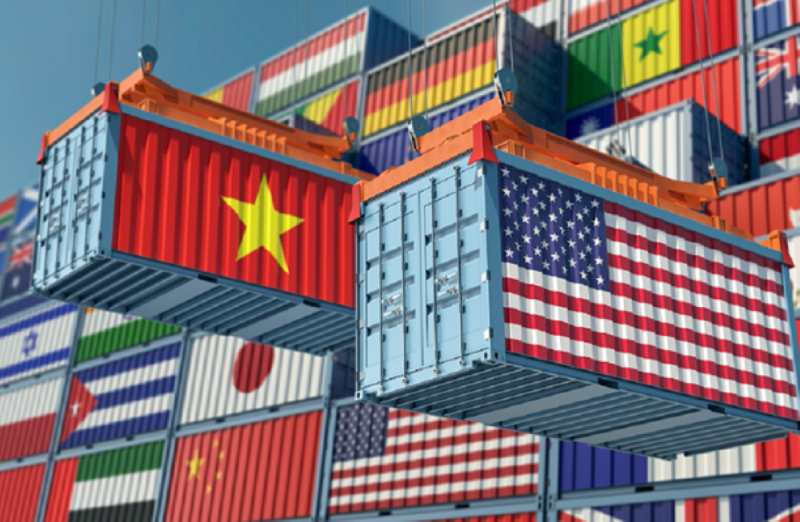
According to the Foreign Market Development Department at the Ministry of Industry and Trade (MoIT), in the 30 years since relations were normalized (1995-2025), Vietnam-US trade has grown strongly and been anchored by several key milestones: the Bilateral Trade Agreement (BTA) signed in 2000, Vietnam’s WTO accession in 2007, the establishment of a Comprehensive Strategic Partnership in 2023, and ongoing efforts towards a fair and balanced reciprocal trade agreement in 2025.
These developments were highlighted at the Vietnam-US Trade Forum held on December 10 in Ho Chi Minh City, with the theme “30 Years of Economic and Trade Cooperation - Overcoming Challenges, Entering a New Era” and organized by the Foreign Market Development Department in collaboration with the American Chamber of Commerce in Vietnam (AmCham Vietnam). The Forum took place as bilateral trade enters a new phase, with major US policy shifts directly affecting many partners, including Vietnam.
Partnership in transition
Over the past three decades, growth in Vietnam-US bilateral trade has become a key driver of economic development, job creation, and strengthened supply chain integration between two highly-complementary economies.
According to Vietnam Customs, as of the end of October, total bilateral trade between Vietnam and the US this year stood at $141.4 billion, up 27.2 per cent compared to the same period of 2024. Of this, Vietnam’s exports to the US totaled $126.2 billion, a 27.6 per cent increase year-on-year and accounting for 32.3 per cent of its total exports, while imports from the US reached $15.2 billion, up 23.8 per cent and representing 4.1 per cent of its total imports. Vietnam’s trade surplus came in at $110.9 billion, up 28.2 per cent year-on-year.
As of October 31, the US ranked eleventh in investment in Vietnam, with 1,501 projects and total registered capital of around $12.3 billion. In 2025 alone, the US registered 108 new projects in the country totaling $610.6 million, maintaining its eleventh position among foreign investors. Conversely, Vietnam had 266 investment projects in the US with total registered capital of nearly $1.4 billion, making the US its sixth-largest recipient of overseas investment among 85 countries and territories.
Mr. Nguyen Hong Duong, Deputy Director of the Foreign Market Development Department, said that before 2025 ends, Vietnamese businesses need to engage in in-depth discussions on issues related to reciprocal tariffs to prepare for new policies in 2026. Enterprises and investors must quickly identify challenges and collaborate to adapt to evolving conditions in the market.
“If Vietnam continues to innovate and approaches negotiations with the US appropriately, combined with domestic economic growth, the Vietnam-US economic and trade relationship will gain even stronger momentum.”
Echoing this view, Mr. Pham Quang Vinh, former Deputy Minister of Foreign Affairs and former Ambassador of Vietnam to the US, noted that despite fluctuations in reciprocal tariff policies, Vietnam-US trade still holds strong growth potential due to the closely intertwined economic interests of both countries. “US tariff policies are a way for a superpower to ‘reset’ the global playing field, directly affecting Vietnam,” he said. “However, this is also an opportunity for Vietnam to reassess its economic position, analyze its strengths in attracting foreign investment, and evaluate its role in global supply chains.”
About 70 per cent of Vietnam’s exports to the US come from FDI enterprises, creating pressure to increase domestic value content, while foreign companies cannot be forced to buy local products. “To balance higher value added content and localization, Vietnam must upgrade its economic quality,” Mr. Vinh explained. “This is a major challenge.” He added that opportunities exist in the Vietnam-US relationship and in Vietnam’s drive for reform and development.
The largest export market for Vietnam is American consumers, and Vietnam has performed exceptionally well.
Ms. Virginia Foote, Vice President and CEO of Bay Global Strategy and a Board Member of AmCham Vietnam, affirmed that the US is a highly-successful export market for Vietnam. “The largest export market for Vietnam is American consumers, and Vietnam has performed exceptionally well,” she said. “When we first started working here, I worried that Americans might not want ‘Made in Vietnam’ products, as they only associated Vietnam with war. But Vietnam quickly transformed ‘Made in Vietnam’ into a symbol of quality and value.”
Rising pressure
Recent developments in US trade policy are reshaping the landscape for Vietnamese exporters, prompting both opportunities and heightened risks across key industries. New tariff measures, shifting trade defense tools, and evolving market requirements are compelling enterprises to strengthen compliance, upgrade supply chains, and prepare for significant policy changes in 2026.
“Reciprocal tariffs are a challenge, but they are also an opportunity to restructure our entire production system, manufacturing processes, and supply chains. We will be able to adapt to US policies, even though their future direction is still uncertain.”
A major point of concern is the series of reciprocal tariff adjustments announced in early 2025. “When the US announced a 46 per cent reciprocal tariff and later reached a temporary agreement to reduce it to 20 per cent, we experienced a wide range of reactions,” according to Mr. Ngo Chung Khanh, Deputy Director General of the Multilateral Trade Policy Department at MoIT. “This is a critical moment to review 2025 and set policy directions for 2026, at both the government and enterprise levels.”
Vietnam’s export sectors are already feeling the effects. Mr. Nguyen Hoai Nam, Secretary General of the Vietnam Association of Seafood Exporters and Producers (VASEP), noted that more than 400 Vietnamese seafood companies export to the US. Seafood exports have climbed from just $39 million in 1995-1997 to nearly $2 billion in recent years, while US seafood products have gained popularity in Vietnam. “Existing difficulties will soon be addressed through government exchanges,” he said. “Political and trade relations in seafood provide a foundation for business confidence.”
In textiles, the US remains the single-most important market for Vietnam, absorbing 38-40 per cent of exports despite tariff fluctuations. “Recent challenges, especially tariffs, also create opportunities to deepen US market penetration and support more than 7,000 textile enterprises,” said Mr. Dang Vu Hung, Deputy Chairman of the Vietnam Textile and Apparel Association (VITAS). “We will continue to adapt and grow.”
From another perspective, Dr. Tran Toan Thang, Head of International Issues Division at the Institute for Strategy and Policy on Finance and Economics, said electronics, phones, and computers led growth with over 40 per cent increases, based on US data. These are the main drivers of Vietnam’s exports to the US amid global supply chain restructuring by US corporations. Textiles and footwear have also recovered, with the US taking about 38 per cent of total trade, while furniture and interior goods turned positive after a slump and seafood remained stable at $ 2-2.2 billion.
Vietnam is a sustainable partner, open to dialogue, and always ready to negotiate. More than 50 per cent of athletic shoes sold in the US are made in Vietnam. Hundreds of millions of Americans are comfortable wearing ‘Made in Vietnam’ sneakers. This will remain true for many years.
Mr. Matt Priest, President and CEO of the US Footwear and Apparel Association
Mr. Matt Priest, President and CEO of the US Footwear and Apparel Association (FDRA), said the Association has recommended that President Donald Trump consider reducing or removing reciprocal tariffs on footwear due to rising retail prices and consumer concerns. “Vietnam is a sustainable partner, open to dialogue, and always ready to negotiate,” he said. “More than 50 per cent of athletic shoes sold in the US are made in Vietnam. Hundreds of millions of Americans are comfortable wearing ‘Made in Vietnam’ sneakers. This will remain true for many years.”
However, rapid growth also brings higher risks. US data shows that imports of Vietnamese goods in the first eleven months of 2025 rose more than 40 per cent across multiple product categories; a level that increases the likelihood of trade defense investigations.
Dr. Thang warned that reciprocal tariffs are not only about rates but also reflect the US strategy of reindustrialization and protecting domestic production. In the worst-case scenario, Vietnamese goods could face tariffs under Sections 232 or 301, with rates exceeding 50 per cent for steel, wood, and solar energy products. Electronics, which account for nearly 28 per cent of exports to the US, are also highly exposed if the origin of components is not strictly controlled.
Ms. Truong Thi Thuy Linh, Deputy Director of the Trade Remedies Authority at MoIT, added that the US could simultaneously apply anti-dumping, countervailing, and safeguard measures over long periods, effectively “locking out” many exporters from the market.
In this context, experts emphasize that the key solution is to increase supply chain transparency, strengthen traceability, control the origin of materials, and proactively implement trade defense measures. Mr. Khanh stressed that enterprises should not only expand exports but also increase imports of high-quality technology and materials from the US to balance trade and upgrade production capacity.
Four scenarios
Based on this situation, Dr. Thang outlined four potential US tariff scenarios for Vietnamese goods, highlighting both the challenges and opportunities for the country’s export sectors.
Scenario A represents the baseline: all Vietnamese exports to the US would face a 20 per cent reciprocal tariff.
Scenario B is more complex: while most goods would be subject to a 20 per cent tariff, products under investigation or showing signs of trans-shipment could face a 40 per cent tariff. Sectors at greatest risk include wooden products, textiles, footwear, and energy storage batteries.
Scenario C is the optimistic outlook: most goods still face a 20 per cent tariff, but certain agricultural products and strategic technologies could enjoy a 0 per cent tariff thanks to positive negotiations under the Fair and Balanced Reciprocal Trade Agreement signed on October 26.
Scenario D represents the highest-risk situation: Vietnamese goods could face not only reciprocal and trans-shipment tariffs but also punitive tariffs under Sections 232 and 301, with wood and steel potentially subject to rates of up to 50 per cent.
Dr. Thang also classified risk levels by sector. High-risk sectors include furniture, solar energy, electronics, and steel, which could be immediately excluded from the market through anti-circumvention tariffs and national security restrictions.
Medium-risk sectors include textiles, seafood, food processing, and digital services. These sectors are affected by compliance audits, forced labor regulations, and potential retaliatory tariffs.
Low-risk sectors include agriculture and strategic technology products. These remain relatively safe due to inelastic US demand but are not completely immune to systemic shocks.
As Vietnamese businesses prepare for 2026 amid volatile US trade policies in 2025, Mr. Khanh highlighted three critical points.
First, the US has changed its trade strategy. Following the release of the US National Security Strategy, the country has shifted from being a global leader in trade liberalization to a reciprocity-first approach, prioritizing bilateral over multilateral relations. This shift is significant at both the government and enterprise levels. Vietnamese businesses need to understand the US bilateral focus while continuing to engage in multilateral trade agreements elsewhere.
Second, the US is not just an export market; it is also an import market. Many Vietnamese businesses still view the US primarily as an export destination. Mr. Duong noted that achieving balanced trade requires importing high-quality inputs, raw materials, and technology from the US. This approach is both a gesture of goodwill and a strategic business move, enabling companies to adapt to trends such as reshoring production to the US and aligning with American supply chain priorities.
And third, supply chain transparency is paramount. Controlling origin and traceability from input to output is essential for doing business with the US. This requirement goes beyond tariffs and rules of origin, encompassing standards, transparency, and credibility across the entire supply chain. Strengthening supply-chain management not only ensures compliance with US regulations but also upgrades Vietnam’s production capabilities and enhances resilience against uncertainties in trade policy.
Mr. Duong concluded that stability is key to navigating uncertainty. By focusing on supply chain transparency, balanced trade, and strategic adaptation, Vietnamese businesses can prepare effectively for 2026 while seizing the opportunity to reform production systems and strengthen their competitiveness in the US market.
Enduring confidence in Vietnam
With 75 per cent of exports to the US generated by FDI enterprises, Dr. Thang sees some positive factors. The Vietnamese Government is actively engaging major FDI investors to reassure and support them, and some investors remain optimistic about Vietnam’s long-term potential. “FDI enterprises operating in Vietnam continued to expand their investment this year, reflecting a positive assessment of the investment environment despite pressures from reciprocal tariffs,” he noted.
According to Ms. Foote, understanding the supply chain is crucial, and full documentation is necessary. “No company can easily relocate its supply chain in such uncertain times, but firms are working to ensure their supply chains remain valuable and sustainable,” she said. “Vietnam has proven to be a long-term partner, and it must maintain that position.”
She also recommended that the government strengthen soft infrastructure while reducing administrative and legal procedures. “FDI firms care about taxes, but this is not the primary reason they invest in Vietnam,” she added. “They see Vietnam as a good place to invest, build partnerships, and plan for the future.”
Looking ahead, Mr. Vinh predicted that with current outcomes, Vietnam’s exports and trade will continue to grow this year, with Vietnam-US trade expected to rise by over 16 per cent compared to 2024.
He emphasized that if Vietnam continues to innovate and negotiates appropriately with the US, as it has been doing recently, bilateral economic and trade relations will strengthen further. “In particular, Vietnam must improve the quality of economic reforms, enhance domestic value content, and increase the quality of exported goods,” Mr. Vinh affirmed.






 Google translate