


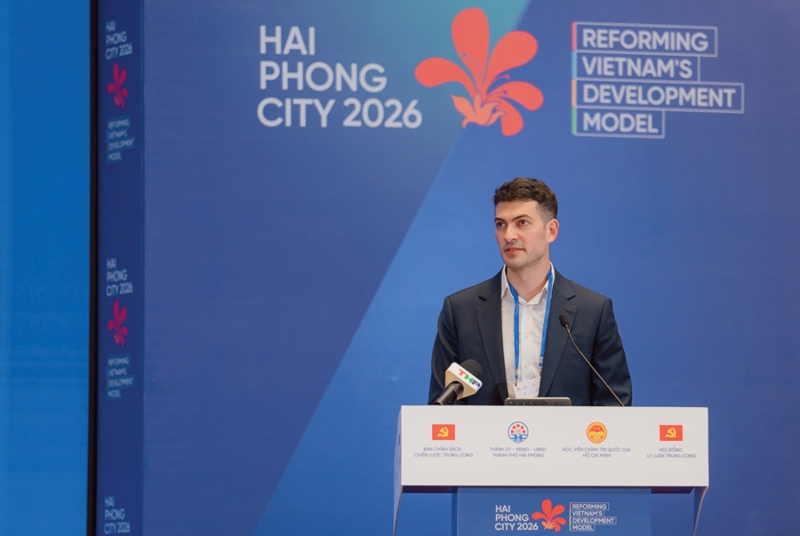
Politburo Resolution No. 57-NQ/TW on breakthroughs in science, technology, innovation, and digital transformation is not merely a policy document. It represents Vietnam’s strong commitment to placing science, technology, innovation, and digital transformation at the center of the country’s new growth model.
Vietnam has already identified eleven groups of strategic technologies it aims to master. These include areas widely expected to shape the future of the global economy, such as AI, the Internet of Things (IoT), 5G and 6G technologies, semiconductors, quantum computing, and biotechnology. Developing and mastering these critical technologies will be essential for Vietnam to strengthen its competitiveness, sustain long-term growth, and build future prosperity.
Just five years ago, few people could have imagined the profound impact AI would have on daily life and the global economy today. Yet the history of technological development has often unfolded in this way: major breakthroughs emerge from what was once unknown. For that reason, choosing the right strategic technologies is not simply a technical decision, it is a matter of long-term policymaking with direct implications for national competitiveness and development trajectories.
Bridging the productivity gap
Vietnam has become one of the region’s most dynamic technology manufacturing hubs. Foreign-invested enterprises (FIEs), including major multinational corporations, have played an important role, accounting for roughly 70 per cent of the country’s total export turnover. Samsung alone generates revenue in Vietnam equivalent to around 13 per cent of the country’s GDP.
Yet measured in labor value-added, the productivity gap remains significant. Labor productivity in Vietnam currently stands at around $7 per hour, compared with roughly $14 in China and approximately $28 in Malaysia.
At the same time, fewer than 20 per cent of Vietnamese companies are capable of becoming suppliers to global corporations operating in Vietnam. In sectors such as electronics, foreign-invested manufacturers still import nearly 90 per cent of production components and accessories. This highlights the extent to which domestic enterprises have yet to fully capitalize on the opportunities generated by international integration and foreign investment flows. The key challenge is how to strengthen the role and participation of local firms so they can benefit more substantially from global economic integration.
Against this backdrop, several policy recommendations can help Vietnam achieve meaningful progress as it pursues a new growth model.
First, public resources must be allocated in a strong, stable, and efficient manner to science, technology, and innovation. This is a prerequisite for laying the foundation for business transformation.
Second, public investment should be optimized through a more focused and targeted approach rather than being spread too thinly. When investment reaches the right recipients - particularly businesses with strong technology absorption capacity - the effectiveness of public capital can increase significantly and generate stronger spillover effects across the economy.
International experience shows that fragmented investment tends to produce limited impact and rarely drives systemic change. By contrast, concentrating support on companies capable of absorbing technology and expanding into new markets can create greater value-added and higher-quality employment from the same level of investment.
Vietnam currently has two groups of enterprises particularly well positioned to absorb such investment. The first group includes companies already participating in global value chains, such as exporters or suppliers to international manufacturing corporations. These businesses are already accustomed to competitive pressures, operate according to international standards, and maintain stable customer networks. As a result, technological and innovation support can help them rapidly upgrade production capabilities.
The country has already demonstrated the effectiveness of this approach. Since 2015, the supplier development partnership program between the Ministry of Industry and Trade and Samsung has helped Vietnamese businesses improve management capacity, production standards, and compliance with international requirements through technical support from engineers and specialists. While Samsung had only around 25 suppliers in Vietnam in 2014, the number has now surpassed 300.
The second group consists of small and medium-sized enterprises (SMEs), which account for a large share of Vietnam’s economy and form the backbone of the country’s production and business ecosystem. However, research by the World Bank suggests that only a small proportion of Vietnamese SMEs are effectively utilizing digital tools such as AI and advanced digital technologies. The gap lies not only in awareness, but also in technology absorption capacity, implementation capability, and organizational readiness. This sector should therefore receive substantial investment over the next five years through digital transformation and innovation support programs.
Third, Vietnam needs to build a synchronized system of infrastructure and development platforms, including physical infrastructure, digital infrastructure, institutions, data systems, and innovation platforms. These foundations will provide the necessary support to ensure that technology adoption takes place on a broad and sustainable scale.
At the same time, Vietnam should continue strengthening incentives for businesses to invest in R&D, not only through direct research spending but also through technology procurement, technology transfer, licensing, and stronger collaboration between businesses, research institutes, and universities.
The country has already introduced a policy allowing companies to deduct up to 200 per cent of R&D expenses. This is a highly-progressive measure that provides strong incentives for the private sector. Yet uptake remains limited in practice, especially among SMEs, due to administrative barriers and limited access to information. Simplifying procedures, improving transparency, and reducing compliance costs will therefore be essential to encourage stronger and more effective private investment in R&D.
Among Vietnam’s more than 640 public science and technology research institutions, only around two-thirds operate under autonomous mechanisms. International experience suggests that research institutions are more effective when granted greater autonomy, allowing them to improve resource allocation, increase flexibility, and strengthen real-world applications. Expanding autonomy for research institutes and science and technology institutions should therefore become an important pillar in strengthening Vietnam’s national innovation system.
Innovation capacity
Beyond infrastructure and institutions, people remain the core pillar of technological transformation. High-quality human capital is the foundation of innovation.
Vietnam possesses considerable human potential, reflected in international assessments such as PISA, where Vietnamese students consistently rank among the region’s strongest performers in mathematics.
The challenge now is how to convert that potential into practical innovation and technology application. Educational institutions, particularly universities, therefore play a critical role in developing a workforce capable of integrating into the global economy. At the same time, Vietnam should strengthen links between universities, research institutes, and businesses, moving beyond conferences and discussion forums toward deeper collaboration through joint research programs, academic funding, co-development initiatives, and technology transfer.
Vietnam is approaching a pivotal moment in shaping its future growth model. As the country works to realize the strategic ambitions of Politburo Resolution No. 57, the World Bank remains committed to supporting and accompanying Vietnam throughout this journey.







 Google translate