


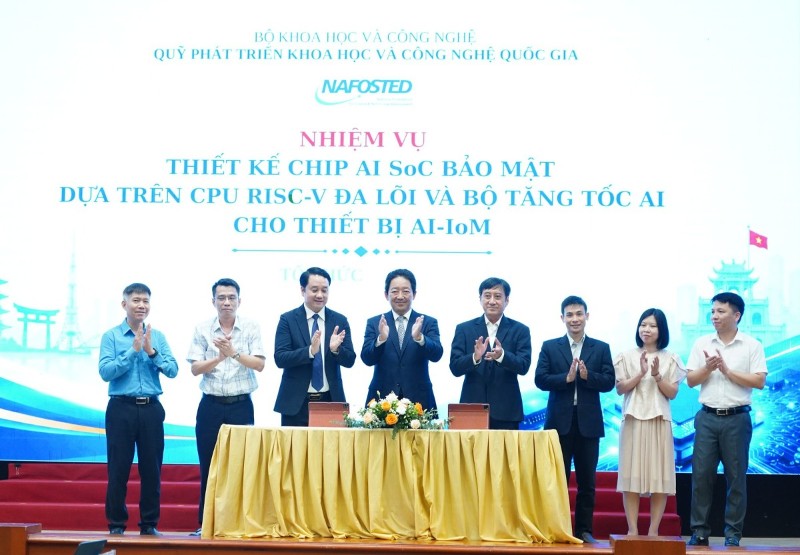
Vietnam and Japan have officially launched a cooperation program to implement five joint research projects in the semiconductor sector, marking a shift from cooperation focused on networking and connections toward the implementation of substantive research programs.
The National Foundation for Science and Technology Development (NAFOSTED) under the Ministry of Science and Technology (MST) held a ceremony on July 22 to announce the results of the project selection process and sign funding agreements for five Vietnam-Japan joint semiconductor research projects in 2026.
The five funded projects include the design of secure AI system-on-chip (SoC) chips based on multi-core RISC-V CPUs and AI accelerators for AIoT devices; research into the fabrication of materials and power electronic devices based on wide-bandgap semiconductors for power management chips used in high-performance power equipment; and the development of advanced semiconductor materials for integrated sensors and renewable energy devices.
The program also covers the development of advanced semiconductor materials for high-electron-mobility transistors through a combination of theoretical simulations and experiments, as well as the design, simulation and fabrication of next-generation three-dimensional CFET integrated circuits using silicon thin-film transistors.
The implementation of these five joint semiconductor research projects is seen as a concrete step toward putting into practice Vietnam’s policies on science and technology, innovation and digital transformation, while strengthening research cooperation and technological capabilities between Vietnam and Japan.








 Google translate